Musher's Secret vs PawTection: which paw wax suits an old dog that slips?
Two well-known paw waxes and a newer balm sold on grip, read against what their own makers say. The most useful sentence on this page comes from Musher's Secret itself.
We earn a commission when you buy through our Amazon links, at no extra cost to you. It never changes our rankings, and we say so when the cheaper product is the better buy. How this works.
If you are shopping for paw wax because your old dog slips on the kitchen floor, start with a sentence from Musher's Secret's own FAQ. Asked whether the wax will help a dog on ice, tile and hardwood, the maker answers: "No, it will not give traction on ice or any other slippery surface." Natural Dog Company's directions for PawTection say "Paws will be slick after application." Of the three products on this page, only the Steady Paws balm sells itself on grip indoors.
That does not make the two famous names bad buys. It means they do a different job from the one many buyers have in mind, and the right choice depends on which job you need done: keeping an old dog's pads in good condition, protecting them outdoors, or chasing a little more grip on a slick floor. Our paw wax roundup already covers what wax can and cannot do and how to put it on. This page goes a level deeper into the three-way difference: wax against balm, stick against fingertip, the listed ingredients, the lick-safety claims, what ends up on your floors and bedding, and what each one offers a cracked senior pad.
The three side by side
Everything in this table comes from the maker's own website or the Amazon listing for the exact product we link to. Where the two sources disagree, the table says so.
Musher's Secret
PawTection
Steady Paws
What the maker calls it
A natural, food-grade wax that "forms a breathable barrier"
A "natural wax blend" that creates "a protective barrier"
A "3-in-1" balm that moisturizes, protects and improves pad traction
Listed base
Beeswax, carnauba and candelilla waxes with oils and vitamin E
Candelilla, carnauba and sunflower waxes with sunflower and rice bran oils and mango butter
Opens with caprylic/capric triglyceride, coconut and olive derivatives and shea butter; beeswax is fifth of twelve
Form
Rubbed in with a fingertip; sold in 60g, 200g and 1 lb sizes, no stick listed
2 oz stick (the one we link), or 1, 2 and 4 oz tins
1.69 oz container, spread on with your fingers
On slippery floors
"It will not give traction"
Slick after application; says moisturized pads grip better over time
Says it helps dogs feel steadier "with consistent use"
On licking
"Safe even if your animal licks it"
Listing title says "Non-Toxic, and Lick Safe"
"Lick-safe", but directions say to prevent licking right after applying
How often
2-3 times a week on the maker's site; the Amazon listing says 1-2
Before going outside; reapply in harsh conditions
Daily, or as needed
Built mainly for
Snow, ice melt, salt, sand and hot pavement
Hot pavement, sand and trails; the maker adds salt, snow and ice
Everyday pad care indoors and out, with a traction claim
Wax or balm: what the makers say they built
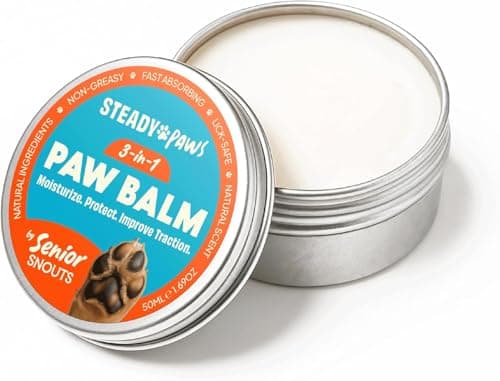
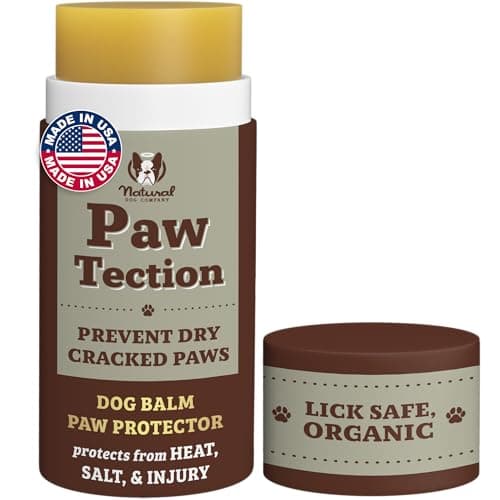
The words on the label are not interchangeable, and these makers use them on purpose. Musher's Secret's Amazon listing describes it as "a dense, barrier wax" developed in Canada for sledding dogs. Natural Dog Company sells two paw products and draws the line itself: PawTection is "a natural wax blend" used "to prevent damage," while its sister product, Paw Soother, is "a butter blend" used "to heal existing damage." The PawTection listing calls it "a harder, waxier formula." Steady Paws calls its product a balm and leads with moisturizing and a "non-greasy formula."
For a senior dog on indoor floors, the difference that matters is where the product ends up. The PawTection listing says its harder wax blend "helps coat the exterior of paw pads" before rough ground. That is what you want between a pad and hot asphalt, and not what you want between a pad and a laminate hallway. Musher's Secret says the opposite about itself: its FAQ says "the wax does not sit topically" and is absorbed into the pad instead. Steady Paws says its balm "absorbs quickly without residue."
We have not put any of these on a dog, so we cannot tell you how completely each one absorbs in practice. What the makers' own descriptions do tell you is that two of the three are designed to disappear into the pad and one is designed to sit on top of it. That single design choice explains most of what follows.
What each maker says about slippery floors
This is the question most people arrive with, so here are the three answers, in the makers' own words.
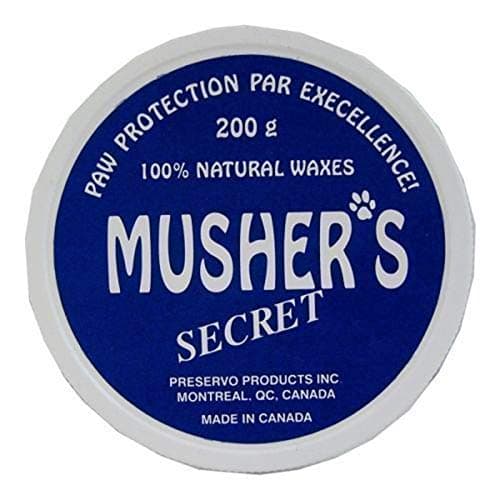
Musher's Secret: no. Its FAQ says it "will not give traction on ice or any other slippery surface," and separately that it will not stop nails scratching wood floors. What it does claim is conditioning: the home page says it "soothes, conditions, and relieves dry and cracked pads."
PawTection: not directly. The directions warn that paws will be slick after application and say to let them dry. The product FAQ does argue that "healthy, moisturized paws will flex rather than split and actually allow dogs to get a better grip," and that dry paws "do not have any traction." But the brand's product guide on the Amazon listing points grip on "smooth surfaces like hardwood floors" at the company's Paw Soother, not at PawTection. Paw Soother is not one of the products we have compared, so we make no call on it.
Steady Paws: yes, with a condition. The listing says the balm "helps dogs feel steadier on slippery floors with consistent use" and that "with regular application" it helps "restore healthy texture and traction." Its product FAQ gives the reasoning: dry, cracked paws "can lose their natural grip."
Read those closely and they describe one mechanism, not three. Nobody is claiming a tacky coating that grips the floor. Two makers say a pad in good condition grips better than a dry, cracked one, and the third declines to make a traction claim at all. Steady Paws is the only one that puts that claim on the label; it is not a different kind of product. That fits what our paw wax page says about the whole category: any grip benefit comes mostly through the condition of the pad, and it is modest.
So if your dog is sliding now, none of these three is the fix. VCA's osteoarthritis guidance says slippery flooring "can make it difficult for dogs with OA to walk, turn, rise, and move comfortably," and its traction list is short nails, non-skid rugs or yoga mats, interlocking foam tiles, baby gates across slick rooms and traction boots for dogs that tolerate them. Paw wax is not on it. For grip you can feel today, socks or toe grips put rubber between the paw and the floor; our toe grips vs socks comparison helps you choose, and checking nail length costs nothing.
Floors, bedding and the first few minutes
A senior dog spends most of its day lying on things you would rather keep clean, so where the wax goes after it leaves the paw is a fair question. The makers answer it differently.
Musher's Secret says it is "absorbed into the pads and will not leave stains on your carpets or furniture," then adds the honest qualifier: "The only time that you will encounter this issue is if too much was applied." Its dose is "a small pea-sized amount," rubbed in "until you no longer see the wax."
PawTection asks for "a generous amount" and warns that paws stay slick until dry. The Amazon listing says to apply it 10 to 15 minutes before heading outside. It is a before-the-walk product, not a before-an-evening-on-the-hardwood product.
Steady Paws says it "won't leave behind slippery or sticky residue," and its FAQ adds that any excess should be wiped away with a dry cloth "before allowing your dog to walk around."
Our reading: all three can leave something behind if you use too much, and PawTection is the one whose directions ask for a generous layer. The paw wax page suggests applying at night for a determined foot-licker. If you do, the bed is where any excess ends up, which is one more reason to use the smallest amount the maker suggests and to have a cover you can wash; our washable orthopedic beds page covers that side.
Fingertip or stick, if your hands are stiff
This is the difference the listings never mention, and for an owner with stiff hands it can matter more than anything on the label.
Musher's Secret and Steady Paws are fingertip products. You take a little on a finger and work it into each pad and between the toes, on four feet, while your other hand holds the paw. Musher's says to rub until you no longer see the wax. That is a small pinch and press, repeated many times, and it is the kind of fine work that stiff or arthritic fingers find tiring.
PawTection is the only one of the three you can buy as a stick, and the stick is the version we link to. You hold the product rather than using your fingertip as the applicator, the wax stays off your hands, and you press it across the pad instead of working it in with a finger. For the tin versions, Natural Dog Company says you can use "two fingers or a low-absorbent cloth." What the stick does not change is the other hand: someone still has to hold a paw still, and for most owners that is the harder half of the job.
Frequency matters as much as the container. Musher's asks for two or three sessions a week, and its FAQ says you can cut back to once a week once the pads are in good shape. Steady Paws suggests daily. Over a month that is roughly ten sessions against thirty, and on tired hands that gap is real. Whatever you buy, it goes easier with the dog lying on its side on a rug, one or two feet per session, at a time of day when it is already settled. Steady Paws' directions also say to wash your hands afterward.
Lick-safety, claim by claim
All three say something reassuring about licking. They do not say the same thing.
Musher's Secret makes the strongest claim. Its FAQ says it is made with natural, food-grade waxes and oils and "is safe even if your animal licks it," and the home page describes it as fully edible. The maker lists its ingredients as white and yellow beeswax, carnauba and candelilla wax, "White & vegetable oils" and vitamin E, and says it contains no nut, soy or flax oils.
PawTection carries "Non-Toxic, and Lick Safe" in its Amazon listing title. The maker's product page, in the sections we read, makes no specific licking claim. The listed ingredients include lavender oil, rosemary extract and benzoin alongside the waxes and oils.
Steady Paws puts "Lick-Safe" in its title, but its own directions say to "prevent licking immediately after application," and its FAQ recommends letting it absorb fully first. The full ingredient list on the listing is longer than the headline version and, near the end, includes peppermint oil and chlorhexidine. The listing also recommends a 24-hour patch test and checking with your vet if your dog has known sensitivities.
For a dog that licks its feet as soon as you let go, Musher's has the plainest claim and no waiting period attached to it. For any dog with known skin sensitivities, or one on a skin routine your vet has set, take the full ingredient list to the vet before you start. Steady Paws suggests the same thing.
Cracked senior pads
The AKC's paw-care guide says "the dry air in your home and the cold air outside can cause dogs' paws to crack, which is uncomfortable," and suggests "a soothing paw balm or protective paw wax to help prevent future problems." Note the pairing: a balm to soothe, a wax to protect. It is the same line Natural Dog Company draws between its two paw products.
Older dogs also get thickened, rough pads. The AKC's article on hyperkeratosis says it commonly presents in older, more sedentary dogs, and quotes veterinarian Dr. Jo Myers: "In many dogs, especially seniors, mild thickening is more of a cosmetic issue than a medical emergency. The goal is not to make the skin perfectly smooth. The goal is to keep it comfortable, intact, and free of infection." The same article says managing it in an older dog may call for veterinary paw balms, and warns against aggressively peeling or cutting thickened tissue at home.
On the makers' own positioning, PawTection is the one not to reach for when the pads are already cracked: Natural Dog Company sells it to prevent damage and sends you to a different product for existing damage. Musher's says it relieves dry and cracked pads and is safe on a raw area; Steady Paws says it soothes cracked pads. A crack that bleeds, a pad that looks hot or swollen, or a problem that is not improving is a question for your vet.
Outdoors, where the order changes
Outside is PawTection's home ground. Almost every line of its Amazon listing is about hot pavement, asphalt, sand and trails, and a wax that coats the pad is the right design for that. The AKC's hot-pavement article notes that "when pads are dry, they're more susceptible to burns from hot pavement," and quotes its chief veterinarian, Dr. Jerry Klein, on the test: place your hand on the pavement for ten seconds, and "if it's too hot for your hand, it's too hot for your dog's paws." Wax is not a reason to skip that test.
Musher's is the winter product. The maker lists salt residue, ice melt and snowballing between the pads among the things it protects against, and tells you to rub it in between the pads for snow. One correction worth making to the usual advice: its own FAQ says it gives no traction on ice, so its outdoor job is protection, not grip. Our outdoor footing guide covers the steps, decks and wet ground where old dogs actually fall, and the winter guide and summer guide cover the seasons.
What we scored these on
The cards below use the four metrics every product on this hub is scored on, so a wax can be compared honestly with a sock or a toe grip.
Grip. How much the product is likely to help an old dog's footing indoors, judged from what each maker actually claims and whether it is designed to absorb or to coat. None of the three scores high, and that is deliberate.
Stays on. How long the maker says it lasts and how often it needs reapplying.
Comfort. Nothing is worn on the foot, so all three score well. The differences are the lick-safety wording and the slick first minutes.
Value. Size, how often you use it, and how many of your dog's jobs one purchase covers.
The order also weighs two things the scores do not show: how many sessions a week a stiff-handed owner signs up for, and how long each claim has been on the market. The Steady Paws listing shows it first available in November 2025, which is a short record next to a recipe Musher's describes as a third-generation family formula. Scores are judgments from the makers' pages, the live listings and the veterinary sources at the foot of this page, in line with our methodology. We have not tested these products or put them on a dog.
The short version: Musher's Secret is our pick for an old dog, provided you buy it for pad care and not for grip, which its maker says it does not give. It conditions dry pads two or three times a week, says it absorbs rather than coating, makes the plainest lick-safety claim and covers winter walks. Steady Paws is the choice if you want the one balm sold on indoor traction and you are happy to apply it daily; its claim rests on the same pad-conditioning idea, on a much newer listing. PawTection is the summer pavement and trail wax, and the only one in a stick. Keep it for the walk, not the kitchen floor.
The lightest-touch option. A natural wax you rub on the pads for a little extra tack — not as grippy as socks or grips, but there's nothing to wear and dogs don't mind it.
One of the few paw balms that puts traction in its own product description rather than treating grip as a side effect of moisturizing. Lick-safe, fast-absorbing, and it doesn't leave a slick on the floor.
A protective barrier wax first and a traction aid second — we're saying that plainly. Worth knowing about if your senior's pads are cracked, because healthy pads grip better than damaged ones.
#ad · Live prices from the Amazon Product API, as of Sep 22, 2026. Where we have no verified live price we show none — we would rather leave a gap than print a number that has rotted.
In detail
The picks, in full
01
Dogs who won't tolerate anything worn
Musher's Secret Paw Wax
Listed as a dense barrier wax, 200g tinListed as 100% non-toxic natural waxesNothing worn on the footAlso conditions dry pads; reapply as needed
7.6/10
The lightest-touch option. A natural wax you rub on the pads for a little extra tack — not as grippy as socks or grips, but there's nothing to wear and dogs don't mind it.
Grip
6.5
Stays on
6
Comfort
9.5
Value
8.5
Pros
+Zero tolerance issue — it's just balm on the pads
+Conditions cracked, dry senior pads at the same time
+A 200g tin lasts a long time on indoor paws
Cons
−Least grip of the three tools — helps, doesn't transform
−Wears off and needs reapplying
Don't buy this if…
…your dog is slipping badly and needs real traction now — start with socks or grips and use wax as a supplement.
Traction-focused balmLick-safe formulationNon-greasy, fast-absorbing1.69 oz tin
7.6/10
One of the few paw balms that puts traction in its own product description rather than treating grip as a side effect of moisturizing. Lick-safe, fast-absorbing, and it doesn't leave a slick on the floor.
Grip
7
Stays on
6.5
Comfort
9.5
Value
7.5
Pros
+Absorbs rather than sitting on top as a slippery film
+Lick-safe, which matters with a dog that grooms its feet
+Softens the hard, glazed pads that make old dogs slide
Cons
−Small tin for the price
−Like all balm, it's a modest improvement, not a transformation
Don't buy this if…
…your dog's slipping is severe. Balm is a finishing touch on top of socks, grips or rugs — not a substitute for them.
Barrier waxPlant-based ingredientsMarketed for hot and rough surfacesTwist-up or tin formats
7.3/10
A protective barrier wax first and a traction aid second — we're saying that plainly. Worth knowing about if your senior's pads are cracked, because healthy pads grip better than damaged ones.
Grip
5.5
Stays on
7
Comfort
9
Value
7.5
Pros
+Genuinely good at protecting and conditioning a damaged pad
+Well-regarded brand with clear ingredient labeling
+Useful year-round for pavement and grit as well as indoors
Cons
−Sold as protection, not grip — expect less tack than Musher's Secret
−A waxy barrier can feel slick on the first application
Don't buy this if…
…traction is the whole reason you're shopping. Buy Musher's Secret or the Steady Paws balm instead — this one is for pad condition.
Pad care two or three times a week, designed to absorb; the grip has to come from elsewhere
Same dog, and you want the product sold on grip
Steady Paws
The only one with a traction claim, if you will apply it daily
Licks its feet the moment you let go
Musher's Secret
The plainest lick-safety claim, with no waiting period attached
Walks on salted winter sidewalks
Musher's Secret
Built for snow, ice melt and snowballing between the pads
Walks on hot pavement, sand or trails in summer
PawTection
A coating wax made for exactly that, applied before you go out
Pads already cracked
Musher's Secret or Steady Paws, and a vet if they bleed
PawTection's maker positions it for prevention, not repair
If you own two of them
Natural Dog Company's own listing suggests two products: PawTection before outdoor time, and its Paw Soother balm after walks or before bed. The same logic works with the picks here. PawTection goes on at the door before a hot or rough walk; Musher's or Steady Paws goes on at home, on days without a long walk. What we would not do is layer two of them on the same paws at the same time. Musher's ties staining to using too much, Steady Paws says to wipe off any excess, and two layers is more than either maker has in mind.
Four mistakes specific to these three
Buying Musher's Secret for grip. Its maker says it will not give traction on slippery surfaces. Buy it for the pads, and fix the floor separately.
Putting PawTection on before an evening indoors. The directions ask for a generous layer and warn that paws are slick until it dries. On a senior dog crossing laminate, that is the wrong ten minutes to make the paws slicker.
Reading "lick-safe" as "lick straight away." Steady Paws says to let it absorb fully first and to prevent licking right after application. Apply it when you can keep the dog busy for a few minutes.
Treating a cracked pad with a barrier wax. By its maker's own description, PawTection is for preventing damage, not healing it.
When to buy none of them
If your dog's legs go out from under it on the way to the water bowl, a jar of wax is not the purchase. Put rugs on the routes it walks today, then look at socks or toe grips: our traction gear rankings compare all three tools, the toe grips page covers the options for a dog that will not wear socks, and the floor setup guide shows where the rugs go. VCA also advises keeping nails short "to increase traction and reduce strain on joints," which is free. The full order of fixes is in how to stop a senior dog slipping.
And if the slipping is new, or it arrived with weakness, knuckling or a dog that no longer wants to get up, that is a vet appointment before it is a shopping trip. A balm will not hide a change like that for long, and it should not try to.
How we chose
We haven't lab-tested these
We compiled the published specifications, manufacturer manuals and aggregated owner reviews, then scored each product against a published rubric. The scores are judgments from that research — they are not measurements we took in a lab, because we don't have one and we won't pretend we do. Prices are pulled live from Amazon; where we can't verify one, we say "check price" rather than print a stale number.
Questions
Frequently asked
Is Musher's Secret or PawTection better for an old dog that slips on floors?+
Neither is a grip product by its own maker's account. Musher's Secret says it will not give traction on slippery surfaces, and PawTection's directions say paws are slick after application. For indoor pad care, Musher's is the better fit: it says it absorbs into the pad, makes the plainest lick-safety claim and needs two or three sessions a week. PawTection is built to coat the pad before hot pavement, sand and trails. For the slipping itself, use socks, toe grips, rugs and short nails.
Does Musher's Secret stop dogs slipping on hardwood floors?+
Its maker says no. Asked whether it helps on ice, tile and hardwood, the Musher's Secret FAQ answers that it will not give traction on ice or any other slippery surface. What it does claim is conditioning dry and cracked pads and protecting them outdoors. Grip on hardwood comes from rubber on the paw (socks or toe grips), rugs on your dog's routes and nails kept short.
What is the difference between paw wax and paw balm?+
In the makers' own terms, a wax protects and a balm soothes. Natural Dog Company describes PawTection as a wax blend that prevents damage and its Paw Soother as a butter blend that heals existing damage; the AKC's paw-care guide likewise pairs "a soothing paw balm or protective paw wax." Steady Paws calls its product a balm and stresses that it absorbs without residue. Musher's calls itself a wax but says it absorbs into the pad rather than sitting on top.
Is Musher's Secret safe if my dog licks it?+
The maker says yes: it is made with food-grade waxes and oils and is "safe even if your animal licks it," and its home page describes it as fully edible. That is the manufacturer's claim, not something we have verified. If your dog has known sensitivities or allergies, show the ingredient list to your vet before you start.
Is the PawTection stick easier to use than a tin of wax?+
For stiff or arthritic fingers it often is, because you hold the stick rather than using a fingertip as the applicator, and the wax stays off your hands. It does not remove the other half of the job, which is holding a paw still. Remember too that PawTection is the outdoor product of the three and is slick until it dries, so the stick suits a before-the-walk routine rather than indoor pad care.
How often should you put Musher's Secret on a senior dog's paws?+
The maker's website says two to three times a week, more often in snowy conditions, and its FAQ says you can cut back to once a week when the pads are in good shape. The Amazon listing we link to says one to two times a week is sufficient for year-round use. Use a small pea-sized amount per the maker; the only time it marks carpets or furniture, it says, is when too much was applied.
We don't run a testing lab, and we don't pretend to. Product facts are compiled from manufacturer listings and manuals; health facts are cited to reputable veterinary sources. Where we couldn't verify something, we say so on the page rather than quietly leaving it out. Read our full method.