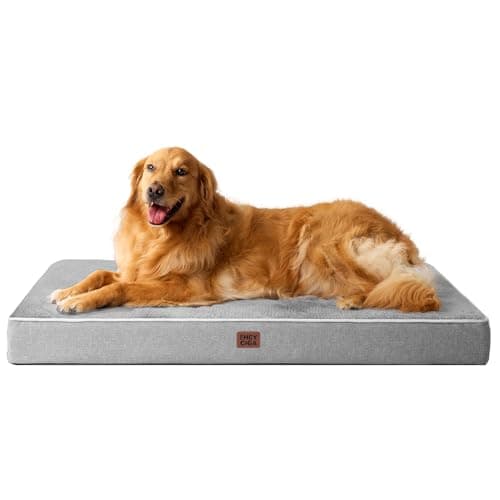
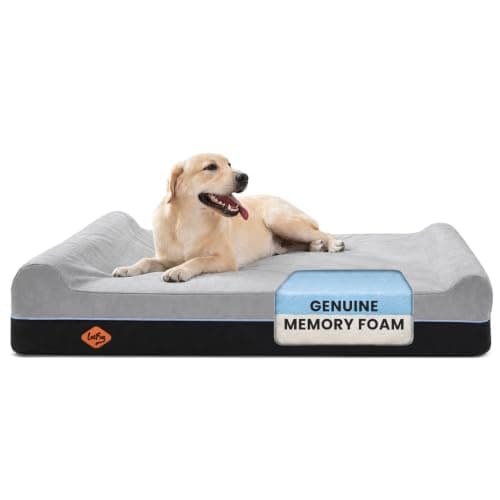
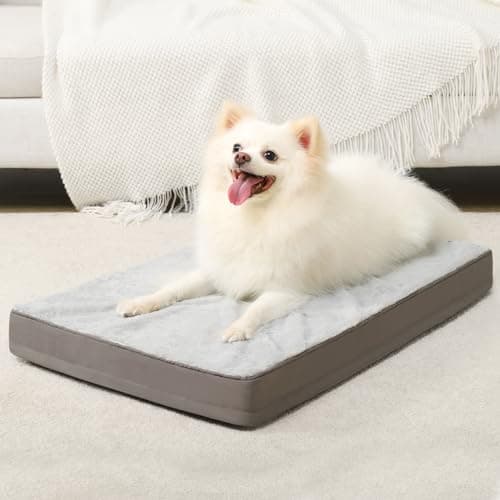
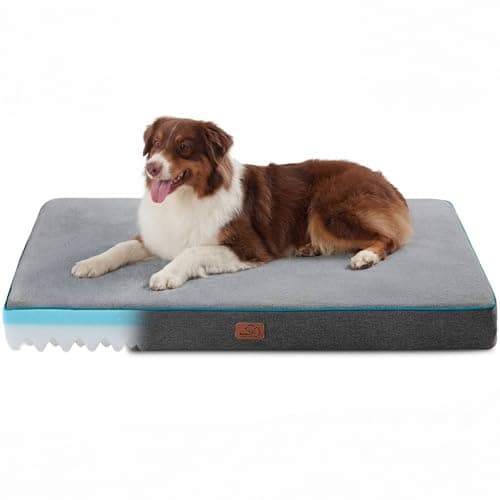
For a dog with disc disease, the feature that matters is the one that isn't there: no rim, no step-up, no twisting to get in. These are the flat, supportive beds we'd choose.
We earn a commission when you buy through our Amazon links, at no extra cost to you. It never changes our rankings, and we say so when the cheaper product is the better buy. How this works.
Intervertebral disc disease is a spinal problem, and the advice that comes with it is almost always about restricting movement: no jumping, no stairs, no twisting, and in an active episode, strict crate rest under veterinary direction. That advice changes what a good bed looks like. Everything that makes a bed feel luxurious — the deep rim, the plush walls, the nest shape — is a small obstacle a dog with a fragile back has to negotiate several times a day.
So the beds below are chosen for what they leave out. They are flat mattresses. The dog walks on at floor level, lies down straight, and gets up straight. That's the whole design brief, and it is genuinely the right one for a dachshund, a corgi, a French bulldog, a basset — the long-backed, short-legged builds where VCA notes disc disease is far more common.
French bulldogs get their own page, because they carry a second problem this one does not cover: VCA names them among the brachycephalic breeds whose ability to pant and cool themselves is compromised, which makes a deep insulating bed the wrong buy even when the shape is right. If that is your dog, start with beds for an older French bulldog.
What actually matters in an IVDD bed
Zero entry height. Every raised edge is a small lift-and-twist. A flat mattress removes the movement entirely, which is the point.
Even support along the whole spine. A bed that dips in the middle lets the back sag into a curve and holds it there for hours. Foam with enough density to stay flat under the dog is doing real work here — this is one of the few situations where the support core matters as much for the back as for the joints.
It has to fit a crate. Many dogs with disc disease spend a prescribed period confined. A bed that goes in the crate means the dog isn't resting on a bare plastic tray for weeks. Check the crate's internal dimensions before ordering, not the advertised crate size.
It has to wash. A dog on restricted movement, or one with reduced bladder control after an episode, will have accidents. A cover that unzips is not optional.
The short version: the Bedsure crate pad is the one we'd buy for most dogs — flat memory foam, washable cover, crate-sized. The EHEYCIGA XL is the same idea for a big dog that needs to stretch out. The Laifug is the upgrade if your dog is heavy enough to flatten a thinner mat. The KSIIA is the small, cheap option for a little dog on a budget.
A flat memory-foam mattress with no walls at all. For a dog with a bad back, the absence of a bolster is the feature — nothing to climb, nothing to twist over.
A thick single-piece memory-foam slab built for big dogs — the depth of foam is the point, and it's what a large arthritic dog needs so it isn't lying on the floor through the mattress.
The cheap one that still has a waterproof lining. It's a flat little mattress rather than a plush nest — which is exactly right for a stiff small dog that would rather not climb.
#ad · Live prices from the Amazon Product API, as of October 20, 2026. Where we have no verified live price we show none — we would rather leave a gap than print a number that has rotted.
In detail
The picks, in full
01
Dogs that must not step up or twist
Bedsure Memory Foam Orthopedic Crate Pad
Flat memory-foam mattressNo bolster or raised edgeRemovable washable coverCrate-friendly sizes
8.7/10
A flat memory-foam mattress with no walls at all. For a dog with a bad back, the absence of a bolster is the feature — nothing to climb, nothing to twist over.
Support
8
Easy entry
10
Washability
9
Size range
7.5
Value
9
Pros
+Effectively zero entry height — the dog walks on at floor level
+Memory foam rather than a thin quilted pad
+Sized to drop into a crate or a corner
Cons
−No edge to lean on, which some dogs miss
−Flat mats slide unless the floor has some texture
Don't buy this if…
…your dog sleeps curled tight against something — a low bolster bed will suit it better.
A thick single-piece memory-foam slab built for big dogs — the depth of foam is the point, and it's what a large arthritic dog needs so it isn't lying on the floor through the mattress.
Support
9
Easy entry
8.5
Washability
8
Size range
7.5
Value
8
Pros
+Deep, dense foam that a heavy dog won't compress to the floor
+Waterproof liner protects the foam from accidents
+Non-slip base so the bed stays put on hard floors
Cons
−Heavy and large — not a bed you'll move room to room
−Flat design has no bolster for dogs that like to lean
Don't buy this if…
…your dog is small or likes to curl against a raised edge — a bolstered bed suits them better.
Waterproof liningFlat mattress shapeRemovable washable cover23 x 17 in size
8.1/10
The cheap one that still has a waterproof lining. It's a flat little mattress rather than a plush nest — which is exactly right for a stiff small dog that would rather not climb.
Support
6.5
Easy entry
9.5
Washability
9
Size range
6
Value
9.5
Pros
+Almost zero entry height — a stiff dog walks straight on
+Waterproof lining under a washable cover at a low price
+Fits inside most small crates
Cons
−Thin compared with a proper foam slab
−No bolster for a dog that likes to rest its chin on something
Don't buy this if…
…your dog is a leaner or curler — it will look for an edge to press against and this bed doesn't have one.
For this page we deliberately weighted entry height above everything else, then support depth, washability, size range and value. A bed that scores brilliantly on foam and badly on entry height is the wrong bed for a dog with a bad back, and we've ranked accordingly. As everywhere on this site, the scores are judgments from published specs and aggregated owner reviews, not lab measurements — see our methodology.
The rest of the house matters more than the bed
Honestly: for a dog with disc disease, the bed is the easy part. The hard part is removing the jumps and the slips. Sofa and bed access needs a ramp rather than steps — a ramp lets a long-backed dog keep its spine level, where steps make it flex and extend with every riser. Slippery floors need traction, because a scramble on tile is exactly the sudden twist you're trying to prevent. And stairs usually need to be gated off entirely.
Don't buy a "memory foam" bed that is a quilted pad
Plenty of crate mats are advertised with the word "orthopedic" over what is really a thin quilted sheet with a little fiber inside. On a flat mat there's nowhere for a thin core to hide — if the listing doesn't describe an actual foam layer with a thickness, assume there isn't much of one.
Raise the bowls while you're at it
A dog that shouldn't be bending and twisting shouldn't be eating off the floor either. Raising food and water to chest height is a free change that removes several dozen neck-and-back flexions a day. We cover the rest of the room-by-room list in senior-proofing your home.
How we chose
We haven't lab-tested these
We compiled the published specifications, manufacturer manuals and aggregated owner reviews, then scored each product against a published rubric. The scores are judgments from that research — they are not measurements we took in a lab, because we don't have one and we won't pretend we do. Prices are pulled live from Amazon; where we can't verify one, we say "check price" rather than print a stale number.
Questions
Frequently asked
What kind of bed is best for a dog with IVDD?+
A flat, supportive foam mattress with no bolster and no raised edge, so the dog can walk straight on and lie down without stepping up or twisting. Firm enough that the spine stays level rather than sagging into the middle, and with a washable cover. Follow any bedding instructions your vet gives during a prescribed rest period.
Are donut or bolster beds bad for dogs with back problems?+
They aren't harmful to lie in, but the rim is an obstacle — a dog with a fragile back has to lift and twist over it every time it gets in and out, which is precisely the movement to avoid. A flat mattress removes that. If your dog loves a nest, a low-walled bed is a compromise; a deep donut is not.
Should a dog with IVDD sleep in a crate?+
During an active episode, vets frequently prescribe strict crate rest — but that's a veterinary instruction with a defined duration, not a lifestyle choice, and you should follow your vet's version of it exactly. Outside a prescribed rest period, a flat, supportive bed in a quiet, non-slippery spot is what most owners settle on.
We don't run a testing lab, and we don't pretend to. Product facts are compiled from manufacturer listings and manuals; health facts are cited to reputable veterinary sources. Where we couldn't verify something, we say so on the page rather than quietly leaving it out. Read our full method.