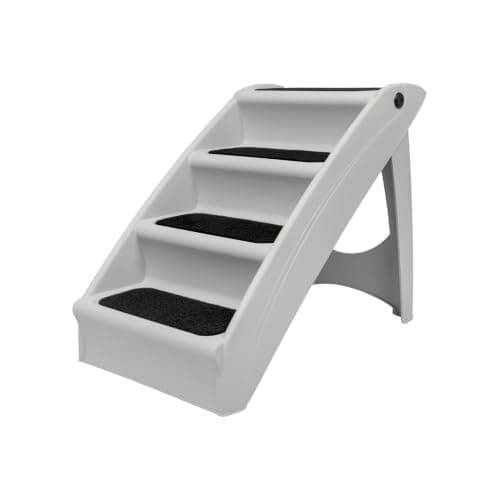
Steps take a fraction of the floor space a ramp needs, which is why most people end up with them. The trick is buying ones your dog will actually commit to — that comes down to riser height and tread depth.
We earn a commission when you buy through our Amazon links, at no extra cost to you. It never changes our rankings, and we say so when the cheaper product is the better buy. How this works.
Most people buy steps rather than a ramp for one entirely reasonable reason: a ramp to a 24-inch bed needs four or five feet of floor sticking out into the bedroom, and steps need about eighteen inches. If your room can't give up that space, steps are the honest answer, and a good set of steps is far better than a ramp you fold up and never deploy.
But steps ask more of the dog. A ramp is one continuous, predictable surface; steps are a sequence of decisions, each one a small lift and a small drop. Whether your dog copes with that comes down to two numbers the listing rarely puts up front.
The two numbers that decide everything
Riser height — how far up each individual step is. This is the load on your dog's joints, repeated once per step. A four-step set reaching 18 inches has gentler risers than a three-step set reaching the same height, and for an arthritic dog gentler is always better. More steps, shorter rises.
Tread depth — how far forward each step goes. This is the number that decides whether your dog will trust the steps at all. A dog needs to place a whole foot on a tread and, ideally, get both front feet on one before the back feet follow. Shallow treads force a dog to balance mid-climb, and a wobbly senior simply won't. Large dogs need genuinely deep treads; this is why the widest sets exist.
Then there is the thing you can only judge in person: flex. Foam steps are kind to paws and forgiving of a stumble, and they compress under a heavy dog until they feel unstable. Rigid steps stay put under any weight and are less forgiving if a paw slips. That trade-off is the reason this list has both, and roughly speaking it splits at 40 or 50 pounds.
The short version:
Best for a medium or large dog: the PetSafe CozyUp folding stairs — rigid, grippy, and they fold away.
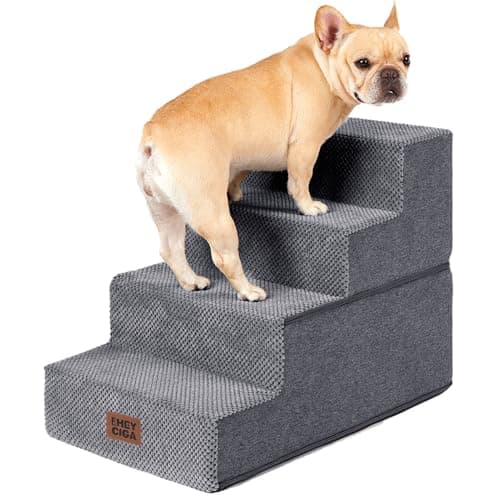
Best for a standard bed and a small-to-medium dog: the EHEYCIGA four-step.
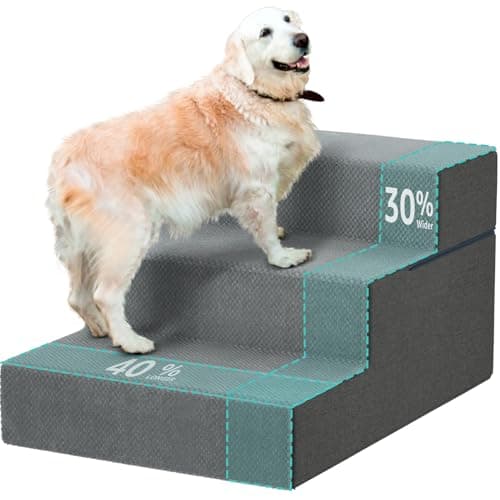
Best treads for a big dog: the YENING, which trades step count for depth.
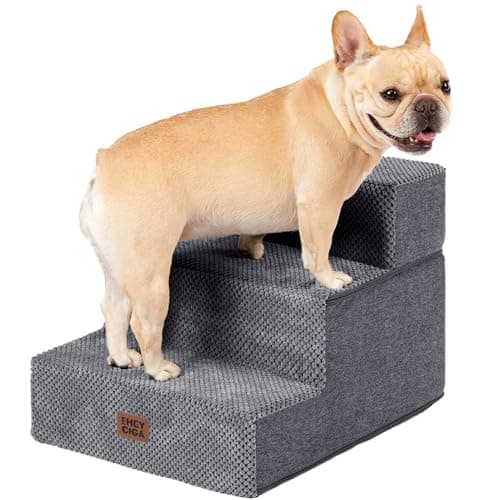
Best for the couch and a little dog: the EHEYCIGA three-step.
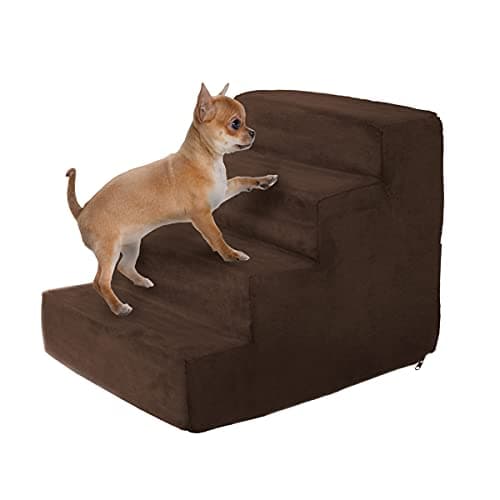
Softest landing: the PETMAKER foam stairs, for a small dog that stumbles.
The steps we'd buy for a medium or large senior. A rigid frame that doesn't flex under a real dog, a high-traction tread, and it folds flat when the guest room needs its floor back.
Foam steps that reach an ordinary bed height without the price of a rigid frame. Soft on the paws, quiet at 2am, and light enough to shift out of the way.
Three deep, wide treads instead of four narrow ones. For a big dog, tread depth is the thing that matters — a step it can put a whole foot on is a step it will use.
#ad · Live prices from the Amazon Product API, as of October 20, 2026. Where we have no verified live price we show none — we would rather leave a gap than print a number that has rotted.
In detail
The picks, in full
01
Medium–large dogs, bed or couch height
PetSafe CozyUp Folding Dog Stairs
Rigid folding frameHigh-traction treads25 in heightFolds flat for storage
8.4/10
The steps we'd buy for a medium or large senior. A rigid frame that doesn't flex under a real dog, a high-traction tread, and it folds flat when the guest room needs its floor back.
Gentle incline
7
Grip surface
9
Weight capacity
9
Portability
8
Stability
9
Pros
+Doesn't squash or sway the way foam steps do under weight
+Grippy tread surface a nervous dog will commit to
+Folds flat, so it isn't furniture you're stuck with
Cons
−Heavier and pricier than foam steps
−Hard edges — a missed step is less forgiving than on foam
Don't buy this if…
…your dog is wobbly on its feet. A dog that sways needs the continuous surface of a ramp, not discrete steps.
18 in total heightFour foam stepsRemovable washable coverNon-slip base
7.5/10
Foam steps that reach an ordinary bed height without the price of a rigid frame. Soft on the paws, quiet at 2am, and light enough to shift out of the way.
Gentle incline
7.5
Grip surface
8
Weight capacity
6.5
Portability
8.5
Stability
7
Pros
+Foam edges are forgiving if a paw catches
+Cover unzips and washes — worth more than it sounds with a senior dog
+Light enough to move one-handed
Cons
−Foam compresses under a heavy dog
−Steps can shuffle away from the bed unless pushed firmly against it
Don't buy this if…
…your dog is over about 50 pounds — the steps will sink and feel unstable exactly when your dog needs confidence.
Three deep stepsExtra-wide treadsBuilt for large dogsTall-bed height
7.5/10
Three deep, wide treads instead of four narrow ones. For a big dog, tread depth is the thing that matters — a step it can put a whole foot on is a step it will use.
Gentle incline
7
Grip surface
8
Weight capacity
8.5
Portability
5.5
Stability
8.5
Pros
+Deep treads take a large dog's whole foot, front and back
+Extra width helps a dog that wanders as it climbs
+Reaches genuine tall-bed height
Cons
−Deep steps mean a big footprint sticking out from the bed
−Fewer, taller risers than a four-step design
Don't buy this if…
…you're tight on floor space, or your dog is small — the risers are sized for long legs.
Steps and ramps share a rubric on this site: incline gentleness (for steps, that's riser height), grip surface, weight capacity, portability and stability. We don't lab-test — these are judgments compiled from published manufacturer specifications and aggregated owner reviews, as our methodology explains.
Measure your bed, not your dog
Take a tape measure from the floor to the top of the mattress, including the topper. That number, not the bed frame's advertised height, is what the steps must reach. Steps that finish two inches short leave your dog making a small jump at the very top, which is the exact movement you bought them to avoid — and it's worse than no steps, because the dog is now jumping from a less stable platform.
Anchor them, or they'll walk away
Almost every complaint about dog steps is really a complaint about them sliding. Push them firmly against the bed frame, and if your floor is hard, put a rubber-backed rug or a couple of non-slip furniture pads underneath. A set of steps that shifts an inch as the dog climbs will teach your dog not to use them within about three attempts.
Steps beside a ramp, not instead of it
A lot of households end up with both: steps at the bed where space is tight, and a folding ramp for the car where the height is greater and the dog only uses it occasionally. That's a sensible outcome rather than a failure to decide — the two problems really are different shapes. If you haven't decided which your dog needs indoors, our ramp vs stairs guide walks the decision properly.
Teach them; don't assume
A dog that has spent a decade jumping onto the bed will not read a new staircase as furniture. Ten minutes of treats and a slow walk-through changes the outcome completely — the method is in our guide on training a senior dog to use a ramp or steps.
How we chose
We haven't lab-tested these
We compiled the published specifications, manufacturer manuals and aggregated owner reviews, then scored each product against a published rubric. The scores are judgments from that research — they are not measurements we took in a lab, because we don't have one and we won't pretend we do. Prices are pulled live from Amazon; where we can't verify one, we say "check price" rather than print a stale number.
Questions
Frequently asked
Are stairs or a ramp better for a senior dog?+
A ramp is gentler and better for dogs that are wobbly, long-backed, or very stiff, because it keeps the spine level and asks for one continuous movement. Steps are better where floor space is limited and the dog is stable on its feet. If your dog sways, knuckles, or has disc disease, choose the ramp.
How tall should each step be for an arthritic dog?+
As low as you can get for the total height you need — which in practice means choosing the set with the most steps for your bed height. A four-step set reaching 18 inches asks less of each joint than a three-step set reaching the same place. Tread depth matters just as much: your dog should be able to put a whole foot on each step.
Are foam dog steps strong enough for a big dog?+
Usually not. Foam steps compress under weight, and for a dog over about 40 to 50 pounds they start to feel unstable partway up — which is when a dog stops using them. For a medium or large dog, buy a rigid framed set; keep foam for small dogs, where its forgiveness on a missed step is a genuine advantage.
We don't run a testing lab, and we don't pretend to. Product facts are compiled from manufacturer listings and manuals; health facts are cited to reputable veterinary sources. Where we couldn't verify something, we say so on the page rather than quietly leaving it out. Read our full method.