Mobility aids for a dachshund: carts, slings and the IVDD weeks
A long-backed dog fails differently from a big dog, and the gear order is different too. What to buy for the crate-rest period, what to buy if the back legs do not come back, and how to size a cart for a dog that is nine inches tall.
We earn a commission when you buy through our Amazon links, at no extra cost to you. It never changes our rankings, and we say so when the cheaper product is the better buy. How this works.
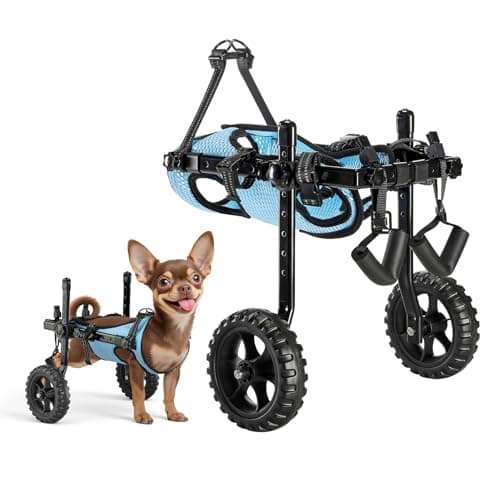
If your dachshund needs wheels, the Walkin' Wheels cart is the one we would buy: it adjusts in height, length and width, which is exactly what a dog that is long and nine inches off the ground requires, and the company supplies fitting help and spare parts. The VEVOR is the budget route if your vet has confirmed a cart and money is the constraint. But most owners arrive here before the cart stage, and for them the right first purchase is a rear sling for the trips outside during crate rest - and, if the dog is going to be out of its cart indoors, the drag bag that stops it scraping its chest and hocks across the floor.
The reason this is its own page rather than a line on our wheelchair roundup is that the dachshund problem is a spine problem, not a leg problem. VCA and the AKC both discuss intervertebral disc disease as disproportionately common in the breed - a long back and short legs is the shape it happens to. The gear follows from that.
The order to buy in
Weeks one to six: a sling, not a cart
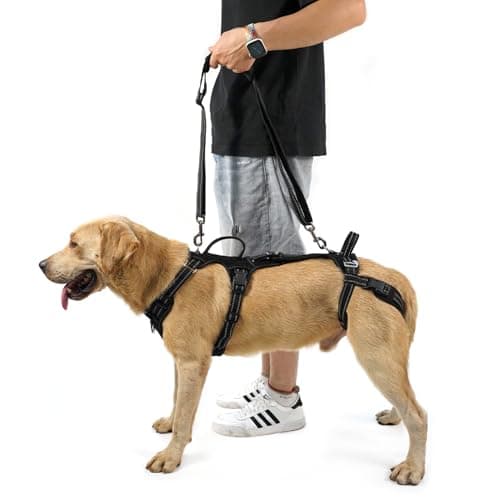
During strict rest the dog still has to go outside, and the five or six trips a day are where owners either hurt their own back or let the dog twist its spine getting up. A cheap rear sling with a grab handle solves both: it goes on in seconds, it takes weight off the back end, and it means the dog never has to launch itself off the floor. Keep one by the door. The lifting technique that goes with it - supporting the whole trunk, never lifting a long-backed dog by the chest alone - is at how to lift a dog without hurting either of you.
Week six onward: wheels, if the legs have not come back
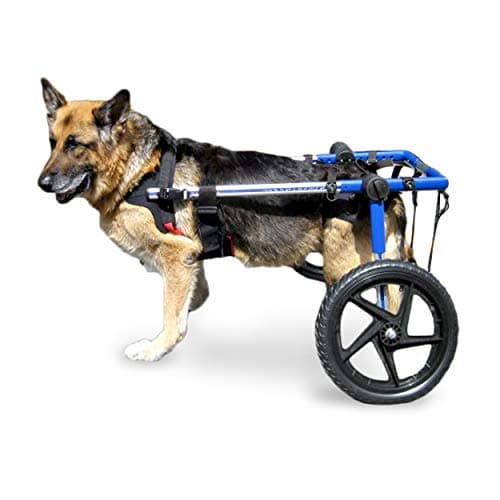
Carts are not a verdict. Plenty of dachshunds use one for a few months while nerve function returns and then stop needing it, which is the strongest argument for buying an adjustable cart rather than a fixed-frame one: you want a rig you can change as the dog changes. The timing question - when is it a cart rather than more rest - belongs with your vet or rehab therapist, and we work through the signals at when does a dog need a wheelchair. What a cart costs is at dog wheelchair cost.
Indoors, out of the cart: a drag bag
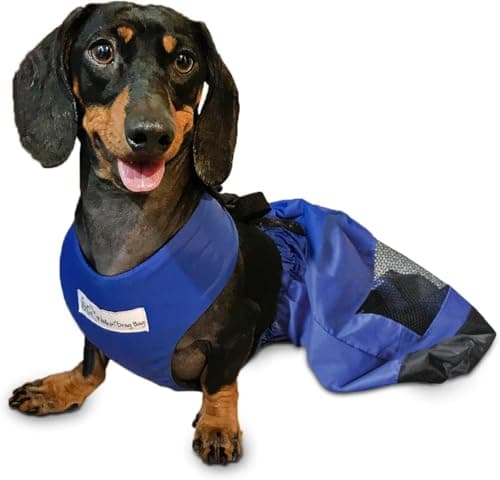
A dog does not live in its cart. In the house, a dachshund with no rear function pulls itself along with its front end, and what pays for that is the skin on its chest, knees and the tops of its back feet. A drag bag zips the back half into a sliding nylon sleeve so the dog moves without abrading. VCA's homecare guidance for paralyzed pets asks for daily skin checks regardless - a bag moves where the pressure lands, it does not remove it.
Sizing a cart for a long, low dog
This is where dachshund owners get caught, because the instinct is to shop by weight and weight is the least useful number here. A cart is set by three measurements, and for this breed the third one is the awkward one:
Height from the floor to the top of the hip. On a standard dachshund this is small, and plenty of frames do not go low enough. Check the stated minimum before anything else.
Length from the base of the neck to the base of the tail. The reason an adjustable frame matters: a cart built around a generic torso puts the support in the wrong place on a long one.
Width across the hips, plus the dog's weight for the load rating.
Measure with the dog standing if it can stand, supported if it cannot, and measure twice. Our general version of this is how to measure your dog for mobility gear. A cart that is too high rolls the dog's weight forward onto its front legs; too long and the saddle sits behind the hips and chafes.
The three things that are not gear
Ban the jumping, permanently. Off the sofa and off the bed is the repeated spinal load you can actually remove, and a ramp is the fix - we size them for this breed at ramps and steps for dachshunds.
Stairs stay closed. Up is a scramble and down is worse. A gate costs less than one vet visit; see stair gates for senior dogs.
Weight. Every extra pound sits on the part of the dog that is already the problem. It is the single most effective thing in this whole list and it is free - keeping a senior dog at a healthy weight.
What about boots and knuckling socks?
If your dachshund is still walking but scuffing or knuckling a back paw, that is a different stage and a different product: a boot to protect the top of the foot, or a rehab training sock used for the short supervised sessions its maker specifies. Both are ranked at boots for a dog that drags its paws, and knuckling itself is a neurological sign worth a same-week vet conversation rather than a purchase.
The wheelchair we'd trust first. Fully adjustable across height, length and width, so one cart fits a range of dogs and adapts as your dog changes — with the best support behind it.
The budget cart. If your vet has confirmed a wheelchair is right and money is tight, this gets a dog rolling for a fraction of the brand-name price — with more trial-and-error on fit.
A quick-on rear sling with a handle — grab it for the few hard moments (up the porch step, into the car) rather than a full walk. Cheap, simple, kept by the door.
For the stage after boots. When the back legs no longer take any weight and the dog moves by pulling itself with its front end, a boot on each back foot is no longer the answer, because the dog is dragging its hocks, knees and chest too. The drag bag zips the whole back end into a double-layer nylon sleeve that slides instead of scraping.
A dog that pulls itself along indoors when it is out of its cart
#ad · Live prices from the Amazon Product API, as of October 20, 2026. Where we have no verified live price we show none — we would rather leave a gap than print a number that has rotted.
In detail
The picks, in full
01
A first, adjustable wheelchair
Walkin' Wheels Dog Wheelchair
Adjustable height/length/widthRear-support designSized by weightEstablished brand support
8.7/10
The wheelchair we'd trust first. Fully adjustable across height, length and width, so one cart fits a range of dogs and adapts as your dog changes — with the best support behind it.
Fit & adjust
9.5
Build quality
9
Rear support
9
Support & parts
9
Value
7
Pros
+Adjusts in three dimensions — the closest to a custom fit off the shelf
+Backed by a real company with fitting help and parts
+Widely used, so vets and PTs recognize it
Cons
−Premium price versus generic carts
−Fitting takes patience to get right
Don't buy this if…
…cost is the deciding factor and your vet says a budget cart will do — a VEVOR is a fraction of the price.
Adjustable frameRear-support designSized by weightBudget price
7.2/10
The budget cart. If your vet has confirmed a wheelchair is right and money is tight, this gets a dog rolling for a fraction of the brand-name price — with more trial-and-error on fit.
Fit & adjust
7
Build quality
6.5
Rear support
7.5
Support & parts
6
Value
9
Pros
+By far the cheapest way into a wheelchair
+Adjustable across the basics
+Fine for a lighter or short-term need
Cons
−Instructions and support are thin — expect to fiddle
−Build isn't as refined as the established brands
Don't buy this if…
…your dog will live in the cart long-term — the fit and support of a Walkin' Wheels is worth the extra.
Rear support slingGrab handleAdjustable strapsBreathable fabric
8.0/10
A quick-on rear sling with a handle — grab it for the few hard moments (up the porch step, into the car) rather than a full walk. Cheap, simple, kept by the door.
Support match
8
Padding
7.5
Owner ergonomics
7.5
Adjustability
8
Value
9
Pros
+Goes on fast for a one-off lift up a step or into the car
+Handle sits right over the hips
+Inexpensive enough to keep one by every door
Cons
−Short handle means more bending than a long-lead sling for full walks
−Best for brief assists, not hours of support
Don't buy this if…
…you need to support your dog for whole walks — a long-handled GingerLead is kinder to your back.
A dog that pulls itself along indoors when it is out of its cart
Walkin' Drag Bag for Disabled Dogs
Double-layer nylon (listed)Fleece-lined chest, mesh panelSide zipper, 7 sizes (listed)Indoor and outdoor use (listed)
7.2/10
For the stage after boots. When the back legs no longer take any weight and the dog moves by pulling itself with its front end, a boot on each back foot is no longer the answer, because the dog is dragging its hocks, knees and chest too. The drag bag zips the whole back end into a double-layer nylon sleeve that slides instead of scraping.
Protects the paw
10
Stays on
9
Easy to put on
6.5
Grip on floors
3
Value
7.5
Pros
+Protects everything a dragging dog scrapes — chest, knees, hocks and the tops of both back feet — in one piece of kit
+A side zipper and touch fasteners rather than four separate boots to do up
+Seven listed sizes, from the maker of the Walkin' Wheels cart it is designed to alternate with
+Water-resistant, so a lawn or a wet floor does not end the day
Cons
−Only for a dog whose back legs do not take weight; a dog that still walks, even badly, needs boots, not a bag
−Gliding is the point, so it does nothing for traction — this is the one product here that is meant to slide
−A dog that lives in the bag needs the same skin checks VCA asks for on any paralyzed pet, because the sores move rather than vanish
−Sizing is by the maker's chart, and a bag that is loose gathers under the chest
Don't buy this if…
…your dog is still standing on its back legs at all — boots and a rear-support sling are the right stage, and a cart is the next one.
On fit range first - whether the product physically adapts to a dog that is long and low - then on what the maker publishes about sizing, then on what the product asks of the person using it five times a day. We have not fitted a cart to a dog and we have no lab; the scores are judgments from published specifications and aggregated owner reviews against the rubric on our methodology page. Every pick here is a product we already rank elsewhere on the site; nothing was added to the registry to build this page.
Before you order a cart
Get the diagnosis and the prognosis. A temporary cart and a permanent one are different purchases.
Take the three measurements - hip height, neck-to-tail length, hip width - and the weight.
Check the frame's stated minimum height against your dog's hip height.
Ask your vet or rehab therapist whether the dog should be in a cart for the whole day or in short sessions.
Plan for indoors as well as out: the cart is for walks, the drag bag is for the kitchen floor.
How we chose
We haven't lab-tested these
We compiled the published specifications, manufacturer manuals and aggregated owner reviews, then scored each product against a published rubric. The scores are judgments from that research — they are not measurements we took in a lab, because we don't have one and we won't pretend we do. Prices are pulled live from Amazon; where we can't verify one, we say "check price" rather than print a stale number.
Questions
Frequently asked
What is the best wheelchair for a dachshund?+
An adjustable rear-support cart, because the breed's proportions - long body, very low hips - are exactly what a fixed frame gets wrong. The Walkin' Wheels adjusts across height, length and width and has real fitting support behind it; the VEVOR is the budget alternative if your vet has already confirmed a cart is right.
Will my dachshund need a wheelchair forever?+
Not necessarily. Some dogs recover rear function after IVDD and stop using a cart; some use one indefinitely. Nobody can tell you which from a product page - it depends on the diagnosis and the treatment, and it is the question to put to your vet. It is also the best reason to buy an adjustable cart rather than a fixed one.
What do I need during crate rest?+
A rear sling with a handle, for the trips outside, and your vet's instructions followed to the letter. Do not introduce a cart or an exercise aid during prescribed rest without asking - the point of the period is that the spine is not being loaded.
Is a drag bag cruel?+
It is the opposite: a dog with no rear function will pull itself around anyway, and without a bag the cost is grazed hocks, knees and chest. The bag lets it move and keeps the skin intact. The genuine caution is that gliding is the point, so it offers no traction - and VCA's homecare guidance still asks for daily skin checks.
Can a dachshund use stairs again after IVDD?+
Assume not, and set the house up that way. Stairs load the back in exactly the way you are trying to avoid, and the going-down direction is the worse of the two. A gate at the top and a ramp to the furniture removes the problem rather than managing it.
We don't run a testing lab, and we don't pretend to. Product facts are compiled from manufacturer listings and manuals; health facts are cited to reputable veterinary sources. Where we couldn't verify something, we say so on the page rather than quietly leaving it out. Read our full method.