The best dog boots for a dog that drags or knuckles its back paws
A worn back nail, a bald patch on the top of the foot, a scuffing sound on the pavement: this is the page for that. Which boots survive being dragged, what to buy when the dog cannot lift its foot at all, and the one product here that is not a boot.
We earn a commission when you buy through our Amazon links, at no extra cost to you. It never changes our rankings, and we say so when the cheaper product is the better buy. How this works.
Most dog boots are sold for hot pavement, snow and hiking. The dog this page is written for is not going hiking. It is walking to the end of the road with one back paw folding under so that the top of the foot, not the pad, is what meets the ground. Owners usually notice the nails first: one rear nail worn flat and short while the other three look normal. Then the hair on the top of that foot thins, then the skin goes pink, and then, if nothing covers it, it opens.
The AKC's advice for a dog with degenerative myelopathy, the condition most people arrive here with, is to use dog boots "to protect the knuckles and toenails from dragging and being scraped." That is the whole brief. It sounds simple until you discover that a boot built for a hiking dog is built for a paw that lifts and lands on its sole, and a dragging paw does neither. It lands on its knuckles, slides on the fabric over the toes and grinds the sole from the front edge backward. Most boots are not designed for that, and some of the picks on our own non-slip socks page would last an afternoon.
So this page is narrower than a normal boot roundup. We are not scoring warmth or trail feel. We are scoring whether the boot survives being dragged, whether it stays on a foot that is not helping, and whether you can get it on with the hands you have.
Why the sock stops being enough
Our degenerative myelopathy page tells you to start with socks, and we stand by that: at the first scuffed nail, a grippy sock covers the top of the foot, adds traction indoors and costs very little if the dog shakes it off. The sock stops being the answer at a specific moment, which VCA describes in its DM page: "The hind feet seem to scrape the ground when walking and sometimes the top surface of the feet become hairless and irritated from repeated trauma."
Once the foot is scraping on every step, a fabric sock is being sanded by the pavement, and it goes through in days. What the foot needs then is a sole thick enough to be worn away slowly and an upper that wraps the top of the toes in something tougher than knit. That is a boot, and it is a particular kind of boot. Southeast Veterinary Neurology describes the severe end of the same progression: "the entire paw flips over, leading to scraping of the nails or even wounds on the top of the foot." A wound there heals badly because the dog keeps landing on it. Preventing the first one is the point of everything ranked below.
Two boots, not four
Most boots are sold in sets of four, and a dog that drags its back feet needs two. Two of the picks on this page, the Ruffwear and the Ultra Paws, are sold in pairs, and Ruffwear's reason is one you can borrow: "Many dogs have wider front paws than rear paws. We offer our boots in sets of two so you can order the appropriate sizes for a good fit on both the front and rear paws." For a rear-dragging dog the arithmetic is simpler still. One pair, on the two feet that need it, and no spares in a drawer. We have weighted value on the boots you use, not the boots in the box.
What we scored these on
Protects the paw. Whether the sole has material to lose and the upper covers the top of the toes, the surface a knuckling dog lands on. This is the criterion, and the two products that are not boots score low here by design: one is a rehab tool, one is for a dog that no longer walks.
Stays on. Judged for a foot that is not lifting itself. A dragged boot is pulled backward with every step, which is the opposite of what a hiking boot's strap is tested against.
Easy to put on. For your hands, not the dog's tolerance. This site is written for owners who may have arthritis of their own. A slip-on rubber boot with nothing to fasten scores higher than two hook-and-loop straps, even if the straps make a better boot.
Grip on floors. A dog with a weak back end slips indoors as well as scuffing outdoors. Grip from the sole on tile and wood, judged from the listed sole and aggregated owner reports.
Value. Price for the boots you will actually use, and how long they can be expected to last on a foot that drags.
Scores are judgments from the live listings, Ruffwear's and Walkin' Pets' own product pages and the veterinary guidance cited at the foot of this page, in line with our methodology. We have not dragged any of these boots along a pavement to see how many miles a sole lasts. Where a material or a size appears, it is the manufacturer's and the copy says so. Every pick was resolved live and confirmed in stock before publication.
The short version: for a paw that scuffs on every walk, the Ruffwear Grip Trex, bought as one pair for the back feet. If your dog is large and the nails are already worn flat, the Ultra Paws Rugged is the other boot with a sole made for the job. If you want to find out whether your dog will tolerate boots at all before spending that money, the QUMY set. For a dog that slips indoors but still lifts its feet, the PawZ rubber boots, which have nothing to fasten. The Walkin' Pets No-Knuckling Training Sock is not a boot; it is a 2-5 minute rehab exercise, and belongs in the plan alongside one. And when the back legs stop taking weight altogether, the boots come off and the Walkin' Drag Bag goes on.
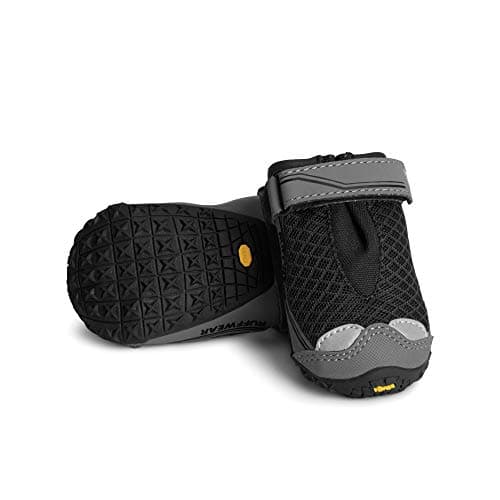
The boot we would put on a paw that drags. A Vibram rubber outsole with real depth to wear through, a ripstop upper that covers the top of the foot, and — the detail that matters here — Ruffwear sells them in pairs, so a dog dragging its back feet only pays for the two boots it needs.
The other boot built for a dragged foot, from a maker whose listing names disabled pets and service dogs among its users. A thick sole the maker says is made from recycled tires, and a foam-padded strap that holds the boot on a paw that is not lifting itself.
The budget boot most owners end up trying first, and a fair one: a rugged sole, a wide split opening that a stiff paw slides into, and two reflective straps. The catch is that it comes as four, so a rear-dragging dog pays for two spares.
Trying boots before committing to the premium pair
A balloon-thin natural rubber boot with nothing to fasten: stretch it over the paw and it stays on by itself. It is the best answer on the page for a dog that slips indoors and the worst for a dog that drags — a dragging paw wears through one in a day or two, which is why they come twelve to a box.
Indoor grip with nothing to buckle, on a dog that still lifts its feet
Not a boot, and it scores like one on purpose. This is a rehab tool: a neoprene sleeve with a cord that sits under the toes and nudges the dog to lift the foot instead of dragging it. Walkin' Pets says to use it for 2-5 minute sessions and take it off in between. For that job it is the only product of its kind we could resolve in stock.
Short daily exercises for a paw that knuckles, alongside a rehab plan
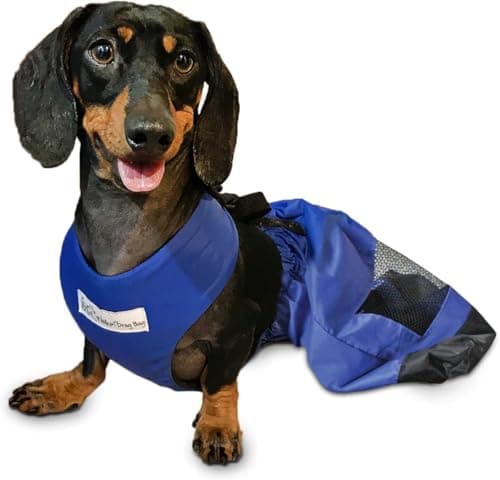
For the stage after boots. When the back legs no longer take any weight and the dog moves by pulling itself with its front end, a boot on each back foot is no longer the answer, because the dog is dragging its hocks, knees and chest too. The drag bag zips the whole back end into a double-layer nylon sleeve that slides instead of scraping.
A dog that pulls itself along indoors when it is out of its cart
#ad · Live prices from the Amazon Product API, as of Sep 22, 2026. Where we have no verified live price we show none — we would rather leave a gap than print a number that has rotted.
In detail
The picks, in full
01
A back paw that scuffs or knuckles on every walk
Ruffwear Grip Trex Dog Boots (pair)
Vibram rubber outsole (listed)Sold in pairs, not sets of 4Hook-and-loop ankle strapSized by paw width, 8 sizes
8.2/10
The boot we would put on a paw that drags. A Vibram rubber outsole with real depth to wear through, a ripstop upper that covers the top of the foot, and — the detail that matters here — Ruffwear sells them in pairs, so a dog dragging its back feet only pays for the two boots it needs.
Protects the paw
9.5
Stays on
9
Easy to put on
7
Grip on floors
8.5
Value
7
Pros
+The thickest, most abrasion-resistant sole on this page — a dragging paw wears through the sole, and this one has the most to give
+Sold as two boots, so a rear-dragging dog costs one pair rather than a four-pack with two spares
+Eight paw-width sizes, with Ruffwear's own instruction to measure across the widest part of the paw while the dog bears weight
+Covers the whole top of the foot, which is exactly the surface a knuckling dog lands on
Cons
−The highest price per boot on the page
−A hook-and-loop strap has to be pulled tight and checked — Ruffwear's own advice is to re-check the closure 15 minutes in — which is fiddly for stiff fingers
−The mesh upper is breathable rather than armored; on a heavy dragger the sole outlasts the toe of the upper
−Each size is a separate listing, so make sure the one you land on is your dog's width before ordering
Don't buy this if…
…you only need grip indoors on a dog that lifts its feet normally — a non-slip sock does that for a fraction of the price.
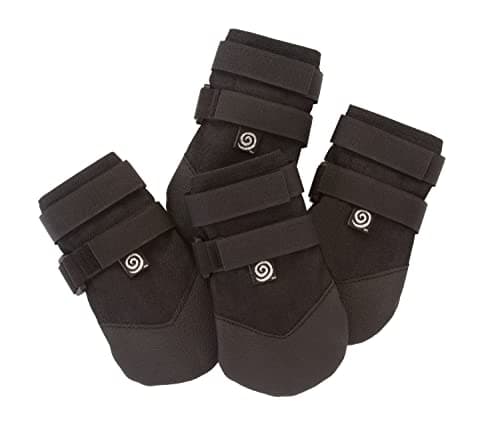
Thick recycled-tire sole (listed)Foam-lined strap for fitSold in pairs (2 boots)Indoor or outdoor use (listed)
8.0/10
The other boot built for a dragged foot, from a maker whose listing names disabled pets and service dogs among its users. A thick sole the maker says is made from recycled tires, and a foam-padded strap that holds the boot on a paw that is not lifting itself.
Protects the paw
9
Stays on
8.5
Easy to put on
7
Grip on floors
8
Value
7.5
Pros
+The listing is explicit that these are used on disabled pets, which is rarer than it should be in this category
+A thick rubber sole that the maker says can be massaged to loosen — a sign it has real material in it
+High-density foam inside the strap, so the boot grips the leg rather than relying on the strap being cranked tight
+Sold in pairs, like the Ruffwear, so you buy the two you need
Cons
−The maker admits the sole can be stiff at first, and a stiff sole on a weak leg is the wrong first impression
−The listing we resolved is a single size; the other sizes are separate listings, so check the size chart before you land on it
−A hook-and-loop strap, with the same stiff-finger problem as any other
−Plainer than the Ruffwear in sizing guidance — measure the paw width and compare it with the chart yourself
Don't buy this if…
…your dog is small or light-footed and mostly needs traction rather than armor — the sole is heavier than a little dog needs.
Trying boots before committing to the premium pair
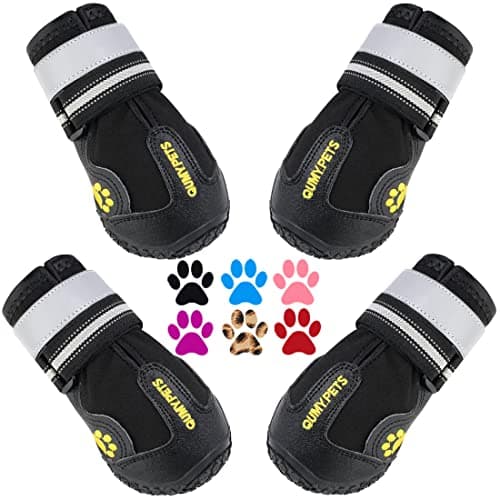
QUMY Dog Boots & Paw Protectors (set of 4)
Rugged anti-slip sole (listed)Wide split-seam openingTwo adjustable strapsSet of 4, 8 sizes by paw width
8.0/10
The budget boot most owners end up trying first, and a fair one: a rugged sole, a wide split opening that a stiff paw slides into, and two reflective straps. The catch is that it comes as four, so a rear-dragging dog pays for two spares.
Protects the paw
7.5
Stays on
8
Easy to put on
8
Grip on floors
8
Value
8.5
Pros
+The wide split opening is the easiest of the strapped boots to get a paw into — useful when the dog cannot help you by lifting its foot
+Two straps, so the boot is held at the ankle and above it, which helps on a paw that drags rather than steps
+The listing publishes a paw width and length per size, and tells you to measure rather than guess from weight
+Cheap enough that if your dog refuses boots altogether you have not lost much
Cons
−Comes as four; for a rear-dragging dog two of them sit in a drawer — the pairs on this page can work out cheaper for the boots you use
−The fabric upper wears at the toe on a dog that drags every step; the sole outlasts it
−Two straps is two more things to fasten than a slip-on rubber boot
−Bulkier on the foot than the sock-style options, so allow a few short indoor sessions before a walk
Don't buy this if…
…your dog drags heavily on pavement every day — buy the Ruffwear or the Ultra Paws once rather than replacing these.
Indoor grip with nothing to buckle, on a dog that still lifts its feet
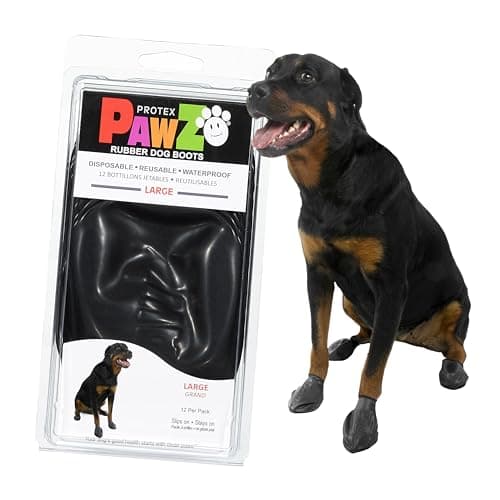
PawZ Rubber Dog Boots (12 pack)
Natural rubber, no straps12 per pack, by paw widthDisposable / reusable (listed)Listing says sizes run small
7.7/10
A balloon-thin natural rubber boot with nothing to fasten: stretch it over the paw and it stays on by itself. It is the best answer on the page for a dog that slips indoors and the worst for a dog that drags — a dragging paw wears through one in a day or two, which is why they come twelve to a box.
Protects the paw
4
Stays on
8
Easy to put on
9
Grip on floors
9.5
Value
8
Pros
+No strap, buckle or hook-and-loop — the only boot here a hand with arthritis can fit without help
+Thin enough that the dog feels the floor through it, which many sock-refusers accept when they will not accept a boot
+Genuine grip on smooth floors, and waterproof for a wet lawn
+Cheap per boot, and the box means a torn one is not a crisis
Cons
−Not a dragging boot: a knuckling paw grinds through the rubber quickly, and a wound on the top of the foot needs more than a membrane over it
−Stretching a small rubber boot over a paw takes some hand strength even though there is nothing to fasten
−The listing warns that sizes run small, so measure first and consider a size up as it suggests
−Traps moisture against the paw if left on for hours; take them off between uses
Don't buy this if…
…the top of the paw is already scraped or wounded — that foot needs a sole and a covered upper, not a rubber skin.
Short daily exercises for a paw that knuckles, alongside a rehab plan
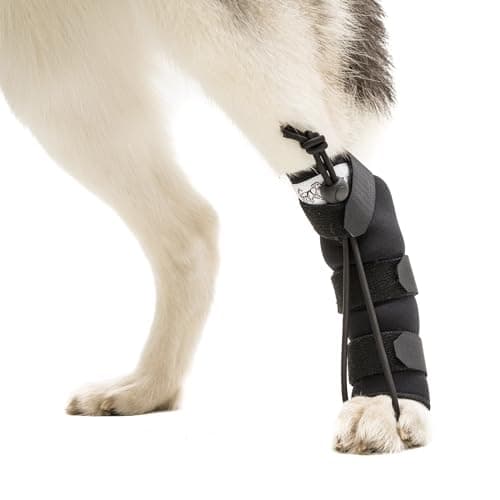
Walkin' Pets Rear No-Knuckling Training Sock
Neoprene sleeve + toe cord2-5 minute sessions (maker)Sized hock to paw + weightRear paws; front version sold
5.7/10
Not a boot, and it scores like one on purpose. This is a rehab tool: a neoprene sleeve with a cord that sits under the toes and nudges the dog to lift the foot instead of dragging it. Walkin' Pets says to use it for 2-5 minute sessions and take it off in between. For that job it is the only product of its kind we could resolve in stock.
Protects the paw
3
Stays on
8
Easy to put on
6
Grip on floors
5
Value
6.5
Pros
+Does something no boot does: it asks the dog to lift the foot rather than protecting the foot from not being lifted
+The maker is unusually honest that it is a temporary, supervised tool for short sessions as part of a rehab program
+Sold in several sizes by hock-to-paw length and weight, with a front-paw version for a dog that knuckles in front
+Fleece pad and cushioned toe cord, per the listing, for a foot that may already be sore
Cons
−It protects nothing on a walk — the maker says not to leave it on for extended periods, so you still need a boot for the dragging
−Fitting it means wrapping straps around the hock and looping a cord under the middle toes, which is a two-hands job on a dog that will stand still
−Whether it helps depends on the cause; a dog with no sensation in the foot has nothing for the cord to stimulate, and that is a question for your vet or rehab therapist
−Premium price for a few minutes of use a day
Don't buy this if…
…you want something the dog wears on walks — this is a rehab exercise, not paw protection, and the maker says so.
A dog that pulls itself along indoors when it is out of its cart
Walkin' Drag Bag for Disabled Dogs
Double-layer nylon (listed)Fleece-lined chest, mesh panelSide zipper, 7 sizes (listed)Indoor and outdoor use (listed)
7.2/10
For the stage after boots. When the back legs no longer take any weight and the dog moves by pulling itself with its front end, a boot on each back foot is no longer the answer, because the dog is dragging its hocks, knees and chest too. The drag bag zips the whole back end into a double-layer nylon sleeve that slides instead of scraping.
Protects the paw
10
Stays on
9
Easy to put on
6.5
Grip on floors
3
Value
7.5
Pros
+Protects everything a dragging dog scrapes — chest, knees, hocks and the tops of both back feet — in one piece of kit
+A side zipper and touch fasteners rather than four separate boots to do up
+Seven listed sizes, from the maker of the Walkin' Wheels cart it is designed to alternate with
+Water-resistant, so a lawn or a wet floor does not end the day
Cons
−Only for a dog whose back legs do not take weight; a dog that still walks, even badly, needs boots, not a bag
−Gliding is the point, so it does nothing for traction — this is the one product here that is meant to slide
−A dog that lives in the bag needs the same skin checks VCA asks for on any paralyzed pet, because the sores move rather than vanish
−Sizing is by the maker's chart, and a bag that is loose gathers under the chest
Don't buy this if…
…your dog is still standing on its back legs at all — boots and a rear-support sling are the right stage, and a cart is the next one.
Every maker on this page sizes by paw width, and every one of them says to measure rather than go by weight. The AKC's method is the one to use: "Take a piece of paper and press your dog's paw into the sheet" so the toes splay as they do under load, then trace the outline and measure across the widest point. Ruffwear adds the detail that matters for a weak dog: measure "across widest part of the paw when bearing weight." A knuckling dog often does not bear full weight on the bad foot, so press the paw gently onto the paper yourself.
Then read the size chart on the listing you are actually buying, not the chart in your head. The QUMY listing publishes a width and length per size and says weight is only a secondary reference. PawZ's listing says its sizes run small and suggests going up one. Ruffwear runs in quarter-inch steps from 1.5 to 3.25 inches, and each step is its own listing on Amazon, so the size you land on from this page is one of eight. Measure both back paws: on a dog that has been dragging for months the two can differ.
Which back feet, and which front
Degenerative myelopathy takes the back legs first and, the AKC notes, can carry on past them over time. Disc disease and other spinal problems can affect the front feet from the start. Boot the feet that scuff, and check the others every week. The Walkin' Pets training sock is sold in a front version as well as the rear one ranked here, and both are sized by the length from the hock (or wrist) to the paw as well as by weight; the maker says to measure "from the top of the paw (at back) to the center of the hock joint with your pet in a natural standing position."
Getting a stiff dog into a boot
The AKC's acclimation advice was written for a healthy dog and works better for an unsteady one: "Start with having your dog wear one boot. Then, once they get used to the sensation, you can put on the other boot," and "have your dog wear the boots indoors for short periods, subsequently increasing the length of time with each additional use." Do the first fitting with the dog lying down, on a rug, with the sock or boot opened as wide as it goes. A dog that cannot lift its foot for you cannot help you, so open the boot fully and bring it to the paw rather than the paw to the boot. The QUMY's wide split opening is the easiest of the strapped boots for this; the PawZ, which has to be stretched over the paw, is the easiest to fasten and the hardest to open.
Then do the AKC's test run: "have them wear the boots indoors. Assess whether your dog's paws stay in the boot or if they slip out." On a dragging paw the failure mode is specific: the boot is pushed backward off the toes with each scuff, and the heel of the boot rides up the leg. If that happens with the strap tight, the boot is a size too wide, not too loose at the strap. Ruffwear's own advice is to check the closure again 15 minutes into the walk, and we would make that a habit with any strapped boot on a dog that drags.
Check the foot every time the boot comes off
A boot hides the foot it is protecting. VCA's guidance for a paralyzed pet, that a dog paralyzed only in the hind limbs "may develop skin sores from dragging their hind end as they move," applies in miniature to a knuckling dog, and the place it applies is the top of the toes. When the boot comes off, look at the tops of the toes and the nails in good light. A pink patch means the boot is being outrun and the sole or upper is worn through; a scab or an open wound means a vet appointment, because a dog that keeps landing on a wound does not give it a chance to heal. The same applies to rubbing from the strap on the leg, and to the skin under the drag bag, where the pressure moves from the feet to the hocks and chest.
Boots also trap moisture. A rubber boot on for a full day is a warm damp bag, and the AKC describes the PawZ style as one-use protection rather than all-day wear. Take boots off indoors when the dog is resting, and let the foot dry.
A boot and a sock are not the same tool
Two products on this page are called socks and they do opposite things. Our non-slip socks are grip for a dog that slips indoors and cover for a paw that has only just started to scuff. The Walkin' Pets No-Knuckling Training Sock is a rehabilitation tool: a cord under the toes that the maker says stimulates the dog to lift the foot higher, used "for 2-5 minute training sessions and removed in between." It protects nothing on a walk, and the maker says not to leave it on for extended periods. If a rehabilitation practice has recommended it for your dog, it belongs in the daily plan alongside a boot. If nobody has, ask your vet whether it suits the cause of the knuckling before you buy it; a foot with no sensation has nothing for the cord to work on.
The evidence for movement itself is stronger than for any device. The AKC reports that dogs with DM who received intensive physical therapy "were able to walk significantly longer," and VCA calls exercise a vital part of DM care. A boot that lets your dog keep walking without shredding its foot is doing that job. That, more than the price of the sole, is why we would buy the durable pair and use it every day rather than a cheaper set and use it on good days.
When the boots come off for good
There is a stage after boots. When the back legs no longer take any weight and the dog moves around the house by pulling itself with its front end, the feet are no longer the only thing being dragged; the hocks, the knees and the chest are too. VCA notes that a dog paralyzed only in the hind limbs may develop sores from dragging its hind end, and that there are clothing options that can reduce skin damage. The Walkin' Drag Bag is that clothing. It is the only product on this page that is meant to slide, which is why it scores 3 on grip, and it is designed to alternate with a cart rather than replace one: our page on when a dog needs a wheelchair covers the decision, and beds for a dog that can't get up covers where it spends the rest of the day.
The floor is half the problem
A dog with a weak back end on tile or laminate spends its remaining leg strength staying upright, and every slip is a scuff waiting to happen. Runners along the routes it actually walks, a ramp for the back step and no unsupervised stairs cost less than a pair of boots and reduce the number of times the boot is needed. Our room-by-room floor guide covers that, and which floors are worst explains why laminate is the one to cover first. A rear-support sling is the other half of the walk for a dog that drags: lifting the hips a little takes weight off the feet that scuff.
How we chose
We haven't lab-tested these
We compiled the published specifications, manufacturer manuals and aggregated owner reviews, then scored each product against a published rubric. The scores are judgments from that research — they are not measurements we took in a lab, because we don't have one and we won't pretend we do. Prices are pulled live from Amazon; where we can't verify one, we say "check price" rather than print a stale number.
Questions
Frequently asked
Why is my old dog dragging its back paws?+
Because something between the brain and the foot is not working. Southeast Veterinary Neurology describes knuckling, the paw curling under so the top of the foot touches the ground, as a sign that the brain, spinal cord or nerves are not working properly, with causes ranging from disc disease and degenerative myelopathy to tumors, inflammation and injury. Some of those are treatable and some are time-sensitive, so a dog that has newly started dragging a paw needs a vet before it needs a boot.
Do dog boots help with knuckling?+
They protect the foot; they do not fix the knuckling. The AKC recommends boots for a dog with degenerative myelopathy specifically to protect the knuckles and toenails from being dragged and scraped. The only product on this page that addresses the lifting of the foot itself is the Walkin' Pets No-Knuckling Training Sock, which is a short-session rehab tool rather than something the dog wears on a walk, and whether it helps depends on the cause.
What kind of dog boot lasts on a dragging paw?+
One with a thick rubber sole that can lose material slowly and an upper that wraps the top of the toes in something tougher than knit fabric. On this page that is the Ruffwear Grip Trex, with a listed Vibram outsole, and the Ultra Paws Rugged, with a listed recycled-tire sole. A thin rubber boot like the PawZ is excellent grip for a dog that still lifts its feet and wears through in a day or two on one that drags.
Do I need four boots if my dog only drags its back feet?+
No. Boot the feet that scuff. Ruffwear and Ultra Paws both sell their boots in pairs, which is why they rank highest on this page for a rear-dragging dog: one pair, on the two feet that need it. The QUMY and PawZ come in fours and twelves respectively, which is fine if you want spares and less good value if you do not.
Should a knuckling dog wear boots or socks?+
Socks first, boots once the foot is scraping. At the first worn nail, a non-slip sock covers the top of the foot and adds grip indoors for very little money. Once VCA's description applies, the foot scraping the ground on every step with the hair on top wearing thin, a sock is being sanded away and the foot needs a sole. That is the point to buy a boot built for it.
How do I get a boot onto a paw my dog can't lift?+
Do it with the dog lying down on a rug, open the boot as wide as it goes and bring the boot to the paw. Follow the AKC's acclimation advice of one boot first, indoors, for short periods that get longer. A boot with a wide split opening is easier to load than one you have to stretch over the foot, and a boot with no straps is easier to fasten than one with two. Check the closure again a quarter of an hour into the walk, as Ruffwear advises.
Can my dog wear boots all day?+
We would not. Boots trap moisture against the paw, and the AKC describes thin rubber boots as one-use protection rather than all-day wear. Put them on for the walk and the slick rooms, take them off for rest, and use every removal to look at the tops of the toes and the nails. A pink patch means the boot is being outrun; a scab or an open wound means a vet.
We don't run a testing lab, and we don't pretend to. Product facts are compiled from manufacturer listings and manuals; health facts are cited to reputable veterinary sources. Where we couldn't verify something, we say so on the page rather than quietly leaving it out. Read our full method.