Degenerative myelopathy: the gear that helps, stage by stage
DM takes the back legs slowly and, unusually, without much pain. That gives you the one thing most bad diagnoses don't — time to get ahead of it. Here's what to have ready, and roughly when.
We earn a commission when you buy through our Amazon links, at no extra cost to you. It never changes our rankings, and we say so when the cheaper product is the better buy. How this works.
Degenerative myelopathy is a progressive disease of the spinal cord that VCA describes as comparable to ALS in people. It takes the back legs first, and the dog it takes them from is usually otherwise well — bright, hungry, pleased to see you, and slowly losing the ability to stand up.
That combination is what makes DM so disorienting to live with. There is no crisis to respond to and, in the disease itself, no pain to treat. There is only a slow slide, and a series of small equipment decisions that arrive one at a time and are much easier if you have already thought about them.
This page is that thinking, done in advance. It is not a treatment plan — DM is diagnosed largely by ruling other things out, and that work belongs with your vet or a neurologist. It is the gear side: what helps at each stage, what to buy before you need it, and what not to waste money on.
What it looks like, in order
VCA lists the early signs as knuckling — the paw folding over so the dog walks on the top of its foot — along with a swaying back end, difficulty rising, and scraped, worn feet from dragging. Owners often notice the nails first: one back foot wearing down flat while the other three stay normal.
From there the weakness and wobble deepen until the dog cannot bear weight behind, and the AKC notes the process can carry on past the hind legs over time. Incontinence tends to arrive late, when the dog can no longer get itself up and out reliably. VCA gives an age range of roughly 4 to 14 years and lists German Shepherds as the most commonly affected breed, alongside Siberian Huskies, Collies, Golden Retrievers and Boxers, with more than 24 breeds recorded; the AKC adds Pembroke Welsh Corgis, Rhodesian Ridgebacks, Chesapeake Bay Retrievers and Bernese Mountain Dogs.
How fast? Neither VCA nor the AKC puts a number on it, and neither will we. Progression varies enough between dogs that a figure quoted at you online is a guess wearing a lab coat. What both sources do agree on is the direction: it is progressive, and it does not reverse.
The one intervention with evidence behind it
Movement. VCA calls diet and exercise — specifically walking and swimming — vital components of care, and says physical therapy may slow progression, prolong quality of life and preserve muscle mass. The AKC goes further, reporting that dogs given intensive physiotherapy stayed walking significantly longer.
That reframes the whole equipment question. You are not buying gear to make your dog comfortable while it declines. You are buying gear so your dog can keep moving, because moving is the closest thing to treatment DM has. A sling that lets you walk a wobbly dog around the block is doing therapeutic work, not just saving your back.
The order things enter the house
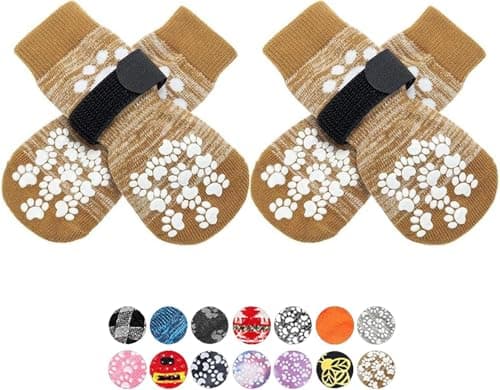
1. Paw protection and floor grip, as soon as you see knuckling or a worn nail. The AKC specifically recommends booties to protect knuckles and nails. Socks do the same job for most dogs at a fraction of the price, and they add grip indoors, which a dog with an unreliable back end needs anyway. Once the foot is scraping on every step and the hair on top is wearing thin, a sock gets sanded through in days and the paw needs a real sole — our page on boots for a dragging or knuckling paw ranks the ones built to survive it.
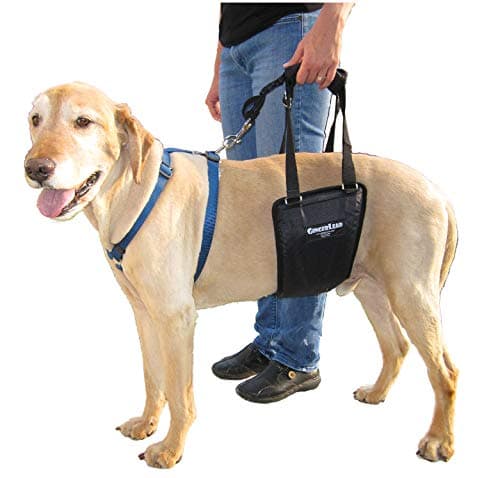
2. A rear-support sling, from the first time your dog needs a hand to stand or fails on a step. Buy this before you are desperate. Sizing takes a go or two, and the day you actually need it is not the day to be measuring your dog.
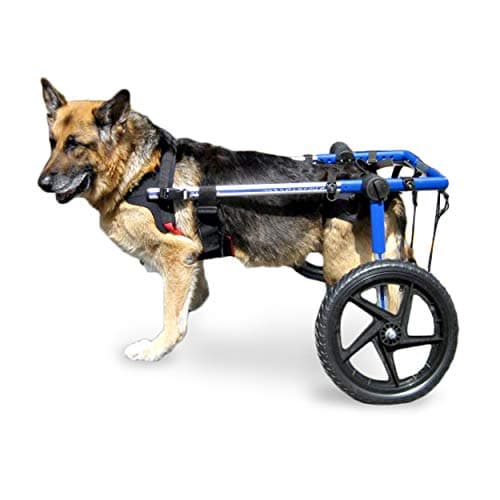
3. A cart, when the back legs can no longer carry the dog and a sling has become a two-hands-permanently job. This is a decision to make with your vet, who can confirm the front end is strong enough to drive one.
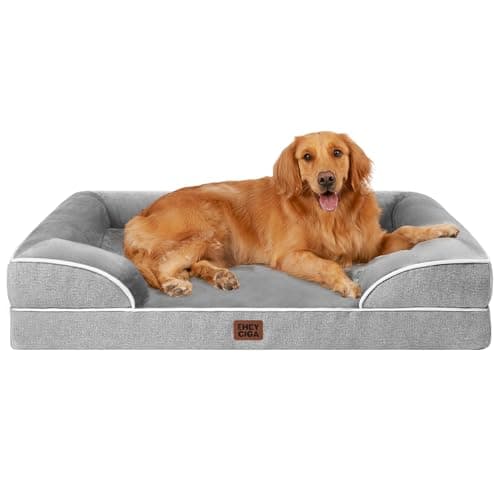
4. Bedding built for accidents and pressure, from the point where your dog stops shifting itself in the night. The AKC lists soft bedding to prevent bedsores as part of standard DM care, and incontinence usually follows the loss of mobility, so the practical answer is a supportive bed that is genuinely waterproof underneath.
The short version: the GingerLead is the piece you will use for the longest stretch of the disease and the one we would buy first; the Walkin' Wheels is the cart to fit when a sling stops being enough; the EXPAWLORER socks protect a knuckling paw and give a scrabbling dog something to push against; the EHEYCIGA waterproof bed is the answer to the two problems that arrive together at the end — pressure and leaks.
A padded belly sling on a long lead so you can support a dog's back end and walk upright behind it — the kind thing for both the dog's hips and your back.
The wheelchair we'd trust first. Fully adjustable across height, length and width, so one cart fits a range of dogs and adapts as your dog changes — with the best support behind it.
The whole-paw fix. Socks cover the pad with a grippy sole, which is the fastest way to give a scrambling dog traction on the whole foot — if your dog tolerates wearing them.
Built around the accident problem. A genuinely waterproof foam layer under a washable cover, with a low bolster — the sensible pick for an incontinent or leaky senior dog.
#ad · Live prices from the Amazon Product API, as of October 20, 2026. Where we have no verified live price we show none — we would rather leave a gap than print a number that has rotted.
In detail
The picks, in full
01
Weak back legs, walks and potty trips
GingerLead Rear Support Sling Harness
Padded belly slingLong integrated leadMale/female cut optionsSized to fit
8.6/10
A padded belly sling on a long lead so you can support a dog's back end and walk upright behind it — the kind thing for both the dog's hips and your back.
Support match
9
Padding
8.5
Owner ergonomics
9
Adjustability
8
Value
8.5
Pros
+Long handle lets you stand straight instead of stooping
+Wide padded sling spreads the lift comfortably under the belly
+Cut-out versions keep it clear for the dog to relieve itself
Cons
−Supports the rear only — no help for a dog weak in front
−Sizing matters; measure before ordering
Don't buy this if…
…your dog is unsteady in the front legs too — you'll want a full-body harness with front and rear handles.
Adjustable height/length/widthRear-support designSized by weightEstablished brand support
8.7/10
The wheelchair we'd trust first. Fully adjustable across height, length and width, so one cart fits a range of dogs and adapts as your dog changes — with the best support behind it.
Fit & adjust
9.5
Build quality
9
Rear support
9
Support & parts
9
Value
7
Pros
+Adjusts in three dimensions — the closest to a custom fit off the shelf
+Backed by a real company with fitting help and parts
+Widely used, so vets and PTs recognize it
Cons
−Premium price versus generic carts
−Fitting takes patience to get right
Don't buy this if…
…cost is the deciding factor and your vet says a budget cart will do — a VEVOR is a fraction of the price.
The whole-paw fix. Socks cover the pad with a grippy sole, which is the fastest way to give a scrambling dog traction on the whole foot — if your dog tolerates wearing them.
Grip
8.5
Stays on
7
Comfort
8
Value
9
Pros
+Covers the entire pad — grip everywhere the foot lands
+Straps help them stay on better than plain socks
+Cheap enough to keep spare pairs
Cons
−Some dogs dislike socks and shake them off
−Need the right size and periodic re-fitting
Don't buy this if…
…your dog won't keep anything on its feet — toe grips or paw wax leave the pad bare.
Built around the accident problem. A genuinely waterproof foam layer under a washable cover, with a low bolster — the sensible pick for an incontinent or leaky senior dog.
Support
7.5
Easy entry
8.5
Washability
9.5
Size range
8
Value
8.5
Pros
+The foam itself is waterproof, not just the cover — accidents don't soak in
+Cover unzips and washes; bed dries out rather than staying damp
+Bolstered sides on a still-low profile
Cons
−The waterproof backing can feel less breathable in summer
−Support foam is mid-tier, fine for medium dogs
Don't buy this if…
…you want the deepest orthopedic support for a very heavy dog — this trades some foam depth for waterproofing.
DM dogs lose muscle over the hips and thighs as they use the back end less, which means harnesses and carts that fitted in spring can be sloppy by autumn. Re-measure every few weeks while things are moving, not once at the start — our measuring guide has the four measurements that matter and the order to take them in.
Why a long-handled sling, specifically
A grab-handle sling is fine for a single lift onto a step. DM asks for something else: the same lift, several times a day, for months, often on a dog that also needs walking. A long lead lets you stand upright behind your dog rather than stooping over it, and the versions with a cut-out let a dog relieve itself while still supported — which stops being a detail the first week your dog cannot squat unaided.
Socks, boots or toe grips?
For a knuckling dog, coverage is the point. Toe grips add traction to the nails but leave the top of the foot exposed, and it is the top of the foot that a knuckling dog drags. Socks or boots cover the whole paw. Start with socks — cheaper, easier to get on a stiff dog, and if your dog shakes them off you have lost very little. Our toe grips vs socks comparison covers the trade-off properly, and keeping socks on deals with the obvious problem. When socks stop lasting, move to a boot with a sole: the dragging-paw boots page explains why pairs beat four-packs for a rear-dragging dog, and covers the no-knuckling training sock and the drag bag for the stage after boots.
Buying a cart before you need one
Two schools of thought, and both are defensible. Buying early means the cart is fitted and familiar before your dog is frightened and weak, and the dog learns to drive it while the front end is still strong. Buying late means you spend the money only if you reach that stage, and you measure a dog whose shape has settled. What is not defensible is buying a cart your dog cannot be fitted to — get the hock height right, and read when a dog actually needs a wheelchair before you commit. If you are leaning toward the adjustable cart ranked above, our Walkin' Wheels review covers how far it adjusts as a dog's shape changes.
The floor plan matters as much as the kit
A DM dog on hard floors is a dog spending its remaining leg strength on staying upright. Runners along the routes it actually walks, a ramp instead of the two back steps, and no unsupervised stairs are the changes that let the muscle work go into walking rather than scrabbling — see setting up floors for an unsteady dog and our indoor ramp picks. In the late stage, when the dog spends most of the day lying down, the bed becomes the main piece of kit, and our page on beds for a dog that can't get up covers the pressure and waterproofing side.
What we would not spend money on
Hip and joint braces. They are built to support an arthritic or unstable joint, and DM is not a joint problem — the weakness is in the spinal cord, and a brace on the hip cannot reach it. If your dog has arthritis as well, treat that on its own terms; our hip brace page is honest about what those can and cannot do.
Supplements sold as nerve or myelin support. We have not found veterinary sources that support them for DM, and we would rather say that plainly than sell you something. Keep the spend for physiotherapy, which does have support behind it.
How we chose
We haven't lab-tested these
We compiled the published specifications, manufacturer manuals and aggregated owner reviews, then scored each product against a published rubric. The scores are judgments from that research — they are not measurements we took in a lab, because we don't have one and we won't pretend we do. Prices are pulled live from Amazon; where we can't verify one, we say "check price" rather than print a stale number.
Questions
Frequently asked
Is degenerative myelopathy painful for a dog?+
VCA states that most dogs with DM are not in pain — the problem is weakness rather than discomfort — and that pain suggests a complicating condition such as arthritis. That is worth knowing both ways round: it is a genuine mercy in a hard diagnosis, and it means a dog that seems sore should be reassessed by your vet rather than assumed to be "just DM".
What is the first thing to buy for a dog with DM?+
Paw protection and floor traction as soon as knuckling starts, then a rear-support sling before you are lifting your dog daily. The AKC recommends booties to protect knuckles and nails; socks do the same job cheaply and add grip indoors. Buy the sling early — sizing takes a couple of attempts and the day you urgently need it is the worst day to measure.
Does physical therapy actually help degenerative myelopathy?+
It is the one intervention with real support behind it. VCA describes exercise — including walking and swimming — as vital, and says physiotherapy may slow progression, prolong quality of life and preserve muscle mass. The AKC reports that dogs given intensive physiotherapy remained walking significantly longer. Ask your vet for a referral to a canine rehabilitation practice rather than improvising.
When should a DM dog get a wheelchair?+
When the back legs can no longer carry the dog and a sling has stopped being a practical way to get around — and once your vet has confirmed the front end is strong enough to drive a cart. Fit is the thing that decides whether a dog uses one: hock height sets the axle, and getting it wrong either puts the dog on its toes or lets the back legs drag.
How quickly does DM progress?+
Neither VCA nor the AKC publishes a timeline, and we will not invent one — the range between individual dogs is wide. What is documented is the pattern: hind-limb weakness and knuckling first, progressing to an inability to bear weight behind, with incontinence typically arriving late. Your neurologist, who has seen your dog, is the only person who can sensibly estimate pace.
Can a DM dog still go for walks?+
Yes, and the veterinary sources actively encourage it. Walking and swimming are listed by VCA as vital parts of care. What changes is how — supported by a sling, on grippy ground rather than tile or ice, in shorter and more frequent outings, and stopping while your dog still has something left rather than at the point of collapse.
We don't run a testing lab, and we don't pretend to. Product facts are compiled from manufacturer listings and manuals; health facts are cited to reputable veterinary sources. Where we couldn't verify something, we say so on the page rather than quietly leaving it out. Read our full method.