Most of this site argues that a cheap orthopedic bed does the job. This page is the exception we owe you — because there is one dog where the cheap bed genuinely does not work, and pretending otherwise would be the same dishonesty we complain about elsewhere.
That dog is heavy. Somewhere north of about 70 lbs, lies down in one place and stays there for hours, and has already flattened a bed or two. For that dog the limiting factor is not cover quality or bolster shape — it is foam depth, and foam depth is the one thing you cannot get cheaply.
What we are reviewing, and what we are not
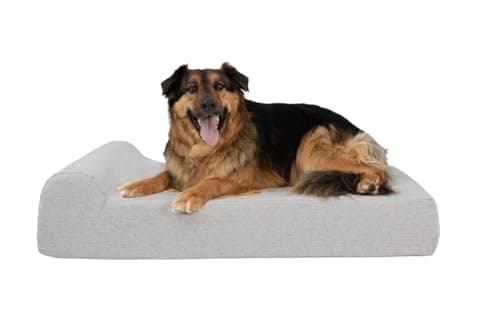
The bed here is the Barker Beds 7-inch Pillow Top with headrest, in the Large size the maker lists for dogs of 50 to 70 lbs. It is sold on Amazon, which is why we can price it live and link it. We have not slept a dog on it — we do not have a lab, we say so on our methodology page, and we are not going to invent a testing story. What follows is a judgment built from the published construction, the sizing scheme, and how those compare to the beds we already rank.
One naming note, because it causes confusion: Barker Beds is the current name of the brand long sold as Big Barker. The company's own about page says it "expanded — from Big Barker to Barker Beds" to cover smaller dogs too, and its direct-sale Large is listed at the same 48 x 30 x 7 inches, with the same headrest edition, as the Amazon listing we link below. So if you have read about Big Barker and landed here, you are in the right place. What we review is the specific Amazon listing linked below, judged on its published construction — not the brand's whole catalog.
The case for it
Seven inches is the whole argument. A budget bed gives you three to four inches of foam. Under a 90-lb dog, three inches compresses toward the floor at the hip and shoulder — the exact two points the bed exists to protect. Seven inches does not. Everything else on the spec sheet is secondary to that number.
Sizing by weight, not by letter. The listing sizes this bed by the dog's weight range rather than by S/M/L, which is a genuinely better system. Two dogs of the same length can differ by 40 lbs, and it is the weight that decides how much foam you need. Almost no budget bed sizes this way.
The headrest is not decoration. A bolstered head end gives an arthritic neck and shoulder somewhere to rest at a slight elevation. For a dog with cervical stiffness — the ones that sleep with their chin propped on anything they can find — that is a real comfort feature rather than upholstery.
The case against it
Height is a cost, not a feature, for a weak dog. Seven inches of foam plus a pillow top is a step your dog has to make. If your dog already hesitates or scrambles getting onto its current bed, this bed makes that worse every single time — several times a day, for the rest of its life. That is a serious mark against it for exactly the dogs its marketing is aimed at.
The money has alternative uses. The same spend covers a good mid-range bed plus a ramp, or a good bed plus a full set of stair treads. For a dog whose real problem is getting up and moving around, that second combination helps more hours of the day than a better mattress does.
A cover is a cover. Removable and washable is table stakes at every price in this category. Paying premium money does not buy you a fundamentally different washing experience, and any bed under a senior dog will need washing often.
Who should buy it
Buy it if your dog is heavy, still mobile enough to step up onto a raised surface without help, and has visibly flattened its last bed. That is a real dog and it is not rare — big old labradors, shepherds and mastiff crosses fit it exactly.
Skip it if your dog is under about 50 lbs, if it struggles to climb onto furniture already, or if you have not yet fixed the floors, the stairs and the jumping down off the sofa. Those three fixes cost less and change more.
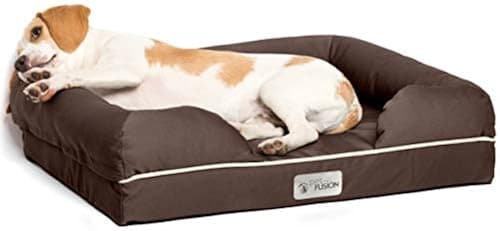
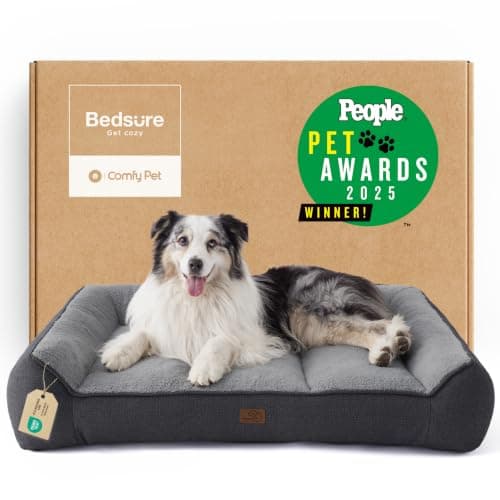
The short version: Barker Beds if your dog is heavy and steady; the PetFusion if you want most of the support at a much lower price; the Bedsure SupportMax if you want thickness on a budget and can live with a less refined cover.
The two beds we would buy instead, for most dogs
A review that only reviews one product is an advert. Both alternatives ranked above are beds we already recommend elsewhere on the site, and for the majority of senior dogs one of them is the better purchase.
PetFusion Ultimate — the sensible middle
Solid memory foam and a firm three-sided bolster at a fraction of the premium price. It gives up some depth and some sizing precision, and it keeps the thing that matters: a base that does not bottom out. This is our default recommendation for a big dog whose owner does not want to spend three figures.
Bedsure SupportMax — thickness on a budget
The extra-thick option from a brand that dominates the value end. Cover and finish are plainer, but the foam block underneath is the part your dog lies on. If depth is what you came for and the budget will not stretch, buy this.
How to tell if your dog has outgrown its current bed
Three checks, none of which need a product. Press the middle of the bed firmly with your palm — if your hand reaches the floor, so do your dog's hips. Look for a permanent dog-shaped dent that does not recover overnight. And watch where your dog sleeps: a dog that has abandoned its bed for the rug or the cold tile has usually told you the foam has gone, not that it dislikes the bed.
Before you spend premium money
Do the cheap things first, because they change more. Make sure your dog is not jumping down off furniture onto hard floors. Make sure the route from bed to water bowl is not slick. Talk to your vet about weight — keeping a dog lean is one of the highest-impact things you can do for arthritic joints, and it costs nothing. Our helping a dog with arthritis at home guide runs through the whole order of operations.