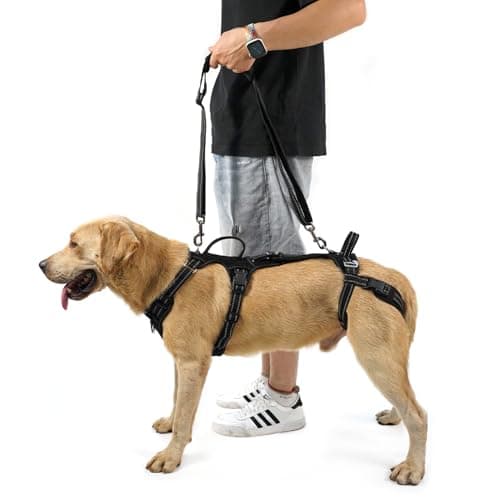
The best dog lifting harnesses and mobility aids under $50
Fifty dollars buys a real sling, a real handle and genuine help up the porch step. What it does not buy is handle length - and on a big dog, handle length is the difference between helping your dog and hurting your back.
We earn a commission when you buy through our Amazon links, at no extra cost to you. It never changes our rankings, and we say so when the cheaper product is the better buy. How this works.
Mobility gear is priced by two things, and neither of them is the fabric. The first is how much of your dog's weight the thing is designed to carry. The second — the one nobody puts on a listing — is how far the load sits from your spine. Under fifty dollars you get the mechanical part in full: a padded panel under the belly, a handle, and straps that adjust. What you do not get is a long handle, and a short handle means you bend at the waist every time you use it.
That is not a reason to skip this tier. It is a reason to be clear about the job. Under $50 is a short-assist budget, and short assists are most of what an aging dog actually needs: the two steps off the porch, the lift into the car, the bad morning after a cold night, the potty trip at 2am. For those, a cheap sling kept by the door gets used ten times as often as an expensive one in a cupboard — and the one that gets used is the one that helps.
Two limits, before any product, because they both cost this page a sale and they are both true:
It does not buy a wheelchair. Not close. The cheapest cart we would actually put a dog in costs several times this budget, and the gap is real engineering — a frame that holds a geometry, wheels that survive a sidewalk, and adjustment in three dimensions for a condition that is still changing. If you are reading about carts, start at what a dog wheelchair actually costs rather than buying down.
It does not buy the thing that saves your back. The long-handled belly sling you walk behind while standing upright, and the structured full-body harness with handles at both ends, both sit above this line. If you are supporting a 70-pound dog several times a day, you are the component that fails first, and that is the purchase to stretch for. We set that argument out in lift harnesses for a large dog and lifting a dog when you cannot lift.
Work out where the weakness is first
Almost every bad purchase in this category is a mismatch between where the dog is weak and where the product lifts. Watch your dog stand up from the floor once, then find your row.
What you see
What lifts it
Which pick
Back end sags or slides; front legs still work
A rear sling under the belly, just in front of the back legs
Picks 1 and 2
Front legs buckle or splay; back end is fine
A chest-and-shoulder sling, which almost nobody sells
Pick 3
Stiff and slow but strong — needs steadying, not lifting
A walking harness with a back handle that a stiff dog can be dressed in
Pick 4
Sore hips, wobbly on the turn, still weight-bearing
A compression wrap — warmth and even pressure, not mechanical support
Pick 5
Unsteady at both ends, or a dog you lift bodily
A full-body harness with front and rear handles — above this budget
With the price capped, the ranking is about fit for the job and about the second patient in the room, which is you. Five criteria, in order:
Where the load goes. A sling placed over the wrong part of the dog is not a cheaper version of the right one — it is the wrong product. Rear slings sit under the belly ahead of the back legs; a chest sling sits behind the front legs; a wrap sits over the hips and lifts nothing.
Handle height, because your back is the limiting part. Lifting a third of a 90-pound dog is roughly a 30-pound load at arm's length, several times a day, often by someone in their sixties or seventies. A short handle is fine for one lift up a step and punishing for a walk, which is exactly how we have split the picks below.
Panel width under the belly. Nothing here is going to break. The failure is comfort: a narrow strap concentrates the whole lift into two inches of soft belly, and a dog that finds the sling unpleasant stops cooperating with it.
Whether you can get it on a dog that cannot help you. Every one of these is fitted by one person, often one-handed, on a dog that is already down. A sling you thread under a lying dog is slower than a harness it wears; a wearable harness is only better if the dog tolerates wearing it all day.
Whether it clears the dog to relieve itself. The single most common reason a sling gets abandoned. Most lifts happen on the potty trip, and a panel sitting too far back makes that trip impossible — check the cut against your dog's sex before you order.
Where this ceiling bites
Three things, specifically, so you can judge whether they matter to you:
No long handle, so you bend. That is the whole difference between this tier and the next one, and for frequent daily use it is worth more than everything else on the listing.
Padding and structure are thinner. Fine for minutes at a time; less comfortable for a dog being held up for a full walk.
No both-ends support. A rear sling and a chest sling are two products here. Above the line they are one harness with handles at both ends — which also means one thing to fit rather than two.
What the budget does buy properly is worth saying plainly, because most owners never need more: help at a small number of fixed moments in the day, a spare kept in the car, and a cheap first try at something your dog may turn out to hate wearing. Plenty of dogs do refuse a harness, and finding that out for under thirty dollars is a much better outcome than finding it out for a hundred and fifty.
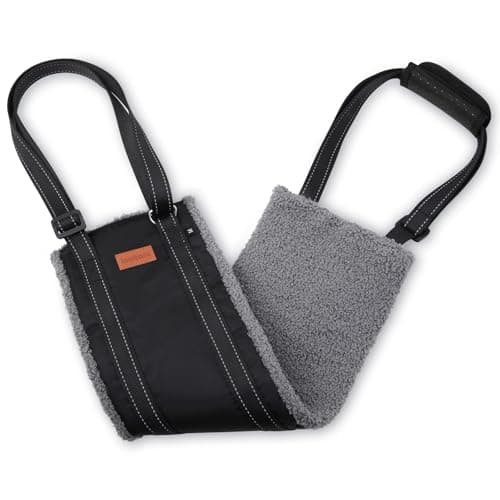
A quick-on rear sling with a handle — grab it for the few hard moments (up the porch step, into the car) rather than a full walk. Cheap, simple, kept by the door.
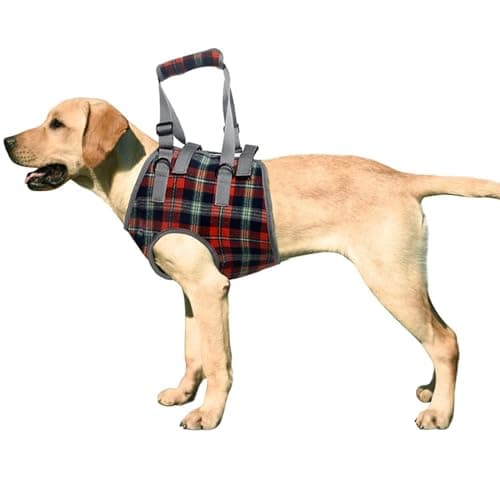
A chest-and-shoulder sling for the dog whose front end is the weak end — the mirror image of the rear-leg slings everyone sells, and much harder to find.
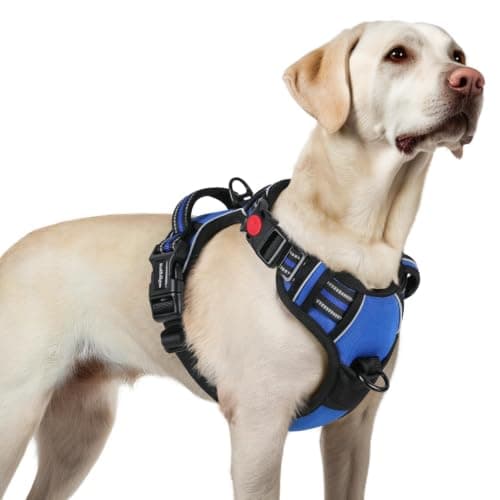
The one harness here that does not ask your dog to do anything. Three buckles mean it opens out flat, goes on around a standing dog and closes — no paw lifted, no head pushed through — which is the whole problem for an arthritic dog and almost the only thing that matters.
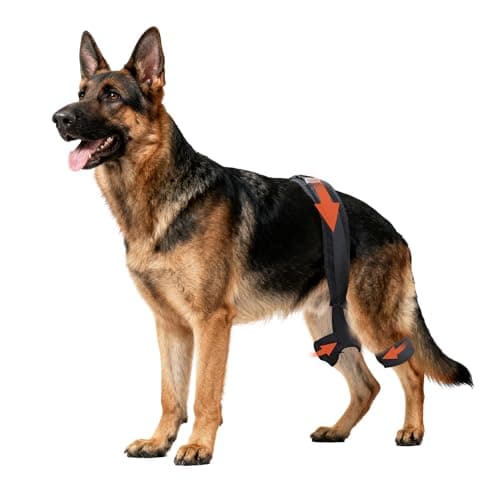
The sensible first brace. Adjustable compression wrap around the hips at a price that doesn't punish you if your dog turns out to hate wearing it — which plenty do.
#ad · Live prices from the Amazon Product API, as of November 22, 2026. Where we have no verified live price we show none — we would rather leave a gap than print a number that has rotted.
In detail
The picks, in full
01
Quick lifts and short assists
Coodeo Dog Lift & Walking Harness
Rear support slingGrab handleAdjustable strapsBreathable fabric
8.0/10
A quick-on rear sling with a handle — grab it for the few hard moments (up the porch step, into the car) rather than a full walk. Cheap, simple, kept by the door.
Support match
8
Padding
7.5
Owner ergonomics
7.5
Adjustability
8
Value
9
Pros
+Goes on fast for a one-off lift up a step or into the car
+Handle sits right over the hips
+Inexpensive enough to keep one by every door
Cons
−Short handle means more bending than a long-lead sling for full walks
−Best for brief assists, not hours of support
Don't buy this if…
…you need to support your dog for whole walks — a long-handled GingerLead is kinder to your back.
A chest-and-shoulder sling for the dog whose front end is the weak end — the mirror image of the rear-leg slings everyone sells, and much harder to find.
Support
7.5
Fit range
7.5
Comfort
8
Stays put
7.5
Value
8.5
Pros
+Takes weight off the front legs, which almost no other consumer sling does
+Grid fabric breathes rather than trapping heat against the chest
+Handle sits where your hand naturally falls when you walk beside the dog
Cons
−Front-only — a dog weak at both ends needs a full-body harness instead
−Padding is modest for the weight of a very large dog
Don't buy this if…
…your dog's problem is its back end, which is far more common — a rear sling or a full-body harness is the right buy.
Three buckles, opens fully (listed)Two leash clips, front and back (listed)Control handle on the back (listed)Soft padded, reflective (listed)
8.3/10
The one harness here that does not ask your dog to do anything. Three buckles mean it opens out flat, goes on around a standing dog and closes — no paw lifted, no head pushed through — which is the whole problem for an arthritic dog and almost the only thing that matters.
Easy to put on
9.5
Comfort on old joints
8
Adjustability
8
Build quality
6.5
Value
9.5
Pros
+Fully opening design is genuinely easier on a dog that cannot lift a front paw or duck its head, and easier on an owner doing it one-handed
+The back handle gives you something to hold on a curb or a step without buying a second piece of kit
+Front clip is there for the days your old dog still pulls
+Cheapest harness on this page by a wide margin, so a sizing mistake does not hurt
Cons
−Three buckles means three things to adjust the first time, and getting it even takes a go or two
−The handle is for steadying, not for lifting — it is stitched to a nylon vest, not to a load-bearing frame
−Budget hardware: the buckles and stitching are fine for a walk and are not what we would trust on a dog that hauls
Don't buy this if…
…you need to take real weight off your dog — that is a lift harness or a sling, not a walking harness.
Price as of November 22, 2026. Prices change — Amazon's is the one that counts.
#ad · we may earn a commission from this link to rabbitgoo Easy On & Off Dog Harness (3 buckles)
05
A first try at hip compression
Yinchogee Dog Hip Brace
Adjustable compression wrapHip and lower-back coverageMultiple sizesFabric-and-strap build
8.1/10
The sensible first brace. Adjustable compression wrap around the hips at a price that doesn't punish you if your dog turns out to hate wearing it — which plenty do.
Support match
7
Padding
7.5
Ease of fitting
8
Adjustability
8.5
Value
9.5
Pros
+Low cost for a category where prices climb fast
+Adjusts in several places, so an odd-shaped dog can still get a fit
+Light enough that many dogs settle into it
Cons
−Compression wrap, not a structured orthotic — no rigid support
−Straps loosen over a long wear and need checking
Don't buy this if…
…your vet has recommended a fitted orthotic for a specific joint problem. Buy the one they specify, not this.
The technique matters more at this price than at any other, because the handle is short and the margin for a bad lift is smaller.
Get close before you lift. Stand beside your dog, not behind it, with the dog against your shin. Distance from the load is what hurts backs.
Bend your knees, keep your spine straight, and lift with your legs. The handle is low, so the choice is between bending your knees and bending your back.
Lift only as much as the dog needs. Most dogs need a few inches of help, not to be carried. Take weight until the back legs engage, then hold steady and let the dog do the rest.
Two short lifts beat one long one. Up the step, pause, let the dog settle, then the second step. Rushing is where dogs panic and owners strain something.
Let the dog set the pace on the way down. Downward is the direction a weak-backed dog has least control over, and the one where a slip does the most damage.
How to lift an old dog covers the technique in full, including the two-person version for a big dog and stairs.
Measure before you order
Every maker here sizes by girth rather than by weight, and the charts do not agree with each other. Take a chest girth just behind the front legs and a waist girth just in front of the back legs, write both numbers down, and compare them to the chart on the listing you are actually buying from — not to a chart you read somewhere else. The measuring guide has the method, and harness fit problems covers what to do when something rubs.
A brace is not a lift
Our fifth pick is a compression wrap, and we want to be exact about what that is. A hip wrap can hold warmth and even pressure over a stiff area and give a hesitant dog enough confidence to move more freely. It does not hold the joint, it does not take weight off the leg, and nothing strapped around the outside of a dog reaches a hip joint buried under the largest muscle group in its body. It is a reasonable cheap try for a stiff dog that still gets around, and the wrong purchase for a dog that cannot stand up — do hip braces work? is the honest long answer.
The cheapest way to need the sling less often
Every lift you remove from the day is worth more than any upgrade to the harness, and the interventions are cheap or free:
Fix the floor it stands up on. A dog that scrabbles on tile uses far more effort to rise than one standing on a runner. Start with traction gear or just rugs and runners.
Remove the one jump that still happens. Usually the bed, the couch or the car. A ramp or a set of steps at that height takes it out of the day entirely.
Keep the nails short and the dog lean. Both change how much work standing up takes, and neither costs anything. Why a lean old dog moves better is the case for the second one.
Put a supportive bed where the dog actually sleeps. A dog that has been lying on a flattened bed on a cold floor is stiffer when it tries to stand.
When to stop buying cheap
Two signals. If you are lifting more than a handful of times a day, buy handle length — the long-handled sling is cheaper than a back injury. And if your dog has started needing help at both ends, stop buying two things and read sling versus full-body harness, because a single harness it wears all day is both kinder and quicker than fitting a sling each time.
How we chose
We haven't lab-tested these
We compiled the published specifications, manufacturer manuals and aggregated owner reviews, then scored each product against a published rubric. The scores are judgments from that research — they are not measurements we took in a lab, because we don't have one and we won't pretend we do. Prices are pulled live from Amazon; where we can't verify one, we say "check price" rather than print a stale number.
Questions
Frequently asked
Is a $30 dog lift harness any good?+
For short assists, yes — genuinely. The mechanical job of taking some weight off a weak back end is done well at this price, and a sling you keep by the door gets used far more than an expensive one in a cupboard. What you give up is handle length, padding and both-ends support, which matter when you are lifting repeatedly or supporting a big dog for whole walks.
Rear sling or full-body harness?+
Match it to where the weakness is. If the front legs still hold the dog up, a rear sling is simpler, cheaper and enough. If the dog is unsteady at both ends, or you are lifting the whole dog, a full-body harness with handles front and back is the right tool and it costs more than this page's ceiling. Our sling versus harness guide walks through the decision.
Can I use a regular walking harness to lift my dog?+
For a steadying hand on a curb, a harness with a sturdy back handle is fine and that is why one is on this list. For taking real weight, no — a walking harness loads the chest and armpits rather than the belly, and a dog hauled up by one is being lifted in the wrong place. Buy the sling for lifting and keep the harness for walking.
What is the cheapest thing that actually helps a dog with weak back legs?+
Traction on the floors it stands up on, which often costs nothing beyond a couple of runners, and removing the one jump still left in its day. Both reduce how often the dog needs lifting at all. After that, a rear sling at this price is the highest-value purchase in the category.
Will a hip brace help my dog stand up?+
Not mechanically. A hip wrap is compression and warmth — it can make a hesitant dog move more confidently, but it does not support the joint or take weight off the leg. A dog that cannot get up needs a lift, not a wrap. See do hip braces work?
How do I know what size to order?+
Measure, do not guess from weight. Chest girth just behind the front legs, waist girth just in front of the back legs, and then read the chart on that specific listing. If your dog is between sizes on a sling, the wider panel is usually the better choice for comfort under load.
We don't run a testing lab, and we don't pretend to. Product facts are compiled from manufacturer listings and manuals; health facts are cited to reputable veterinary sources. Where we couldn't verify something, we say so on the page rather than quietly leaving it out. Read our full method.