The rear-support cart our wheelchair roundup ranks first, read closely through its maker's own manual. What the adjustability is for, what the extra money does and does not buy, and who should buy something else.
We earn a commission when you buy through our Amazon links, at no extra cost to you. It never changes our rankings, and we say so when the cheaper product is the better buy. How this works.
If you have looked for a dog wheelchair, you have met this one. It sits at the top of our wheelchair roundup, which gives the short reasons. This page is the long version: how it is sized, what adjusts and why that matters for the conditions most carts are bought for, what the extra money pays for, and who should buy a different cart or none at all.
The standing disclosure first. We have never used a Walkin' Wheels, or either alternative on this page, on a dog. What follows is built from Walkin' Pets' product pages, sizing guides and instruction manual, the Amazon listings, Best Friend Mobility's and VEVOR's own descriptions, and the veterinary sources at the foot of the page. Where those sources disagree, we say so. The reasoning is on our methodology page.
What it is
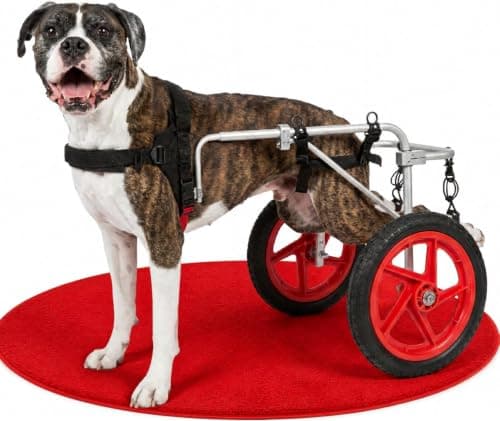
A rear-support cart. An aluminum frame carries two wheels; the dog's hindquarters sit in padded leg rings slung under the frame; two side bars, which Walkin' Pets calls extenders, run forward and clip to a harness at the shoulders. The front legs walk, and the wheels carry the back end. Walkin' Pets sizes the frame by weight and the struts and wheels by rear leg height. The Large is listed for dogs of 70 to 180 pounds, in four rear leg height ranges from 14 to 16 inches up to 23 to 25 inches.
According to Walkin' Pets, the Large arrives with the frame, a pair of 26-inch length extenders and a 9-inch width connector already fitted, two foam wheels on struts, a front harness with comfort sleeves, the leg rings, a belly belt, stirrups and an instruction manual. It folds flat by turning a dial on each knuckle. The standard wheels are dense foam with a rubber outer layer that the maker says will not puncture; air tires are an option. Walkin' Pets also makes Mini, Small, Medium and Medium/Large frames, and says only its rear wheelchairs are sold on Amazon.
Why the adjustability is the whole argument
Most carts are bought for a condition that changes, and degenerative myelopathy is the clearest case. VCA describes DM worsening until the hind end is paralyzed. The AKC's page goes further: after the rear legs, "the paralysis moves forward, affecting the front legs until they no longer work, either." Walkin' Pets calls its chair ideal for progressive conditions like DM, and each stage of that progression maps onto something on the chair you can change:
While the back legs still work, the manual says to set the height so the toe pads touch the ground and the dog can take part in the walking motion. Walkin' Pets says it encourages dogs to use their rear legs in the chair to maintain muscle mass.
When the back feet drag or knuckle under, the manual says to put the legs in the stirrups, which hold them several inches off the ground, or protect the feet with boots. It adds that if you use stirrups you should use both, because one leaves the dog feeling unbalanced.
As the dog loses muscle and changes shape, the length, width and height all move on push buttons. On the Large, the width connector runs from 9 to 14.5 inches, with a wider connector available by phone. If the spine starts to bow downward in the chair, the manual says to add the belly belt.
When the front legs weaken, a Front Wheel Attachment converts the same rear chair into a full-support, four-wheel chair. Walkin' Pets says every Walkin' Wheels rear chair converts this way "so you don't have to start over"; the Large attachment fits the Large rear chair only, and the manual says it can be removed at any time.
Disc disease (IVDD) can run the other way. VCA's page on disc disease says the return of walking ability after surgery may not come for several days to weeks, and depends partly on whether physical therapy can be done at home and whether the dog is motivated to recover. For a dog regaining the use of its legs, the useful adjustment is the reverse: out of the stirrups and down to toe-touch height, so the legs do more of the work as they come back. The manual also suggests the belly belt for dogs with spinal or disc issues. When a cart belongs in a disc recovery is a question for your vet or neurologist, not for a product page.
If DM is your dog's diagnosis, our degenerative myelopathy page puts the cart in order with the sling, the socks and the bed that come before and after it.
What the extra money buys
A conversion path instead of a second cart. The front attachment is the feature that most separates it from the other two carts here. Best Friend Mobility sells a quad conversion kit, but for its Pro rear chair; we could not locate one for its Standard chair. The VEVOR listing mentions no front conversion at all.
A published fitting process. A sizing calculator, a five-point fit check in the manual, and an offer to review side, rear and overhead photos of your dog in the chair by email. For a dog that is changing, that help keeps being useful.
Parts. Struts in three lengths, foam or air wheels, replacement harnesses, stirrups, a boot-and-stirrup kit, a belly support and a spare-parts list. A frame you can re-equip is a frame you do not have to replace.
Range for big dogs. The Large goes to 180 pounds. The VEVOR listing's own size chart stops at 88.
A frame guarantee. The manual guarantees the frame for five years from purchase against defects in material or workmanship; it is non-transferable and you pay shipping. This is not unique: Best Friend Mobility's Amazon listing describes a lifetime limited warranty covering replacement parts.
Something to pass on. Walkin' Pets points out that because the chair adjusts, it can be resold or used on another dog. That is an honest point about value, and a kind one, since the chair can go on to help a dog after yours.
What it does not buy
A treatment. The manual's own liability note says the company makes "no representation to the effectiveness or appropriateness of this product", and its FAQ says every dog and disability is unique, and so is the recovery. A cart gives a dog movement. It does not change the condition underneath.
Somewhere to rest. A dog cannot sit or lie down in a Walkin' Wheels; the maker says the chair is designed never to collapse onto the leg or spine. The manual says that once a dog is used to it, it can be in the chair about an hour at a time before it needs to come out and rest. One Walkin' Pets collection page says dogs can rest in the chair without taking it off; the product page and the manual both say to take the dog out to rest, and that is the instruction we would follow. The rest happens on a bed, and for a dog that cannot shift its own weight, that bed matters: see our beds for a paralyzed or down dog.
Uniqueness. The Amazon listing calls it "the only dog wheel cart that can be tailored to your dog's size and changing health". Both alternatives on this page are also sold as adjustable for height, width and length, so we would not lean on that line. The real differences are the conversion path, the fitting help and the parts.
An easy afternoon. The manual runs through knuckle angle, length, width, height, leg rings, stirrups, harness straps, set screws and the belly belt. Our own card lists the patience fitting takes as a con, and the manual bears that out. Expect to revisit the fit as your dog changes.
A light thing to lift. The Amazon listing gives the Large an item weight of 21 pounds. It folds flat, but you are the one lifting it into the car.
Who should not buy a rear-support cart
A dog with weak front legs. Walkin' Pets puts it simply: in a rear chair, "your dog's front legs do the driving." Best Friend Mobility's product page is blunter: "Your pet should have normal front leg strength to use this cart." If the front end is already failing, Walkin' Pets' answer is its full-support chair, which it describes for dogs that have lost strength or mobility in both the front and rear legs, adding that your vet can help you decide when it is time to switch. Your dog will not be able to lie down in that one either.
A dog that will not settle to it. VCA's DM page says the nature and temperament of the dog determines whether a cart will improve its quality of life. The AKC's guide to mobility devices makes the same point from the other side: confident dogs usually have an easier time with this equipment, and shy, cautious dogs generally struggle more. That is not a reason not to try, but it is a reason to go slowly and to accept the answer.
An owner who cannot lift the back end. Getting a dog in means lifting its hind legs through the leg rings. For a big dog, that is a real lift every time; our page on managing a big dog when you cannot lift covers the owner's side of that.
A dog that walks fine but tires. That is a stamina problem, and the tool for it is a stroller or wagon, not a wheelchair.
What we scored these on
Fit and adjustment. How many directions the chair adjusts, how finely, and whether it can follow a dog whose condition is changing.
Build quality. Frame, wheels and hardware as described by the maker, and whether the listing describes them consistently.
Rear support. How the hindquarters are held, and the options for a dog whose feet drag.
Support and parts. Fitting help, a documented process, spare parts and a path to more support later.
Value. What the price bracket buys, including how long the chair stays useful.
Scores are judgments from the manufacturers' pages and manuals, the live listings and the veterinary sources cited below, in line with our methodology. We have not fitted any of these carts to a dog.
The short version: the Walkin' Wheels if your dog's condition is progressing, your dog is large, or you want the option to add front wheels later without buying a second cart. The Best Friend Mobility if your dog's front end is sound and you want a well-established aluminum cart for less. The VEVOR if your dog is small or medium, the need looks short-term, and your vet agrees a budget cart will do.
The wheelchair we'd trust first. Fully adjustable across height, length and width, so one cart fits a range of dogs and adapts as your dog changes — with the best support behind it.
A lighter aluminum rear cart at a middle price. Simpler to assemble than most, and a common recommendation for a dog that needs wheels without the top-tier cost.
The budget cart. If your vet has confirmed a wheelchair is right and money is tight, this gets a dog rolling for a fraction of the brand-name price — with more trial-and-error on fit.
#ad · Live prices from the Amazon Product API, as of Sep 22, 2026. Where we have no verified live price we show none — we would rather leave a gap than print a number that has rotted.
In detail
The picks, in full
01
A first, adjustable wheelchair
Walkin' Wheels Dog Wheelchair
Adjustable height/length/widthRear-support designSized by weightEstablished brand support
8.7/10
The wheelchair we'd trust first. Fully adjustable across height, length and width, so one cart fits a range of dogs and adapts as your dog changes — with the best support behind it.
Fit & adjust
9.5
Build quality
9
Rear support
9
Support & parts
9
Value
7
Pros
+Adjusts in three dimensions — the closest to a custom fit off the shelf
+Backed by a real company with fitting help and parts
+Widely used, so vets and PTs recognize it
Cons
−Premium price versus generic carts
−Fitting takes patience to get right
Don't buy this if…
…cost is the deciding factor and your vet says a budget cart will do — a VEVOR is a fraction of the price.
Aluminum frameRear-support designSized by weight/heightNeoprene leg rings
8.1/10
A lighter aluminum rear cart at a middle price. Simpler to assemble than most, and a common recommendation for a dog that needs wheels without the top-tier cost.
Fit & adjust
8
Build quality
8.5
Rear support
8.5
Support & parts
7.5
Value
8
Pros
+Lightweight frame is easy for the dog to power
+Sized by measurement and generally quick to set up
+Long-standing, widely reviewed model
Cons
−Less fine adjustment than a Walkin' Wheels
−Get the size right the first time — less room to tweak
Don't buy this if…
…your dog is between sizes or still changing — a fully adjustable cart forgives that better.
Adjustable frameRear-support designSized by weightBudget price
7.2/10
The budget cart. If your vet has confirmed a wheelchair is right and money is tight, this gets a dog rolling for a fraction of the brand-name price — with more trial-and-error on fit.
Fit & adjust
7
Build quality
6.5
Rear support
7.5
Support & parts
6
Value
9
Pros
+By far the cheapest way into a wheelchair
+Adjustable across the basics
+Fine for a lighter or short-term need
Cons
−Instructions and support are thin — expect to fiddle
−Build isn't as refined as the established brands
Don't buy this if…
…your dog will live in the cart long-term — the fit and support of a Walkin' Wheels is worth the extra.
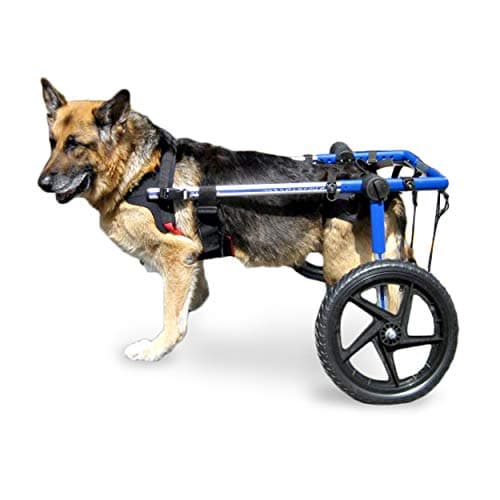
Best Friend Mobility describes its Standard Rear Support chair as aircraft-grade 6061 aluminum, fully adjustable for height, width and length, with all-terrain dense wheels, a padded rear harness and an adjustable shoulder harness, folding flat. The Amazon listing adds adjustable stirrups that can hold a paralyzed dog's legs off the ground or let a dog with some movement touch down, and sizes from XX-Small to X-Large by hindquarter height. Our card below lists less fine adjustment than the Walkin' Wheels as a con; that is our read of the published adjustment detail, and the maker itself describes the chair as fully adjustable in all three directions.
Three things we could not square. The Amazon title calls it "K9 Orthopedic Surgeon Designed & Tested"; we could not locate that claim, or a surgeon's name, on Best Friend Mobility's own site. One listing bullet mentions pneumatic tires, while the manufacturer's page says dense wheels and sells pneumatic wheels separately. And its quad conversion kit is for the Pro rear chair; the listing does not say which model it is. Ask the seller before you order if any of this matters to you.
It wins when your dog's front legs are sound, the diagnosis is not one expected to reach the front legs, and you would rather spend less on a lightweight, well-established cart.
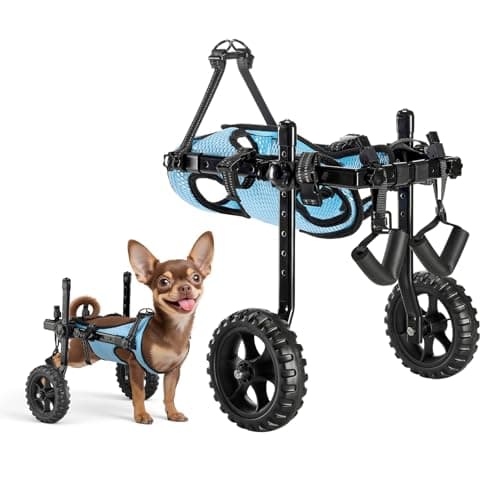
VEVOR
The budget cart. The listing describes five lengths, six widths and seven heights, set with spring buckles and screws, shock-absorbing EVA wheels, a removable mesh and a D-ring for a leash. Read the size before anything else: the version our link opens on is the X-Small, rated for dogs up to 22 pounds, and the listing's own chart runs up to a Large rated for 48 to 88 pounds. There is nothing on it for a dog heavier than that.
The listing is not consistent with itself. The bullets and spec table say aluminum alloy, while the product description says a high-strength steel frame. Its FAQ says weight alone is not enough to choose a size, which is worth knowing because our card lists it as sized by weight: measure body length, width, height and the distance between the front and back legs, as the listing asks. The package list on the listing does not mention a front harness; Walkin' Pets includes one.
It wins for a small or medium dog, a need that looks temporary, and a tight budget, with your vet's agreement that a basic cart is enough.
Measuring: each brand asks for something different
Brand
What it asks for
How, per the maker
Walkin' Pets
Rear leg height and weight; also armpit-to-rump length for dogs under 25 lb
Dog lying on its side; from the crease where the thigh meets the body down to the toe pads, with a natural bend, not pulled straight
Best Friend Mobility
Hindquarter height
From the floor to the dog's back, with a helper supporting the hind legs if needed
VEVOR
Body length, width, height, distance between front and back legs
Compared against the listing's size chart; weight alone is not enough
Walkin' Pets measures lying down because, it says, many dogs who need a wheelchair cannot stand up straight. Its sizing article gives the frame by weight: Mini for 2 to 10 pounds, Small for 11 to 25, Medium for 26 to 49, Medium/Large for 50 to 69 and Large for 70 to 180. It notes that Corgis and Dachshunds, with their long backs, need specially designed chairs. The exact cut-offs vary slightly between its own pages, so run the numbers through its SureFit calculator rather than trusting a chart. If your dog falls between sizes, Walkin' Pets says a larger wheel is sometimes possible but not always, and asks you to call.
Our measuring guide covers the general measurements for mobility gear, including hock height as the usual cart number. For a specific chair, use that maker's method; the three above do not ask for the same thing. It is worth the care. The AKC's mobility-device guide warns that a device that does not fit correctly can cause more harm than good.
Putting your dog in
The manual's quick start, condensed. Set the length, height and width first. Clip the leg rings to the frame. Put the front harness on your dog. Stand the chair behind your dog with the extenders resting on the ground, lift the back legs through the leg rings, then lift the extenders, slide each through the D-ring on the harness and clip it in. If you use stirrups, release them first when you take your dog out.
Checking the fit
Walkin' Pets says a correctly adjusted dog stands in a natural position, and gives five checks:
Knuckles at the hips. An imaginary line between the two knuckles should pass through the hip joints, with about an inch of room between the dog and each knuckle.
Front harness clips behind the shoulder blades. The extenders should run parallel to the ground through the middle of the body and not reach past the front legs.
A straight back. Straight or slightly arched up. A back that sags needs the belly belt.
Toe pads just touching, or just off the ground, depending on how much the back legs can do.
Or feet in the stirrups, above the hock, for a dog that cannot use its back legs or whose feet drag.
The manual adds that the leg rings should hang about three inches below the frame and look like two Cs, not two Vs. If you are unsure, it invites you to send side, rear and overhead photos for a fitting check.
The harness, and the others that fit it
The included front harness has three straps. Per the manual, the dog's head goes between the black and blue straps, the blue strap goes over the shoulders, the red strap goes behind the front legs, and the black strap runs under the neck across the chest, with the neoprene side panels over the shoulder blades and all three straps snug. Walkin' Pets also lists a rear lift harness that can be used in the chair instead of the leg rings, and a full-body harness it describes as wheelchair compatible, which is useful if you want one garment for the cart and for lifting. Our full-body harness roundup covers that category in general.
Getting your dog used to it
The manual is candid that this does not always happen in a few moments. Its method: assemble the chair and leave it where your dog can see, smell and touch it. Put the front harness on and leave it for a while. Work before a meal, with favorite treats. Once the dog is in the chair, hold a treat at nose level, then step back so the dog walks toward you. Keep sessions very short, five to ten minutes, several times a day, on a short leash in a clear area. If your dog is frightened, disconnect the harness and try later. Walkin' Pets' separate tips sheet adds starting in a wide, open space and building up by a few minutes per walk.
On bathroom breaks, the maker says dogs can pee and poop in the chair while standing, and suggests draping a long tail over the back bar and taking the dog to its usual spot. Its website says resistance is normal at first and that most dogs come around within a few days; that is the maker's claim, not something we can confirm. The same page says that if a dog still refuses after a week, the fit is usually the issue, and asks you to contact them for help adjusting it. Our guide to when a dog needs a wheelchair covers the questions to ask your vet about how long to start with.
Care, wheels and parts
The manual says the frame will not rust, but that saltwater, mud and sand can wear the hardware and bearings, so hose it down after exposure. The foam wheels are the low-maintenance choice. The air tires offer more shock absorbency and are aimed at active dogs that hike off-road, but they need inflating and can puncture. Wheels, struts and the soft parts are sold separately as they wear.
How we chose
We haven't lab-tested these
We compiled the published specifications, manufacturer manuals and aggregated owner reviews, then scored each product against a published rubric. The scores are judgments from that research — they are not measurements we took in a lab, because we don't have one and we won't pretend we do. Prices are pulled live from Amazon; where we can't verify one, we say "check price" rather than print a stale number.
Questions
Frequently asked
Are Walkin' Wheels dog wheelchairs worth the money?+
For a dog whose condition is progressing, or a large dog, the case is strong: the chair adjusts in height, length and width, and the same rear frame can take a front-wheel attachment later rather than being replaced. For a small dog with a short-term need, a budget cart may be enough if your vet agrees. We have not used any of these carts; this is a judgment from the published details.
How do I measure my dog for a Walkin' Wheels wheelchair?+
Walkin' Pets asks for your dog's weight and rear leg height, measured with the dog lying on its side, from the crease where the thigh meets the body down to the toe pads, with the leg in a natural bend. Dogs under 25 pounds also need an armpit-to-rump length. Enter the numbers into its SureFit calculator rather than relying on a chart.
Can a Walkin' Wheels be converted to a quad cart?+
Yes, according to Walkin' Pets. A Front Wheel Attachment in the matching size converts the rear chair into a full-support, four-wheel chair for a dog whose front legs have weakened too, and the manual says it can be removed at any time. The attachment is sold separately and fits only the same size of rear frame.
Can my dog lie down or sit in a Walkin' Wheels?+
No. Walkin' Pets says the chair is designed never to collapse onto the dog's leg or spine, so the dog stays standing. It is meant for bathroom breaks, exercise and walks, and the dog should come out of it to rest.
How long can a dog stay in a Walkin' Wheels each day?+
The manual suggests starting with sessions of five to ten minutes, several times a day, and says that once a dog is used to the chair it can be in it about an hour at a time before coming out to rest. Ask your vet how much activity suits your dog's condition.
What size Walkin' Wheels does a large dog need?+
Walkin' Pets lists its Large frame for dogs of 70 to 180 pounds, with struts and wheels chosen by rear leg height in four ranges from 14 to 16 inches up to 23 to 25 inches. Its Medium/Large covers 50 to 69 pounds. Confirm with the SureFit calculator before ordering.
We don't run a testing lab, and we don't pretend to. Product facts are compiled from manufacturer listings and manuals; health facts are cited to reputable veterinary sources. Where we couldn't verify something, we say so on the page rather than quietly leaving it out. Read our full method.