The best slings and harnesses for the weeks after knee surgery
After TPLO or another cruciate repair, your dog goes outside on a short leash for bathroom breaks and almost nowhere else for weeks. A sling is what keeps those trips from turning into a slip. Here is what the surgeons ask of you, and which one to buy.
We earn a commission when you buy through our Amazon links, at no extra cost to you. It never changes our rankings, and we say so when the cheaper product is the better buy. How this works.
Your dog comes home from knee surgery with a shaved leg, a cone, a bag of medication and a sheet of instructions that turns the next two months into a very small life: a crate or a small room, short trips outside on a leash to go to the bathroom, and nothing else. The part people plan least for is the walk from the back door to the grass, over whatever floor is in the way. That is the trip the discharge sheets want supported, and a sling is the tool for it.
One rule runs through this whole page. Your surgeon's discharge instructions come first. Hospitals differ on how long the restrictions last, whether stairs are allowed and when a sling can be put away, and the surgeon who repaired your dog's knee is the only person who knows what that knee can take. Everything below is gear that supports those instructions. If anything here disagrees with what your surgeon told you, do what the surgeon said.
What the discharge instructions actually say
The American College of Veterinary Surgeons (ACVS) page on cranial cruciate ligament disease describes the main repairs, TPLO, TTA, CBLO, the lateral suture and TightRope, and is plain about what follows all of them: "Activity must be restricted for several weeks after surgery to ensure that there are no complications with implants or healing." The University of Missouri's Veterinary Health Center explains why in its TPLO handout: until the bone heals, the plate and screws are the main things holding the tibia stable, "so resting the dog after surgery is critically important."
We read what three veterinary schools and a specialty surgery practice publish about home care after cruciate surgery. They are not identical, and that is the point:
Source
Confinement
Going outside
Sling
University of Missouri Veterinary Health Center
Cage restriction, with no running, jumping, playing or stairs for the first eight weeks
Short leash walks for elimination only
For walking over slick surfaces, for two weeks
University of Florida Small Animal Hospital
At least three months of exercise restriction
Leash walks only, no free roam of the backyard
Not mentioned on the page
Texas A&M College of Veterinary Medicine
Kept calm and confined when unsupervised for the first eight weeks
Short, leash-only walks
Not mentioned in the article
Madison Veterinary Specialists (home-care sheet)
No free run of the house until weeks 8 to 12, and then only after x-rays and the surgeon's approval
Short leash walks only to void in the first two weeks, on a 4 to 6 foot leash; no retractable leashes
On slippery or uneven surfaces and on stairs, in the first two weeks
Read across the rows and the shape is the same everywhere: a confined dog, a short leash, bathroom trips and nothing more, with a sling for the surfaces where a slip is likely. The details, eight weeks or three months, stairs never or stairs with a sling, change from hospital to hospital. That is why your own sheet decides.
What a sling is for in those first weeks
VCA's page on TPLO says about half of dogs begin walking on the operated leg within 24 hours of surgery, and that by two weeks most bear moderate to complete weight on it. So in the first days, many dogs are not yet putting full weight on the operated leg. That is the dog you are walking across a kitchen floor to the back door.
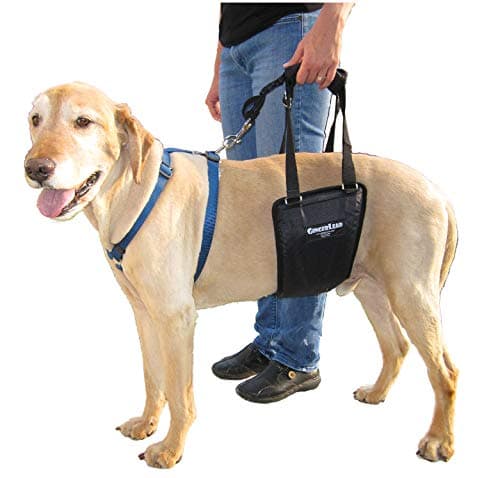
A sling does two jobs on those trips. It lets you take some weight at the back and steady the dog where the floor is slick, which is exactly where the Missouri and Madison instructions call for one. And it gives you a second point of control besides the leash. GingerLead's listing, for example, says its lead can be hooked to a collar for younger dogs recovering from orthopedic surgery, and its website pitches that as speed control. That matters because the Madison sheet asks you to keep walks slow so the operated leg is used with every step, and a dog that wants to hurry to the grass is hard to slow with a collar alone.
What a sling is not for, after surgery, is carrying the dog around. The instructions above are about short, supported walking, not avoiding it. If you find yourself lifting most of your dog's weight on every trip, tell the surgical team; it is information they want. For the lift itself, our guide to lifting a large dog safely covers where your hands go and how to spare your back, and managing a big dog when you cannot lift is written for owners without much strength to spare.
Set up the house before the dog comes home
A confined rest area. The instructions above confine the dog when you are not watching it: Missouri to a cage, Texas A&M whenever the dog is unsupervised. VCA's general post-operative advice is a soft, clean bed in a quiet, draft-free room. If a crate is the plan, the bedding problem is specific: flat support foam cut to the tray, with no rim to climb over. Our orthopedic crate pad picks cover exactly that.
The route to the door. Walk the path your dog will take four or five times a day, from the rest area to the grass, and look at the floor. Laminate, glazed tile and polished wood are the kind of slick surfaces the discharge sheets mean. Runners or rubber-backed rugs along that one route are cheap and take an afternoon. Our page on which floors are worst for a dog explains why the floor that looks safe often is not.
Stairs. Missouri's instructions rule out stairs for eight weeks; the Madison sheet uses the sling on stairs in the first two. If your house has steps between the rest area and the outside, ask your surgeon which rule applies before the day of surgery, because the answer changes where the dog sleeps. Either way, gate the flights your dog should not attempt alone. The gate at the top of a staircase has to screw into the wall; our stair gate guide explains which gate goes where. If a few steps are unavoidable and your surgeon allows them with a sling, non-slip stair treads add grip to every step.
Furniture. Missouri, Florida and Madison all rule out jumping, and the Madison sheet keeps jumping on and off high furniture, such as a high bed, off limits even in weeks 8 to 12. Close the bedroom door, block the sofa, and settle the question of the bed before your dog tests it.
Belly sling or full-body harness?
For most dogs after a single knee repair, a belly sling is the right tool. It slides under the abdomen in seconds, takes weight off the back end, and comes off when you are back inside. Our sling versus harness comparison sets out the general difference. After knee surgery, a full-body harness with front and rear handles earns its extra cost in three situations:
A big dog. With a belly sling all of your control is at the back end. A heavy dog that lunges at the door or stumbles on the step is easier to steady with a handle at the shoulders as well.
Arthritis elsewhere. Missouri's handout says a dog will always have arthritis in the repaired knee. If your dog was already stiff or unsteady before the surgery, weak in front or sore in the hips, supporting only the back end leaves you holding half the problem. If hips are the other issue, our guide to helping a dog with hip dysplasia at home covers the day-to-day side.
The other knee is also suspect. The ACVS page says up to 50 percent of dogs diagnosed with cruciate disease in one knee develop it in the other, usually within 12 to 18 months of diagnosis; the University of Florida says about 30 to 50 percent of dogs rupture both cruciate ligaments within one to two years of each other. If your vet has already raised the other knee, you may be supporting this dog for longer than one recovery, and a harness designed to stay on, with handles at both ends, is money spent over months rather than weeks.
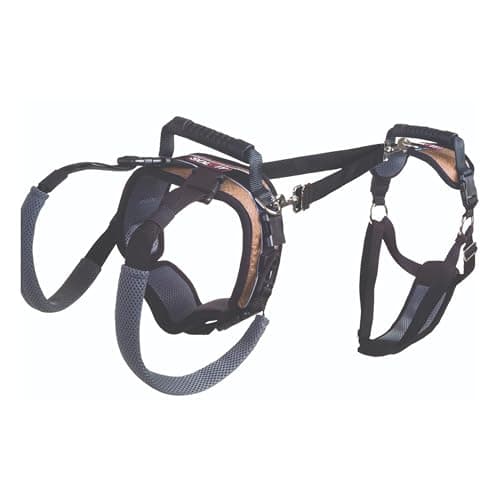
Our full-body harness roundup compares that category in depth. Both full-body picks on this page, the PetSafe CareLift and the Lafoty, name surgery recovery on their listings.
Fit around the incision, the cone and the bathroom trip
We could not locate a veterinary source that says where a sling strap should sit relative to a knee incision, so we are not going to guess. Ask the surgical team at discharge to show you how they want it positioned. If you buy before the surgery date, take the sling with you and ask them to check it on your dog. Ask the same question before you use any design with straps that loop around the back legs, rather than a pad that runs under the belly.
Three practical points apply whichever you buy. First, the cone. Texas A&M's recovery article recommends an e-collar to stop licking and chewing at the incision, so check how the harness goes on: a sling that slides under the belly from the side never goes near the head, while a harness with a chest section may mean working around the cone. Second, the bathroom trip is the whole reason for the sling, so it has to stay clear when your dog goes. For a male dog, look for a cutout or a shield. Third, it will get dirty. Four of the five picks are listed as machine washable or washable; the Lafoty's listing says hand wash only, which is worth knowing before weeks of bathroom trips.
Check the skin under every strap each day. A rub on a dog that is confined and cannot move away from it gets worse quickly; our guide to harness rubbing and slipping covers the fixes.
What we scored these on
Support where the recovery needs it. Rear support for a typical single-knee repair; both ends for the big dog, the arthritic dog and the dog with a second suspect knee.
Control at a slow walk. A long lead or a leash attachment you can use to keep the pace down, on top of the short leash the discharge sheets require.
The bathroom trip. Whether the listing says it stays clear for urinating and defecating, and whether there is a cut for male dogs.
Getting it on a sore dog. How much handling it takes, for a dog in a cone that is not yet using one leg.
Washable, and useful afterward. Whether it survives weeks of daily wear, and whether it still has a job once the restrictions end.
Scores are judgments from the live listings, the manufacturers' own pages and the veterinary instructions cited at the foot of this page, in line with our methodology. We have not used any of these slings or harnesses on a dog. Where a size or feature appears, it is the manufacturer's and the copy says so.
The short version: the GingerLead for most dogs after a knee repair, because its maker designs and markets it for exactly this. The PetSafe CareLift if your dog is big, arthritic elsewhere, or has a second knee your vet is watching. The Coodeo if you want something quick that can stay on for bathroom trips at a lower price. The Lafoty for a large male dog, if your surgeon is happy with straps around the back legs. The LOOBANI as the budget backup.
A padded belly sling on a long lead so you can support a dog's back end and walk upright behind it — the kind thing for both the dog's hips and your back.
The premium option: a structured full-body harness with front and rear handles, so you can support either end or the whole dog. Built for the long haul, priced like it.
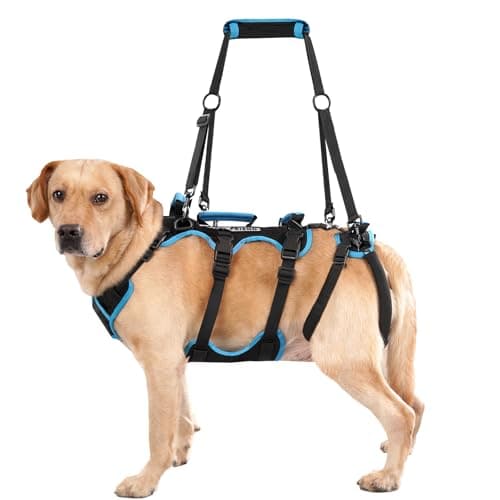
A quick-on rear sling with a handle — grab it for the few hard moments (up the porch step, into the car) rather than a full walk. Cheap, simple, kept by the door.
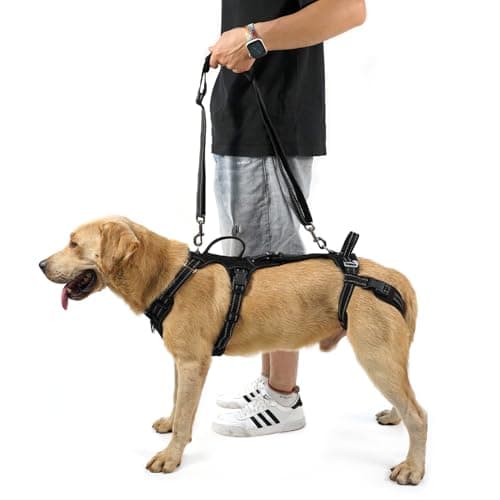
Built around the two moments that break a routine — stairs and a hind end that gives out — with a cut that keeps clear of a male dog's underside, which is a genuine problem with cheap slings.
#ad · Live prices from the Amazon Product API, as of Sep 22, 2026. Where we have no verified live price we show none — we would rather leave a gap than print a number that has rotted.
In detail
The picks, in full
01
Weak back legs, walks and potty trips
GingerLead Rear Support Sling Harness
Padded belly slingLong integrated leadMale/female cut optionsSized to fit
8.6/10
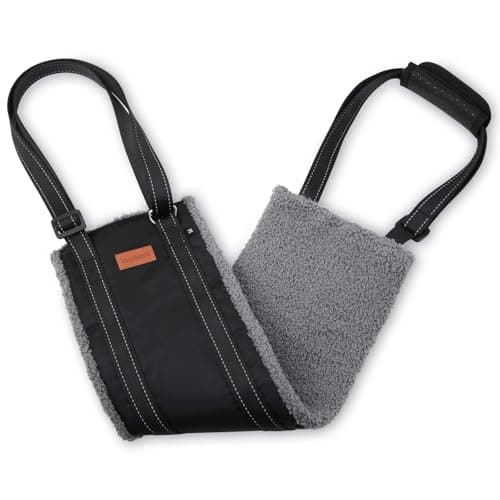
A padded belly sling on a long lead so you can support a dog's back end and walk upright behind it — the kind thing for both the dog's hips and your back.
Support match
9
Padding
8.5
Owner ergonomics
9
Adjustability
8
Value
8.5
Pros
+Long handle lets you stand straight instead of stooping
+Wide padded sling spreads the lift comfortably under the belly
+Cut-out versions keep it clear for the dog to relieve itself
Cons
−Supports the rear only — no help for a dog weak in front
−Sizing matters; measure before ordering
Don't buy this if…
…your dog is unsteady in the front legs too — you'll want a full-body harness with front and rear handles.
Full-body harnessFront + rear lift handlesPadded and structuredAdjustable fit
8.5/10
The premium option: a structured full-body harness with front and rear handles, so you can support either end or the whole dog. Built for the long haul, priced like it.
Support match
9.5
Padding
9
Owner ergonomics
8.5
Adjustability
8.5
Value
7
Pros
+Supports the whole dog — front, rear, or both
+Structured build distributes the lift and stays put
+Handles are placed for an upright, back-friendly lift
Cons
−The most expensive harness here
−More straps to fit and put on than a simple sling
Don't buy this if…
…your dog is only weak in the back legs — a rear sling is simpler, cheaper, and enough.
Rear support slingGrab handleAdjustable strapsBreathable fabric
8.0/10
A quick-on rear sling with a handle — grab it for the few hard moments (up the porch step, into the car) rather than a full walk. Cheap, simple, kept by the door.
Support match
8
Padding
7.5
Owner ergonomics
7.5
Adjustability
8
Value
9
Pros
+Goes on fast for a one-off lift up a step or into the car
+Handle sits right over the hips
+Inexpensive enough to keep one by every door
Cons
−Short handle means more bending than a long-lead sling for full walks
−Best for brief assists, not hours of support
Don't buy this if…
…you need to support your dog for whole walks — a long-handled GingerLead is kinder to your back.
Listed 4 handles, front and rearMale-friendly cutDetachable rear support6 straps, sizes M to XXL
8.3/10
Built around the two moments that break a routine — stairs and a hind end that gives out — with a cut that keeps clear of a male dog's underside, which is a genuine problem with cheap slings.
Support match
9
Padding
9
Owner ergonomics
8.5
Adjustability
8
Value
7
Pros
+Cut deliberately to stay clear underneath a male dog
+Handles at both ends, listed for stairs and car lifts rather than just standing still
+Six adjustable straps spread the load instead of concentrating it on one band
+The rear section detaches, so it doubles as an ordinary harness between lifts
Cons
−Premium price for a harness
−Sizing runs specific — measure rather than guess
−The listing admits it is heavier than a regular harness, which you feel on a long walk
Don't buy this if…
…you only need an occasional hand up off the floor. That's a job for a simple rear sling at a third of the price.
It is the only pick here whose maker sells it as a recovery tool rather than listing surgery as one use among many. GingerLead's website headings call its products "Dog Support & Rehabilitation Harnesses", the homepage lists orthopedic surgery recovery and post-op use, and the Amazon listing says it helps dogs recovering from orthopedic surgeries including TPLO and TTA. The listing describes a padded sling with a soft corduroy lining, an integrated leash, a cutout so it suits male and female dogs, and optional stay-on straps, and says it is machine washable and dryable. GingerLead's homepage also carries a recommendation it attributes to a veterinary professional, but does not name that person, so we have not given it any weight.
On size: the version our link goes to is the medium/large unisex sling. Its listing says it typically fits female dogs over 45 lb and male dogs over 60 lb, with a sling length that adjusts from 38 to 60 inches. GingerLead's own site suggests its Tall Male size for tall, lean dogs and its Small Male size for barrel-chested dogs with a narrow waist, such as Boxers, and lists smaller sizes for smaller dogs. The chest harness is sold separately.
The other four, for this job
PetSafe CareLift
The listing names dogs in rehabilitation and surgery recovery, and describes a full-body harness you can use by a lifting leash or by front and rear handles, with a padded shoulder strap, extra padding and, for males, a removable protection shield. It is machine washable. It is a premium option with more straps to fit, which is what handles at both ends cost you. It is the one to buy for a big dog, a dog stiff in front, or a dog whose other knee is under watch.
Coodeo lift harness
Coodeo lists it as a rehabilitation support vest and names anterior cruciate ligament injury among the conditions it is designed for. The listing says it goes on in about a minute, lets a dog relieve itself without taking it off, and can be worn all day. Its short handle means more bending than a long lead, but the trips after surgery are short, so that matters less here than on a full walk. Before leaving anything on a crated dog, ask the surgical team, and check the skin daily.
Lafoty 2-in-1 harness
Built for a large male dog: the listing says the handles are cut to stay clear of male genitalia, lists four handles and six adjustable straps, and says the rear-leg section detaches so it works as a plain harness later. It also admits the harness is slightly heavier than a regular one, and its listing says hand wash only. The rear section uses straps around the back legs, so this is the pick to clear with your surgeon before the first trip outside.
LOOBANI sling
The budget pick, and a sensible spare for the car. The listing names ACL and CCL surgery, describes a padded underside with a soft lining and a handle with removable padding, and says it folds into a bag and machine washes. It gives you less control than the GingerLead, and its note about staying out of the way when the dog relieves itself is written about a female dog; the listing does not describe a male cut. It also lists helping a dog onto furniture, which is off limits while your dog recovers.
Buy it before the surgery date
The day your dog comes home is not the day to be measuring. Order a week or two ahead, measure a standing dog with a soft tape as our measuring guide describes, and try the sling on once at home so the dog has seen it before it is sore. Ask the hospital whether it supplies one before you buy; there is no point owning two of the same thing.
If the surgery is tomorrow and nothing has arrived, a folded bath towel under the belly is the stopgap many owners reach for. It works for a trip or two. Our sling and harness comparison explains why it is a poor tool for weeks of daily use: it slides back and gives you no handle height.
A recovery checklist
If you searched for "TPLO recovery must-haves", here is the short list, built from the instructions we read rather than from a shopping cart:
The discharge sheet itself, somewhere you will see it, with the recheck dates. Missouri books x-rays at eight weeks; Florida at four to six weeks and three months.
A short, fixed leash. The Madison sheet recommends 4 to 6 feet and rules out retractable leashes.
A sling, from the list above, used on slick and uneven ground as your instructions direct.
The cone or recovery suit the hospital recommends, so the incision is left alone.
A crate or small room with bedding that fits it; see our crate pad picks.
The medication, given as prescribed. VCA's TPLO page says pain management after knee surgery is critical and to give all medications as prescribed until they are gone. Doses are your vet's decision, not ours.
How long you will use it
The sling works hardest in the first two weeks, which is the period both the Missouri and Madison instructions attach it to. VCA's TPLO page gives the wider arc: by ten weeks most dogs do not have an appreciable limp, at four months most can begin walking and playing normally with only the most stressful activities restricted, and within six months most can resume full activity. The Madison sheet still has flights of stairs walked on a leash in weeks 8 to 12. Put the sling away when your surgeon says so, not when the dog looks ready.
For an older dog, it may not go away at all. A sling bought for recovery can become the everyday aid for back legs that were already weakening, which is the job our rear-support harness roundup is about.
Rehabilitation is part of the plan
The ACVS page says physical rehabilitation can speed a dog's recovery and improve final outcomes, whatever the surgical technique, and that it usually includes passive range of motion, balance exercises and controlled leash walks. Some discharge sheets, including Madison's, set out exercises and cold packs for home. Do those only as your own surgeon or rehabilitation vet instructs; they are part of a medical plan, not something to copy from a stranger's handout.
The same Madison sheet makes a point worth hearing early: if your dog is overweight, it says to start a weight-loss plan immediately after surgery to reduce long-term stress on the joints. Ask your vet for the plan; our page on why a lean old dog moves better covers the reasoning.
Where a knee brace fits
None of the discharge instructions we read mention a brace after surgery. The ACVS page discusses custom bracing under non-surgical management and warns that braces can be pricey and have potential complications such as sores, continued pain and patient intolerance. Our knee brace page is about the dog managed without surgery. After a repair, a brace is a question for your surgeon, not an add-on to buy.
When to choose something else
If your dog is small enough to be carried to the grass and set down, your surgeon may be happy with that and you may not need a sling at all; ask. If your dog was already weak in front before the surgery, go straight to a full-body harness rather than buying twice. And if recovery stalls, or the other knee goes, talk to your vet about the longer-term plan before buying more equipment.
How we chose
We haven't lab-tested these
We compiled the published specifications, manufacturer manuals and aggregated owner reviews, then scored each product against a published rubric. The scores are judgments from that research — they are not measurements we took in a lab, because we don't have one and we won't pretend we do. Prices are pulled live from Amazon; where we can't verify one, we say "check price" rather than print a stale number.
Questions
Frequently asked
Does my dog need a sling after TPLO surgery?+
Many discharge plans build one in. The University of Missouri's Veterinary Health Center tells owners to use a sling to help their dog walk over slick surfaces for two weeks, and Madison Veterinary Specialists' home-care sheet uses one on slippery or uneven ground and on stairs in the first two weeks. Your own surgeon's instructions decide whether and for how long.
How long should I use a sling after my dog's knee surgery?+
Until your surgeon says to stop. In the instructions we read, the sling is tied to the first two weeks on slick surfaces, inside a confinement period of eight weeks at Missouri and at least three months of exercise restriction at the University of Florida. The Madison sheet still has stairs walked on a leash in weeks 8 to 12, and an older dog with weak back legs may keep a sling for good.
Is a belly sling or a full-body harness better after ACL surgery?+
A belly sling suits most dogs after a single knee repair: quick to put on, and it supports the back end where the weakness is. A full-body harness is worth it for a big dog, a dog with arthritis elsewhere or weakness in front, or a dog whose other knee is suspect. The ACVS says up to 50 percent of dogs with cruciate disease in one knee develop it in the other.
Can my dog use the stairs after TPLO surgery?+
It depends on your surgeon. The University of Missouri rules out stairs for the first eight weeks, while Madison Veterinary Specialists' sheet allows them with a sling and a leash in the first two weeks. Ask before the surgery date, gate the stairs your dog should not use alone, and add grip to any steps it has to use.
Should my dog wear a knee brace after cruciate surgery?+
None of the discharge instructions we read include one. The ACVS discusses custom braces as part of non-surgical management and notes potential complications, including sores, continued pain and dogs not tolerating them. Do not add a brace after a repair unless your surgeon asks you to.
What are the TPLO recovery must-haves?+
The discharge sheet and its recheck dates, a short fixed leash (one specialty practice recommends 4 to 6 feet and no retractable leashes), a sling for slick ground, the cone the hospital recommends, a crate or small room with bedding that fits it, grip on the route outside, gates on the stairs, and the prescribed medication given exactly as directed.
We don't run a testing lab, and we don't pretend to. Product facts are compiled from manufacturer listings and manuals; health facts are cited to reputable veterinary sources. Where we couldn't verify something, we say so on the page rather than quietly leaving it out. Read our full method.