Lift harnesses for a big dog: what holds, and what hurts your back
A sling that works on a spaniel becomes a two-handed wrestle on a labrador. At this weight the question stops being which harness grips the dog and starts being where the load goes - into a wide padded panel, or into your spine.
We earn a commission when you buy through our Amazon links, at no extra cost to you. It never changes our rankings, and we say so when the cheaper product is the better buy. How this works.
The short answer for a heavy dog: start with the GingerLead rear-support sling, because its long integrated lead is the only design here that lets you stand upright while you take the weight - and on a big dog your posture is the thing that fails first. If the problem is specifically the stairs, the Lafoty 2-in-1 is the four-handle harness we would buy. If your dog is unsteady at the front as well as the back, go to the PetSafe CareLift. The two cheaper picks below are for short assists and for keeping a spare in the car, and we say plainly which jobs they are not up to.
Why a separate page. Lift harnesses are designed, photographed and reviewed around medium dogs, and the arithmetic changes badly as the weight goes up. Lifting a third of a 90 lb dog is a 30 lb load at arm's length, several times a day, usually by an owner who is not young either - this site's buyer is often a person in their sixties or seventies helping a dog they can no longer pick up. At that point three things matter that nobody mentions on a product page: how wide the panel under the dog is, how far you have to bend to use the handle, and whether the harness stays on between lifts so you are not refitting it on the floor every time.
What changes when the dog is big
1. The load is yours, not the harness's
A harness does not reduce the weight; it decides where the weight goes. On a heavy dog the failure is almost always human - a strained lower back from a short handle that forces you to stoop, or a shoulder from a one-handed grab. A long handle you can hold at hip height while standing straight is worth more than any amount of padding.
2. Panel width beats strap strength
Nothing here breaks. What hurts the dog is a narrow strap concentrating 30 lbs of lift into two inches of belly, over and over. A wide padded sling spreads the same load across the abdomen, which is why we rank the wide-panel slings above the strap-style ones for a dog this size even though the straps are perfectly strong.
3. Fitting it is the part that gets skipped
A harness that takes two minutes and a kneeling owner to fit is a harness that gets left in the cupboard by week three. On a big dog look for something you can leave on the dog for a few hours - a wearable harness with handles - rather than something you thread under a dog that cannot lift itself to help you.
4. Stairs are the real test
Flat-ground support is the easy case. Going down stairs with a heavy dog, you are taking its weight and controlling its descent while walking backwards or sideways. That needs handles at both ends, or a handle long enough to work from above. If the stairs are the daily problem, read helping a dog up and down the stairs before you buy anything.
5. The male-dog problem
It is rarely mentioned and it rules out products. A belly sling that sits too far back on a male dog is both uncomfortable and unusable for a potty trip, which is the single most common reason the sling comes out in the first place. Two of the picks below are explicitly cut for this.
Which aid for which problem
The problem
For a big dog, buy
Back legs give out on walks and potty trips
GingerLead - long lead, wide padded sling, stand upright
The stairs, every day
Lafoty 2-in-1 - four handles, front and rear
Wobbly at both ends
PetSafe CareLift - full body, front and rear handles
Occasional hand up off a slippery floor
Coodeo - quick to fit, cheap, not for whole walks
A backup to keep in the car
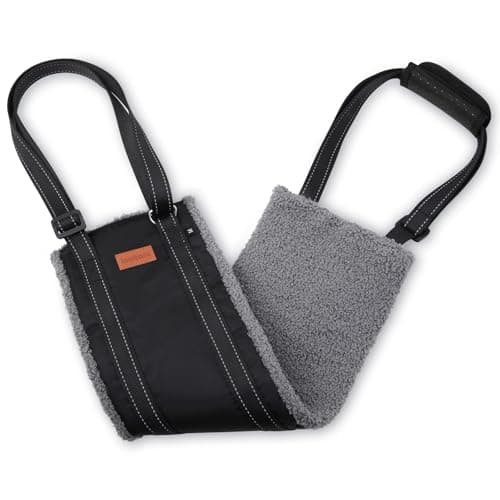
LOOBANI - folds into a pocket; a backup, not a daily sling
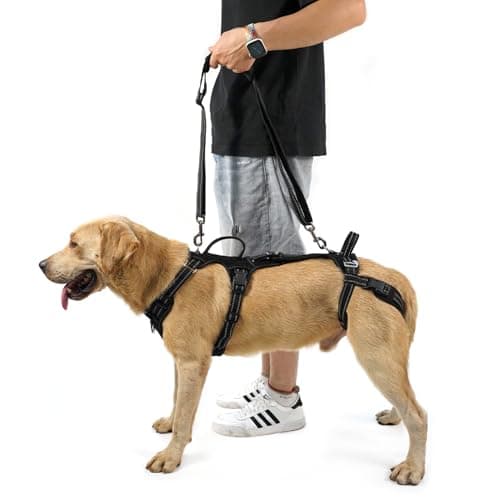
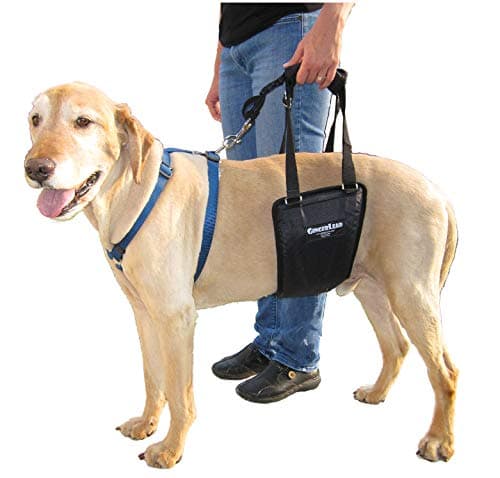
GingerLead Rear Support Sling - the default for a heavy dog with a weak back end. The long lead is the feature; it protects your back, which is the part most likely to end this arrangement.
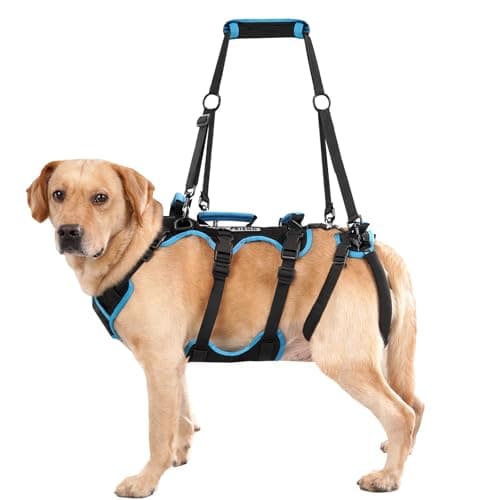
Lafoty 2-in-1 Full-Body Lift Harness - for stairs and a hind end that drops without warning. Four handles, a detachable rear section, and a cut that keeps clear of a male dog's underside.
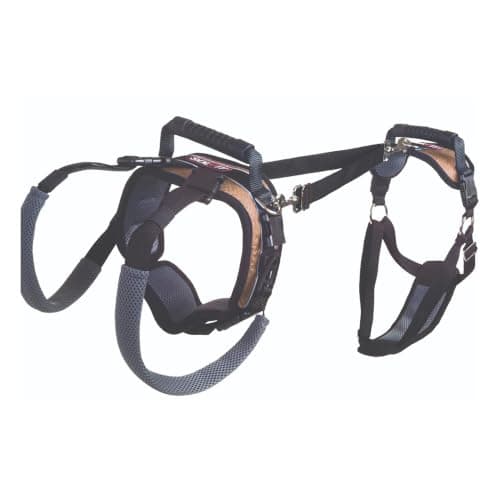
PetSafe CareLift - the structured full-body option, for a dog that needs front and rear support. Premium price, built for long-term daily use.
Coodeo Dog Lift Harness - for quick assists. Cheap and fast to fit; not the one for supporting a big dog for a whole walk.
LOOBANI Portable Rear-Leg Sling - the pocketable backup. Keep it in the car or by the back door; it is not comfortable enough to be the daily harness on a heavy dog.
What we have and have not done
We have not load-tested a harness and we have not weighed the force through a panel. There is no lab here, and our methodology page says so in those words. What follows is the manufacturers' published claims kept at claim level, read against the published veterinary guidance on mobility aids and on managing pain in an arthritic dog, and re-ranked for weight. Prices render live from the Amazon listing on the date shown.
A padded belly sling on a long lead so you can support a dog's back end and walk upright behind it — the kind thing for both the dog's hips and your back.
Built around the two moments that break a routine — stairs and a hind end that gives out — with a cut that keeps clear of a male dog's underside, which is a genuine problem with cheap slings.
The premium option: a structured full-body harness with front and rear handles, so you can support either end or the whole dog. Built for the long haul, priced like it.
A quick-on rear sling with a handle — grab it for the few hard moments (up the porch step, into the car) rather than a full walk. Cheap, simple, kept by the door.
#ad · Live prices from the Amazon Product API, as of October 19, 2026. Where we have no verified live price we show none — we would rather leave a gap than print a number that has rotted.
In detail
The picks, in full
01
Weak back legs, walks and potty trips
GingerLead Rear Support Sling Harness
Padded belly slingLong integrated leadMale/female cut optionsSized to fit
8.6/10
A padded belly sling on a long lead so you can support a dog's back end and walk upright behind it — the kind thing for both the dog's hips and your back.
Support match
9
Padding
8.5
Owner ergonomics
9
Adjustability
8
Value
8.5
Pros
+Long handle lets you stand straight instead of stooping
+Wide padded sling spreads the lift comfortably under the belly
+Cut-out versions keep it clear for the dog to relieve itself
Cons
−Supports the rear only — no help for a dog weak in front
−Sizing matters; measure before ordering
Don't buy this if…
…your dog is unsteady in the front legs too — you'll want a full-body harness with front and rear handles.
Listed 4 handles, front and rearMale-friendly cutDetachable rear support6 straps, sizes M to XXL
8.3/10
Built around the two moments that break a routine — stairs and a hind end that gives out — with a cut that keeps clear of a male dog's underside, which is a genuine problem with cheap slings.
Support match
9
Padding
9
Owner ergonomics
8.5
Adjustability
8
Value
7
Pros
+Cut deliberately to stay clear underneath a male dog
+Handles at both ends, listed for stairs and car lifts rather than just standing still
+Six adjustable straps spread the load instead of concentrating it on one band
+The rear section detaches, so it doubles as an ordinary harness between lifts
Cons
−Premium price for a harness
−Sizing runs specific — measure rather than guess
−The listing admits it is heavier than a regular harness, which you feel on a long walk
Don't buy this if…
…you only need an occasional hand up off the floor. That's a job for a simple rear sling at a third of the price.
Full-body harnessFront + rear lift handlesPadded and structuredAdjustable fit
8.5/10
The premium option: a structured full-body harness with front and rear handles, so you can support either end or the whole dog. Built for the long haul, priced like it.
Support match
9.5
Padding
9
Owner ergonomics
8.5
Adjustability
8.5
Value
7
Pros
+Supports the whole dog — front, rear, or both
+Structured build distributes the lift and stays put
+Handles are placed for an upright, back-friendly lift
Cons
−The most expensive harness here
−More straps to fit and put on than a simple sling
Don't buy this if…
…your dog is only weak in the back legs — a rear sling is simpler, cheaper, and enough.
Rear support slingGrab handleAdjustable strapsBreathable fabric
8.0/10
A quick-on rear sling with a handle — grab it for the few hard moments (up the porch step, into the car) rather than a full walk. Cheap, simple, kept by the door.
Support match
8
Padding
7.5
Owner ergonomics
7.5
Adjustability
8
Value
9
Pros
+Goes on fast for a one-off lift up a step or into the car
+Handle sits right over the hips
+Inexpensive enough to keep one by every door
Cons
−Short handle means more bending than a long-lead sling for full walks
−Best for brief assists, not hours of support
Don't buy this if…
…you need to support your dog for whole walks — a long-handled GingerLead is kinder to your back.
We took the harnesses and slings this site already stands behind and asked one question of each: what happens to it, and to the person using it, when the dog weighs 80 lbs? That reordering is the entire contribution of this page. Long-handled and wide-panelled designs move up, because the human is the weak link at this weight. Strap-style and pocket slings move down to the roles they are genuinely good at. We did not invent a large-dog product line and nothing was added to the registry to fill a slot.
Measure before you order, not after
Returns in this category are overwhelmingly sizing. Measure your dog's girth at the widest part of the chest and again at the waist just in front of the hips, both with the dog standing, and compare those to the chart on the specific listing you are buying - sizes are not standardized between brands and "large" means nothing on its own. Our measuring guide walks through it, and getting the fit right covers what to check once it arrives.
How to lift a heavy dog without hurting either of you
The technique matters more than the product. Get the dog standing square if you can, put the panel under the belly in front of the back legs rather than under the hips, take up the slack before you lift, and lift by straightening your legs with the handle held close to your body. Never lift and twist. If you are lifting on stairs, do it one step at a time with a pause on each, and have the dog's head uphill. Our full walkthrough is at how to lift a senior dog.
Sling or full-body harness?
Match the aid to where the weakness actually is, which is the single most useful rule in this hub. Back legs only, front end working: a rear sling, and you will be glad of the simplicity. Unsteady everywhere, or a dog that stumbles forwards as well as collapsing behind: a full-body harness with handles at both ends. A dog that has lost the back end entirely: this is wheelchair territory, not harness territory. The decision in detail is at sling vs harness.
Fix the floor at the same time
Half the lifts in a big-dog household are not strength problems, they are grip problems - a heavy dog on a polished floor cannot get the purchase to push itself up, so it waits for you. Put a rug or a runner where your dog gets up, and a mat at the foot of the stairs, and you will be lifting measurably less. The published veterinary advice says the same thing: VCA recommends non-slip rugs and runners where a mobility-compromised dog spends its time. Start at traction gear for a big dog.
When to stop using a harness
A harness is for a dog whose legs still do some of the work. When you are carrying rather than supporting - when the dog's back feet are not contributing at all, or when you are doing it eight times a day and dreading each one - the harness has become a way of postponing a better answer. That answer is usually wheels, and it is often a much better life for the dog than being carried. Read when a dog needs a wheelchair and what a dog wheelchair actually costs.
How we chose
We haven't lab-tested these
We compiled the published specifications, manufacturer manuals and aggregated owner reviews, then scored each product against a published rubric. The scores are judgments from that research — they are not measurements we took in a lab, because we don't have one and we won't pretend we do. Prices are pulled live from Amazon; where we can't verify one, we say "check price" rather than print a stale number.
Questions
Frequently asked
What is the best lift harness for a large dog?+
For most heavy dogs with weak back legs we would start with the GingerLead rear-support sling, because its long integrated lead lets you support the dog while standing upright - on a big dog your own back is the thing most likely to fail. If the stairs are the daily problem, a four-handle full-body harness like the Lafoty is the better buy; if the dog is unsteady at the front too, the PetSafe CareLift.
How much of my dog's weight am I actually lifting with a sling?+
A rear sling takes the back end, which is roughly a third of the dog - so about 30 lbs on a 90 lb dog, held away from your body, repeatedly. That is why handle length and panel width matter more than strap strength at this size, and why we rank designs that let you stand upright above ones that make you stoop.
Can one person lift a 90 lb dog with a harness?+
Usually yes with a rear sling, because the dog's front legs are doing their share. Lifting a 90 lb dog bodily on your own is a different thing and we would not plan around it - use a full-body harness with handles at both ends, get the dog standing first, and on stairs take one step at a time. If a single lift is already at your limit, read lifting a dog when you cannot lift.
Can my large dog wear a lift harness all day?+
A wearable full-body harness is designed to be left on for stretches, which is most of its value - no refitting on the floor every time. Check under the straps for rubbing at least twice a day, take it off overnight, and keep the fit snug but not tight. A strap-style sling is not an all-day product.
Is a rear sling or a full-body harness better for a big dog?+
Match it to the weakness, not to the price. Back legs only: a rear sling is simpler, cheaper and enough. Unsteady at both ends, or stumbling forwards as well: a full-body harness with front and rear handles. The failure mode of buying the wrong one is that you stop using it, so be honest about what your dog is actually doing.
We don't run a testing lab, and we don't pretend to. Product facts are compiled from manufacturer listings and manuals; health facts are cited to reputable veterinary sources. Where we couldn't verify something, we say so on the page rather than quietly leaving it out. Read our full method.