Nail tools for an old dog's nails, and for tired hands
Two things make a senior dog's nails harder than they used to be: the quick has crept forward with every trim you missed, and the dog has less patience for having a foot held. The right tool is the one that answers both.
We earn a commission when you buy through our Amazon links, at no extra cost to you. It never changes our rankings, and we say so when the cheaper product is the better buy. How this works.
The click on the hardwood is usually how it starts. You notice it in the hallway at night, realize you cannot remember the last trim, and go looking for the clippers — and then the job turns out to be harder than it used to be, for two reasons that have nothing to do with you being out of practice.
The first is that the nails did not just get long, the inside of them changed. The second is that your dog is older, stiffer, and less willing to stand on three legs while you work. Every tool below is judged against those two facts rather than against a groomer's bench.
How to tell they are actually too long
VCA gives two checks that need no equipment. Get down and look at whether the nails touch the ground when your dog is standing — if they do, they are too long. And if you can hear the nails clicking on a hard floor as your dog walks, that is the same message arriving by ear. On this site that matters twice over, because a nail long enough to touch the floor is also a nail that is changing how the foot meets it. Our guide to nail length and slipping covers why that is the cheapest traction fix in the house; this page is about the tool that does it.
The frequency is the part that quietly goes wrong in a senior household. AKC puts most dogs at a trim every three to four weeks. VCA says roughly monthly — and then adds the sentence that matters here: a dog walked often on pavement can go longer, because a hard rough surface files the nail, while an inactive dog may need trimming more often, as frequently as every three weeks. An old dog doing two slow laps of the yard is the inactive dog in that sentence. The schedule that worked for a decade is now too slow, at exactly the point in life when nobody is thinking about nails.
The problem with an overdue nail: the quick moved
Inside every nail is the quick. AKC describes it plainly: it supplies blood to the nail and runs through the core of it, and nerves in the quick cause bleeding and discomfort when it is cut. The part owners do not expect is that it is not fixed in place — regular trimming causes the quick to recede from the end, and the reverse is equally true. Leave the nails long for six months and the quick has followed the nail forward.
That single fact decides the tool. You cannot cut an overgrown nail back to a correct length in one session, because the correct length now has a blood vessel and a nerve inside it. You have to take a little off, wait a week or two while the quick retreats, and take a little more. That is a job for something that removes a sliver at a time and lets you stop the instant the nail changes color — which is a description of a grinder, not of a squeeze.
Grinder or clippers — the honest comparison
AKC is even-handed about this: both are safe when used correctly, some dogs tolerate grinders better and others prefer clippers. VCA is more specific about the trade, and its list of grinder downsides is the one you will not find in a product listing.
Rotary grinder
Clippers
How much comes off
A sliver per pass — you choose when to stop
A chunk per squeeze — you commit before you see the result
Risk to the quick
Lower, per VCA
Higher, especially on a nail whose quick has moved
Finish
Smooth — VCA notes it eliminates sharp edges
Leaves an edge unless you file it afterwards
Time per foot
Minutes. Slow is the whole method
Seconds
What your dog has to accept
Noise, vibration and a long hold
A brief hold and a click
Its own hazards
VCA warns hair can catch in the rotating bit, and a slipping file can burn skin
Cutting the quick, and crushing rather than cutting if the blade is dull
What it asks of your hands
A steady hold, no strength
A firm squeeze
Read the bottom two rows together and you get the answer for most of the people this site is written for. If your grip is the weak link — arthritic thumbs, a bad wrist, one usable hand because the other is steadying a wobbly dog — a grinder asks for steadiness rather than strength, and steadiness is the easier thing to supply. If your dog is the weak link and will not tolerate a motor near a foot, none of that matters and you want the best clipper you can hold.
What we scored these on
Safety margin. How much room the tool leaves you to be wrong. This is the criterion that separates a grinder from a plier on an overdue nail, and it is why the styptic powder is on this page at all.
Ease on your hands. Squeeze force, grip diameter, weight, and whether you can work one-handed while the other hand supports the dog. Almost no review scores this, and for an older owner it is the whole decision.
Dog tolerance. Noise, vibration and how long the foot has to stay in your hand. A tool your dog refuses has a score of zero regardless of its specification.
Senior-dog fit. Whether it suits a thick, overgrown, often dark nail with a quick that has crept forward — as opposed to a young dog's tidy nail being kept in trim.
Value. Including consumables. A grinder's sanding bands are a running cost and we counted them.
Scores are judgments from published manufacturer specifications, veterinary sources and listings, in line with our methodology. We have not measured a decibel level or timed a battery; where a figure appears below it is the manufacturer's and the copy says so. Every ASIN here was resolved live and confirmed in stock before publication, and prices come from our live feed rather than being typed into the article.
The tool that matches the actual problem with an overdue senior nail. A grinder takes off a sliver at a time, so you can creep toward a quick that has grown forward instead of guessing where it is and squeezing.
Two built-in lights aimed at the nail, for a fraction of the Dremel's price. If your dog has black nails and your eyes are not what they were, that is the feature that decides this category.
The clipper to buy if a grinder is never going to happen in your house. A light and a guard on a scissor-style cutter, which is the sensible shape for a thick senior nail.
The plain plier-style clipper groomers have used for decades, for less than the price of a bag of treats. No light, no guard, nothing clever — just a blade that is properly sharp.
Buy it before you need it, because the moment you need it you will not be shopping. Both AKC and VCA name styptic powder as the answer when you quick a nail.
#ad · Live prices from the Amazon Product API, as of October 19, 2026. Where we have no verified live price we show none — we would rather leave a gap than print a number that has rotted.
In detail
The picks, in full
01
An overgrown nail with a quick you cannot see
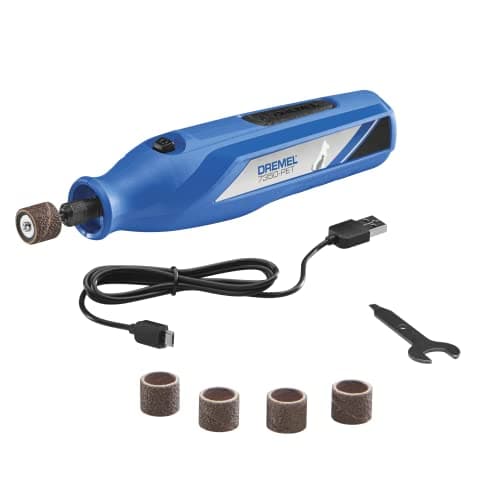
Dremel 7350-PET Dog Nail Grinder
4V lithium-ion, USB rechargeable; listed 0.55 lbListed as 7% quieter with 30% more runtime than the 7300-PTKit lists 4 sanding bands plus a band-and-drum mandrelCordless, no guard attachment on this model
8.1/10
The tool that matches the actual problem with an overdue senior nail. A grinder takes off a sliver at a time, so you can creep toward a quick that has grown forward instead of guessing where it is and squeezing.
Safety margin
9
Ease on your hands
8.5
Dog tolerance
6.5
Senior-dog fit
9
Value
7.5
Pros
+Removes a sliver per pass, which is the only safe way to shorten a badly overdue nail
+Leaves a smooth end instead of the sharp edge a clipper leaves, per VCA
+The brand's comparative noise and runtime claims are against its own prior model, not a vague 'quiet'
+Light enough to hold steady for eight nails with a tired hand
Cons
−No LED — on a black nail you are working by feel, and the cheaper Casfuy has two lights
−Sanding bands are a consumable, so the real cost is the tool plus refills forever
−Grinding a foot takes several times longer than clipping it, and a short-tempered old dog may not sit for it
−It is still a motor against a foot: some dogs simply refuse a grinder and no amount of technique changes that
Don't buy this if…
…your dog has already told you what it thinks of a vibrating tool near its feet — buy the clippers and stop fighting about it.
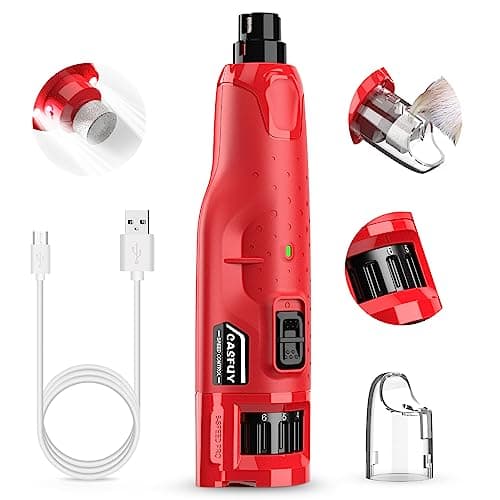
2 built-in LED lights, listed as helping you find the quick6 speeds, listed at 7,000-12,000 RPM3 grinding ports sized for small, medium and large nailsListed at 45 dB; listed up to 4 hours per charge
8.4/10
Two built-in lights aimed at the nail, for a fraction of the Dremel's price. If your dog has black nails and your eyes are not what they were, that is the feature that decides this category.
Safety margin
9
Ease on your hands
8
Dog tolerance
7
Senior-dog fit
8.5
Value
9.5
Pros
+The lights are genuinely useful on a black nail, which is where owners quick a dog
+Six speeds let you start slow and quiet while the dog decides whether to tolerate it
+The removable sheath catches nail dust instead of putting it on your carpet
+Cheap enough to find out whether your dog accepts a grinder at all before spending more
Cons
−The port sized for a big dog's nail is the open one, so the guard disappears exactly where you want it
−45 dB is the manufacturer's published figure, not a measurement we took
−More plastic than the Dremel and a shorter expected working life
−Three ports and a sheath means small parts to lose, which matters if dexterity is the problem
Don't buy this if…
…you want one tool that will still be working in ten years — the Dremel is the buy-once option and this is not.
Price as of October 19, 2026. Prices change — Amazon's is the one that counts.
#ad · we may earn a commission from this link to Casfuy 6-Speed Dog Nail Grinder with 2 LED Lights
03
A dog that will not tolerate a motor
Boshel LED Large Dog Nail Clippers
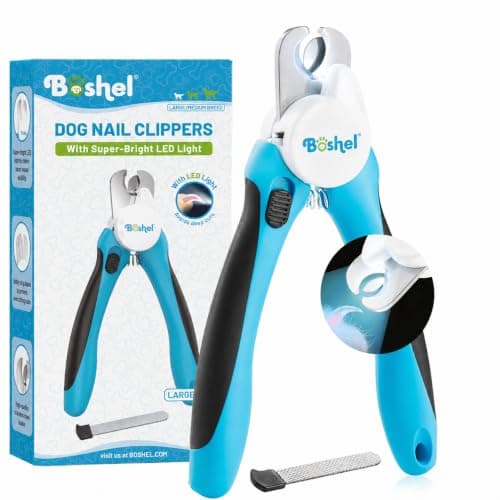
Built-in LED light plus an adjustable safety guardStainless steel blades; listed 0.33 lbNail file stored in the handleListed ergonomic non-slip grip
7.9/10
The clipper to buy if a grinder is never going to happen in your house. A light and a guard on a scissor-style cutter, which is the sensible shape for a thick senior nail.
Safety margin
7
Ease on your hands
7
Dog tolerance
9
Senior-dog fit
7.5
Value
9
Pros
+Silent — no motor, no vibration, no negotiation with a dog that hates both
+The light does the same job as the grinder's LEDs for a dog with black nails
+One squeeze per nail, so a dog with a short handling tolerance is done in a minute
+The stored file lets you take the sharp edge off, which is the grinder's main advantage
Cons
−The listing's 'quick sensor' is a light and a guard, not a detector — nothing here senses anything
−A guard set for an average nail is set wrong for an overgrown one, which is the nail you actually have
−A clipper removes a chunk per squeeze, so it is the wrong instrument for creeping up on a moved quick
−It still needs a firm squeeze, which is the thing arthritic hands cannot reliably produce
Don't buy this if…
…your dog's nails are badly overdue and dark — the amount you have to take off in stages suits a grinder far better.
Millers Forge Stainless Steel Dog Nail Clipper 743C
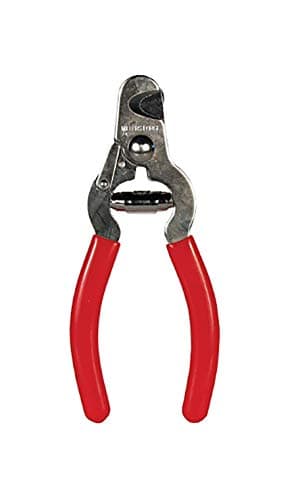
Plier (scissors) style, stainless steelListed 8 in long, 0.14 lbNo light, no guard, no fileThe listing publishes essentially nothing else
7.2/10
The plain plier-style clipper groomers have used for decades, for less than the price of a bag of treats. No light, no guard, nothing clever — just a blade that is properly sharp.
Safety margin
5.5
Ease on your hands
5.5
Dog tolerance
9
Senior-dog fit
6.5
Value
9.5
Pros
+Sharpness is the whole product, and a sharp blade crushes the toe less than a blunt one
+Nothing to charge, nothing to lose, nothing to break
+Cheap enough to keep a second pair wherever your dog actually settles
+Scissor-style is the shape VCA describes for cutting rather than the guillotine hole
Cons
−No guard and no light: every cut is your judgment, on a nail whose quick has moved
−The squeeze needs real hand strength, which is the wrong ask for an arthritic grip
−The listing gives you almost no published specification to check against
−Leaves a sharp edge unless you file it, and there is no file in the box
Don't buy this if…
…your hands are the limiting factor, or your dog's nails are black — you are buying away the two features that prevent an accident.
Price as of October 19, 2026. Prices change — Amazon's is the one that counts.
#ad · we may earn a commission from this link to Millers Forge Stainless Steel Dog Nail Clipper 743C
05
The thing that should already be in the drawer
Miracle Care Kwik Stop Styptic Powder
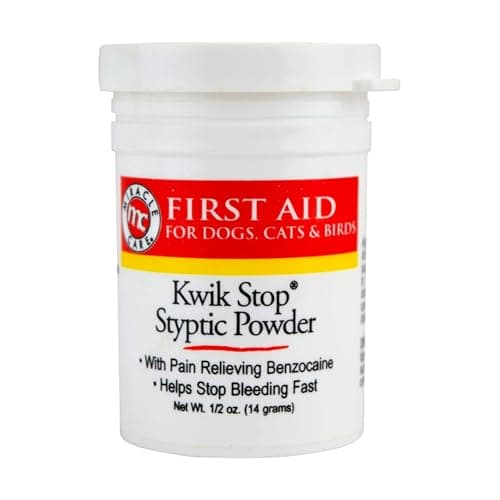
0.5 oz tub; listed as containing benzocaine for pain reliefListed method: apply on a moistened applicator with moderate pressure for 5-10 secondsListing warns against use on deep wounds or body cavitiesListed as made in the USA; brand in the category for over 40 years
8.6/10
Buy it before you need it, because the moment you need it you will not be shopping. Both AKC and VCA name styptic powder as the answer when you quick a nail.
Safety margin
9.5
Ease on your hands
9
Dog tolerance
7
Senior-dog fit
9
Value
8.5
Pros
+Stops the bleed in seconds, which stops the session becoming the thing your dog remembers
+The benzocaine addresses the part owners forget — a quicked nail hurts, it does not just bleed
+A tub lasts years; the cost per use is effectively nothing
+Small enough to live in the grooming box rather than a cupboard you have to go find
Cons
−It is a nine-dollar admission that you are going to quick a nail eventually
−Benzocaine stings on contact for some dogs, so the first second is worse before it is better
−The 0.5 oz tub cakes if it gets damp, and a damp tub is a useless tub
−VCA notes flour or cornstarch will do the same job in an emergency, so this is convenience rather than necessity
Don't buy this if…
…you have flour in the kitchen and you are trying to spend nothing — VCA says it works, and we are not going to pretend otherwise to sell a tub.
VCA splits the job by nail color, and it is the most practical distinction in this whole subject. On a light nail you can see the quick, so you can work to it. On a dark nail you cannot, and VCA's instruction is blunt: trim just the very tip off the nail.
"Just the tip" is an easy instruction with a clipper and an easier one with a grinder, because a grinder lets you take the tip off in three passes instead of one and watch the cut face as you go — the center of the nail changes appearance as you approach the quick, and you get warning you would never get from a squeeze. This is also why the two picks above with LED lights earn their place: on a black nail, a light aimed at the cut face is doing real work, not decorating a listing.
The schedule does the job, not the session
If the nails are badly overdue, resist the urge to fix it on a Sunday afternoon. AKC's point about the quick receding with regular trimming is the mechanism you are relying on: take a small amount off, leave it a week or two, take a small amount off again. Over a couple of months the quick withdraws and the nail can come back to a sane length. Try to do it in one sitting and you will hit the quick, hurt your dog, and buy yourself a dog that fights the clippers for the rest of its life.
The senior version of that advice is to split the job by foot as well as by week. Two feet today, two tomorrow. An old dog's tolerance for being handled is shorter than it used to be, and pushing past it costs you far more than it saves.
Set the floor up before you set the dog up
This is the part specific to an arthritic dog and it gets skipped constantly. Asking a stiff dog to balance on three legs on tile while you hold the fourth is asking a lot, and a dog that feels unsafe will pull the foot back — which is how nails get cut at the wrong angle. Work on a rug or a non-slip mat, let the dog lie down if that is easier, and keep the leg low and close to the body rather than extended out, because extending a sore hip or elbow hurts. Our floor setup guide covers where to put runners so that the grooming spot is also a safe spot.
The cheap version, honestly
You do not have to buy styptic powder. VCA says plainly that if you do not have any, flour or cornstarch will stop the bleeding. That is a real substitute from a real veterinary source, and we would rather tell you than sell you a tub you already have the answer to in the kitchen.
What the bought version buys is benzocaine for the pain and a container that lives in the grooming box, so the answer is in your hand in three seconds rather than in the pantry behind the baking things. For a nine-dollar tub that lasts years, most people will decide that is worth it — but the decision should be made knowing the free option exists.
Two grinder hazards worth knowing before you start
VCA names both, and they are the sort of thing you find out the hard way otherwise. Hair can catch in the rotating bit — a real risk on a feathered foot, so hold the fur back or tie it off before the tool goes near it. And a file that slips off the nail can burn skin, which is an argument for short bursts and a firm hold rather than long continuous passes.
Neither is a reason to avoid a grinder. They are reasons to work in two-second passes with the foot properly controlled, which is also how you avoid overshooting the quick.
When to stop doing this yourself
There is a version of this that ends with a bought tool in a drawer and a dog that now hates having its feet touched, and it is worth naming the off-ramp before you get there. VCA is clear that groomers and vet clinics both do nail trims, and that a vet clinic can offer sedation for a dog that is genuinely distressed by the procedure. For a very anxious or very painful old dog, a professional every few weeks is not a failure — it is the same money you would otherwise spend on tools, spent on an outcome.
If the problem is handling rather than the nails themselves, AKC's advice is desensitization: frequent, gentle, cheerful handling of the paws, and a staged introduction to the tools over about a week before any of them actually cut anything. The same principle runs through our guide to bathing and grooming a dog that can barely stand — the dog's confidence in what you are about to do is a bigger variable than the equipment.
One last reason to keep on top of this
If you are considering toe grips — the little rubber rings that sit on the nail and grab the floor — nail condition decides whether they will work at all. They need a nail with enough healthy length to hold onto and not so much that it is levering the toe. Our toe grips guide covers the fit, and it is another argument for a regular trimming rhythm rather than an annual rescue mission.
How we chose
We haven't lab-tested these
We compiled the published specifications, manufacturer manuals and aggregated owner reviews, then scored each product against a published rubric. The scores are judgments from that research — they are not measurements we took in a lab, because we don't have one and we won't pretend we do. Prices are pulled live from Amazon; where we can't verify one, we say "check price" rather than print a stale number.
Questions
Frequently asked
Is a nail grinder or clippers better for a senior dog?+
AKC says both are safe when used correctly, and that some dogs tolerate grinders better while others prefer clippers. For a senior dog specifically, a grinder usually wins on the two things that matter: it removes a sliver at a time, so you can creep up on a quick that has grown forward, and VCA notes it carries less risk of damaging the quick and leaves a smooth end. The exception is a dog that will not accept the noise or vibration — then the best clipper you can comfortably squeeze is the right tool, because a refused tool helps nobody.
How do I know if my dog's nails are too long?+
VCA gives two checks. Look at your dog standing: if the nails touch the ground, they are too long. And listen — nails clicking on a hard floor as your dog walks means the same thing. Both are worth doing monthly on an older dog, because the nails get longer for a reason that is easy to miss: they wear down on pavement, and a senior dog walking less is no longer wearing them down.
How often should an old dog's nails be trimmed?+
AKC puts most dogs at every three to four weeks. VCA says approximately monthly, but adds that an inactive dog or one that does not spend time on hard surfaces may need trimming more frequently — as often as every three weeks. A senior dog doing short slow walks falls into that group, so if anything the interval should get shorter as your dog slows down, not longer.
What do I do if I cut the quick and the nail bleeds?+
Stay calm and apply styptic powder or a clotting product straight away — that is AKC's instruction, and VCA adds that flour or cornstarch will do the job if you have no powder in the house. Kwik Stop's own directions are to put it on a moistened applicator and press with moderate pressure for five to ten seconds. If the bleeding does not stop, contact your veterinarian.
My dog won't let me near his feet. What now?+
Work on the setup before the tool: a rug rather than a slick floor so a stiff dog is not balancing on three legs, the leg held low and close to the body rather than extended, and two feet per session instead of four. AKC's answer to the underlying problem is desensitization — frequent gentle handling of the paws and a staged introduction to the tools over about a week. If it is still a fight, VCA notes groomers and vet clinics do nail trims and that clinics can offer sedation for a genuinely distressed dog. Paying someone every few weeks is a legitimate answer, not a defeat.
We don't run a testing lab, and we don't pretend to. Product facts are compiled from manufacturer listings and manuals; health facts are cited to reputable veterinary sources. Where we couldn't verify something, we say so on the page rather than quietly leaving it out. Read our full method.