The best dog wheelchairs for weak or paralyzed back legs
When a dog can no longer carry its own back end, a rear-support cart can give it its walks back. It's a decision to make with your vet — here's what to buy once you have.
We earn a commission when you buy through our Amazon links, at no extra cost to you. It never changes our rankings, and we say so when the cheaper product is the better buy. How this works.
A wheelchair is the biggest step on this site, and the most hopeful — many dogs adapt to a well-fitted rear cart quickly and get their walks, and their spark, back. But it's also the one decision you should not make alone.
Once you and your vet agree a cart is right, the thing that matters most is fit. A cart that's adjustable across height, length, and width can be dialed in and adapts as your dog changes; a fixed-size cart has to be measured perfectly the first time. We ranked on fit and adjustability, build quality, the quality of rear support, the availability of help and parts, and value.
The short version: the Walkin' Wheels is our first choice for its three-way adjustment and real company support; the Best Friend Mobility is a lighter aluminum cart at a middle price; the VEVOR gets a confirmed case rolling on the tightest budget, with more fiddling to fit.
The question most people ask before this one is what a cart actually costs, and the answer is three distinct tiers that buy genuinely different things. We have set those out with today's prices - plus the extras that never appear on a product page - at what does a dog wheelchair cost?
One shape of dog needs its own page here, because a fixed frame gets it wrong: a long, low, short-legged dog, which in practice usually means a dachshund with disc disease. The cart choice, the sizing measurements and the sling-first order of purchase are at mobility aids for a dachshund.
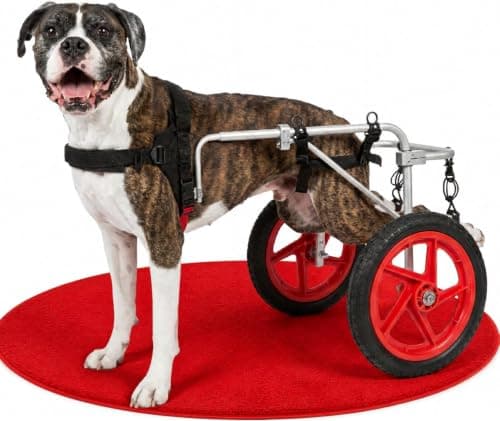
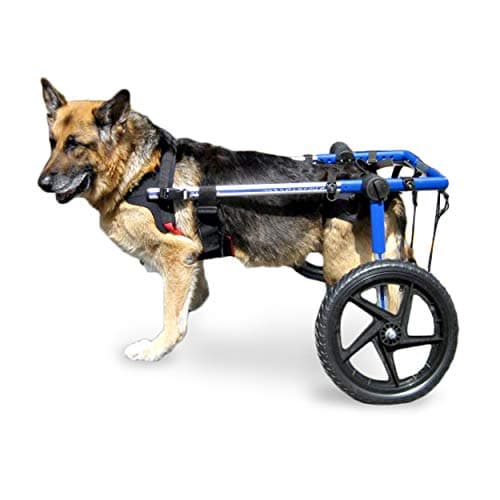
The wheelchair we'd trust first. Fully adjustable across height, length and width, so one cart fits a range of dogs and adapts as your dog changes — with the best support behind it.
A lighter aluminum rear cart at a middle price. Simpler to assemble than most, and a common recommendation for a dog that needs wheels without the top-tier cost.
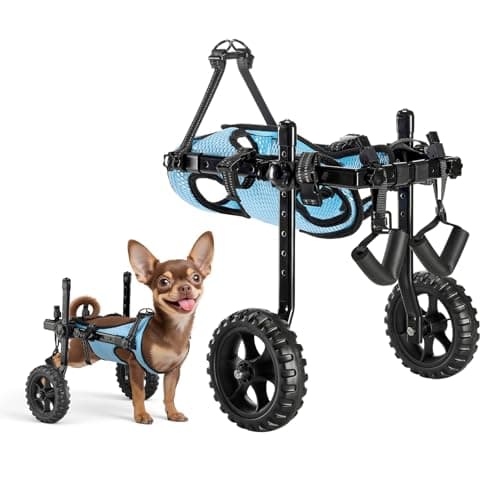
The budget cart. If your vet has confirmed a wheelchair is right and money is tight, this gets a dog rolling for a fraction of the brand-name price — with more trial-and-error on fit.
#ad · Live prices from the Amazon Product API, as of October 19, 2026. Where we have no verified live price we show none — we would rather leave a gap than print a number that has rotted.
In detail
The picks, in full
01
A first, adjustable wheelchair
Walkin' Wheels Dog Wheelchair
Adjustable height/length/widthRear-support designSized by weightEstablished brand support
8.7/10
The wheelchair we'd trust first. Fully adjustable across height, length and width, so one cart fits a range of dogs and adapts as your dog changes — with the best support behind it.
Fit & adjust
9.5
Build quality
9
Rear support
9
Support & parts
9
Value
7
Pros
+Adjusts in three dimensions — the closest to a custom fit off the shelf
+Backed by a real company with fitting help and parts
+Widely used, so vets and PTs recognize it
Cons
−Premium price versus generic carts
−Fitting takes patience to get right
Don't buy this if…
…cost is the deciding factor and your vet says a budget cart will do — a VEVOR is a fraction of the price.
Aluminum frameRear-support designSized by weight/heightNeoprene leg rings
8.1/10
A lighter aluminum rear cart at a middle price. Simpler to assemble than most, and a common recommendation for a dog that needs wheels without the top-tier cost.
Fit & adjust
8
Build quality
8.5
Rear support
8.5
Support & parts
7.5
Value
8
Pros
+Lightweight frame is easy for the dog to power
+Sized by measurement and generally quick to set up
+Long-standing, widely reviewed model
Cons
−Less fine adjustment than a Walkin' Wheels
−Get the size right the first time — less room to tweak
Don't buy this if…
…your dog is between sizes or still changing — a fully adjustable cart forgives that better.
Adjustable frameRear-support designSized by weightBudget price
7.2/10
The budget cart. If your vet has confirmed a wheelchair is right and money is tight, this gets a dog rolling for a fraction of the brand-name price — with more trial-and-error on fit.
Fit & adjust
7
Build quality
6.5
Rear support
7.5
Support & parts
6
Value
9
Pros
+By far the cheapest way into a wheelchair
+Adjustable across the basics
+Fine for a lighter or short-term need
Cons
−Instructions and support are thin — expect to fiddle
−Build isn't as refined as the established brands
Don't buy this if…
…your dog will live in the cart long-term — the fit and support of a Walkin' Wheels is worth the extra.
Every brand sizes by measurement — usually rear leg length, and height and weight. Measure carefully, twice, and use the maker's size guide; if your dog is between sizes, an adjustable cart forgives that far better than a fixed one. Expect an adjustment period: fit it in short, positive sessions, watch for any rubbing, and let your dog build confidence gradually.
Adjustable vs budget
For a dog that will live in the cart long-term, or is still changing, the fine adjustment of a Walkin' Wheels is worth the extra. For a lighter dog, a short-term need, or a tight budget — with your vet's agreement — a simpler or budget cart can do the job. Buyer- first: the cheaper cart is genuinely fine for some dogs, and we'll say so.
If you are weighing whether our top pick justifies its price, our Walkin' Wheels review goes through what the adjustability buys, what comes in the box, and when the Best Friend or the VEVOR is the better call.
How we chose
We haven't lab-tested these
We compiled the published specifications, manufacturer manuals and aggregated owner reviews, then scored each product against a published rubric. The scores are judgments from that research — they are not measurements we took in a lab, because we don't have one and we won't pretend we do. Prices are pulled live from Amazon; where we can't verify one, we say "check price" rather than print a stale number.
Questions
Frequently asked
When does a dog need a wheelchair?+
When it can no longer reliably bear weight on its back legs and a sling isn't enough for it to move around — and when your vet agrees a rear-support cart suits your dog's condition. Many dogs take to a well-fitted cart quickly. It's a vet conversation first, not an online purchase first.
How do I measure my dog for a wheelchair?+
Follow the specific brand's size guide — typically rear leg length plus height and weight — and measure twice. If your dog falls between sizes, choose a fully adjustable cart, which can be dialed in rather than relying on a single fixed measurement.
Are cheap dog wheelchairs any good?+
A budget cart can genuinely work for a lighter dog, a short-term need, or a confirmed case on a tight budget — the trade-offs are less refined fit and thinner support and instructions. For a dog that will use the cart long-term, a fully adjustable brand is worth the extra. Either way, confirm the decision with your vet.
We don't run a testing lab, and we don't pretend to. Product facts are compiled from manufacturer listings and manuals; health facts are cited to reputable veterinary sources. Where we couldn't verify something, we say so on the page rather than quietly leaving it out. Read our full method.