The best dog knee braces — and the honest limits of one
A brace is a support, not a repair. Used with your vet's blessing it can help a stiff old knee feel steadier; bought instead of a diagnosis, it hides the problem.
We earn a commission when you buy through our Amazon links, at no extra cost to you. It never changes our rankings, and we say so when the cheaper product is the better buy. How this works.
This is one of the more careful pages on the site, so the caveat goes first rather than in a footnote: a dog knee brace does not fix a cruciate ligament. It limits how far the joint can wander, which can make a dog feel steadier and can be part of a conservative management plan — but that plan is your vet's to write, not ours.
With that said: plenty of senior dogs are living with a partially torn or chronically degenerating cruciate that surgery is not the right answer for — because of age, other health problems, or cost — and their vets do support a brace as part of managing it. If that is your dog, this page is for you.
What we ranked on
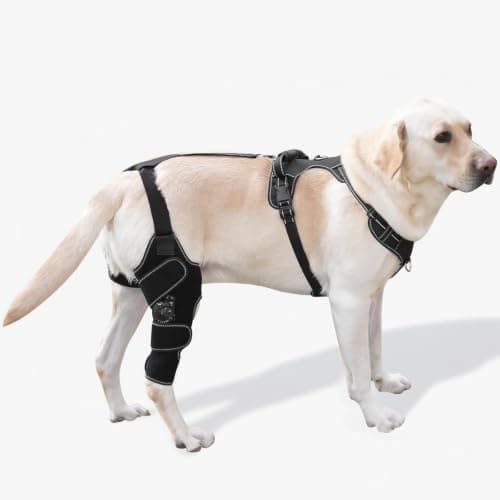
Stays put. This is the make-or-break property and the one most reviews skip. A dog's back leg is a cone: anything wrapped around the thigh slides down toward the hock as the dog moves. A brace on the floor supports nothing. Anchoring — to a chest harness or at least a back strap — is what separates the braces that work from the ones you find under the sofa.
Real support versus warmth. A soft neoprene sleeve provides compression and warmth, which many dogs seem to appreciate, but it does not meaningfully stabilize a joint. A structured brace with stays does more, and asks more of the fitting.
Fit range and side. Most braces are sold per leg and per side. Getting this wrong is the most common ordering mistake in the category.
Comfort over a whole day. Neoprene traps heat and mats fur. Any brace worn for hours needs the skin underneath checked daily, especially on an old dog with thin skin.
The short version: the FurWell is the one we would pick because the chest harness solves the slipping problem properly; the ZhiMengPet gets most of the way there with a back strap for less; the MerryMilo is the firmer plain wrap; the Noorace is the simple, wide-fitting starting point.
If you are not certain the stifle is the problem - hind-leg lameness can come from the hip, the knee, the back or the foot, and a wrap on the wrong joint does nothing - work through which leg brace does my dog need? first.
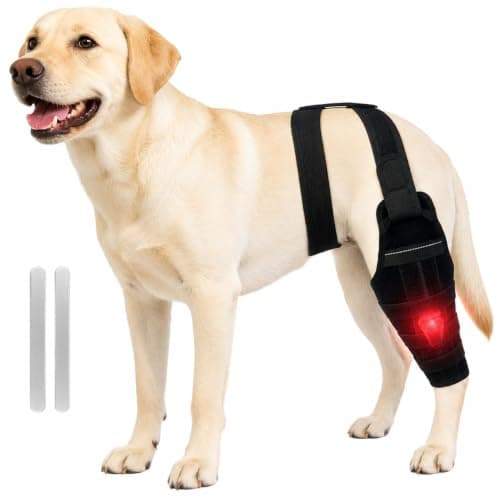
The one that solves the real problem with dog knee braces — it comes with a chest harness, so the brace is anchored to the dog rather than sliding down the leg by lunchtime.
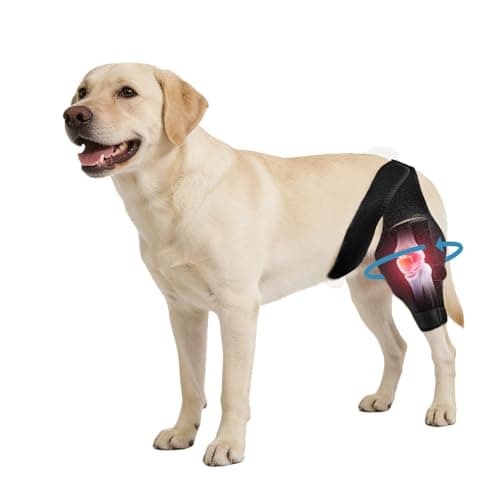
The straightforward wrap brace: a neoprene sleeve with adjustable straps that keeps the stifle from wandering sideways. The one to start with while you work out what your vet wants.
#ad · Live prices from the Amazon Product API, as of October 19, 2026. Where we have no verified live price we show none — we would rather leave a gap than print a number that has rotted.
In detail
The picks, in full
01
A brace that actually stays where you put it
FurWell Dog Knee Brace with Chest Harness
Knee brace plus secure chest harnessAdjustable support strapsListed for ACL/CCL recovery and post-surgery stabilizationSide- and size-specific (Right, L listed)
7.7/10
The one that solves the real problem with dog knee braces — it comes with a chest harness, so the brace is anchored to the dog rather than sliding down the leg by lunchtime.
Support
8.5
Fit range
7.5
Comfort
7
Stays put
9
Value
6.5
Pros
+The chest harness is the difference between a brace that works and a brace in a heap on the floor
+The most structured support of the braces here
+Adjustable enough to loosen as swelling changes
Cons
−Two to three times the price of a plain wrap
−More straps means a longer fitting routine every single time
Don't buy this if…
…you need something you can put on one-handed in ten seconds — this is the thorough option, not the quick one.
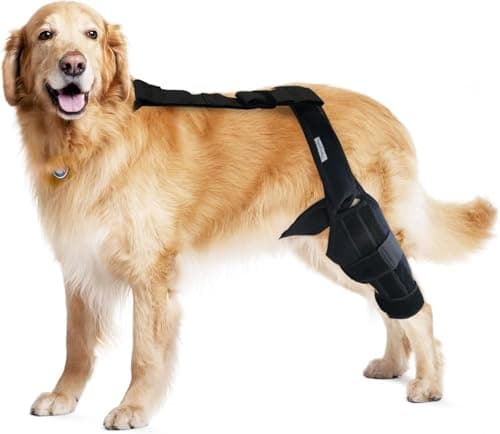
Knee brace with an anti-slip back strapListed for luxating patella and joint pain recoveryFits small, medium and large dogs (L listed)Adjustable straps
7.9/10
A middle option: a back strap over the hips stops the brace migrating, without the full chest harness. Sized to cover small through large dogs.
Support
7.5
Fit range
8.5
Comfort
7.5
Stays put
8
Value
8
Pros
+The back strap fixes most of the slipping for far less than a harness system
+One of the few braces that lists luxating patella specifically
+Broad size coverage in a single product line
Cons
−The back strap needs re-tensioning as fur compresses
−Support is between a soft wrap and a rigid brace — good for neither extreme
Don't buy this if…
…your dog is a heavy, powerful breed pulling hard against it — that dog needs the harness-anchored version.
Neoprene wrap with adjustable strapsFor hind-leg stifle (knee) supportMultiple sizes including XL and XXLHand washable
7.7/10
The straightforward wrap brace: a neoprene sleeve with adjustable straps that keeps the stifle from wandering sideways. The one to start with while you work out what your vet wants.
Support
7
Fit range
8.5
Comfort
7.5
Stays put
7
Value
8.5
Pros
+Simple enough that a tired owner can fit it the same way every time
+Size range goes up to XXL, which most wrap braces do not
+Light — a dog that hates rigid gear will usually tolerate it
Cons
−Soft support only; it limits movement rather than truly stabilizing a joint
−Neoprene gets warm on a long wear
Don't buy this if…
…your dog has an undiagnosed limp — a brace over an unknown injury delays the diagnosis that actually helps. See the vet first.
Measure with your dog standing, not lying down — the leg changes shape under load. You will usually need the circumference above the stifle (mid-thigh), the circumference below it, and the length from hip to hock. Compare those against the maker's chart rather than guessing from your dog's body weight, which is a poor proxy for limb shape. Our measuring guide has the full sequence and the mistakes to avoid.
Fitting it without causing a new problem
Two fingers should slide under any strap. Start with short wearing periods — twenty minutes, then an hour — and look at the skin each time you take it off. Redness that does not fade within a few minutes means it is too tight or rubbing. Never leave a brace on overnight unless your vet has specifically told you to.
Fur matting under a brace is not cosmetic: matted fur creates pressure points. Brush the area before fitting, and consider a thin sock-style liner if your dog is long-coated.
What a brace will not do
It will not repair a ruptured ligament, it will not rebuild the muscle your dog has lost, and it will not make it safe for your dog to do the things that caused the injury. Dogs often feel better in a brace and then do more, which is precisely the risk. Controlled activity is part of the plan; a brace that lets your dog return to chasing a ball is a brace being misused.
If your vet recommends surgery instead, the brace question goes away and a different one arrives: how to get the dog through the first weeks at home. Our guide to slings and harnesses after TPLO or ACL surgery covers the support gear for that stretch.
Things that help more than a brace, for most senior dogs
Weight control is the single highest-impact thing for any dog with a bad joint, and it is free. After that: good footing, so the leg is not sliding out on every floor; and access gear so the dog is not jumping down onto it. If you have not already done those, do them first.
A brace supports one joint. A rear-support harness takes weight off the whole back end and puts it into your hand. If your dog's problem is general hind-end weakness rather than one specific knee, the harness is the more useful buy — and it is easier to fit correctly.
On price: knees are where most of the money in this category goes, and it is worth knowing what you are buying before you compare a brace against surgery. How much a dog leg brace costs covers the tiers, the extras nobody lists, and what the veterinary literature on cruciate rupture actually recommends.
How we chose
We haven't lab-tested these
We compiled the published specifications, manufacturer manuals and aggregated owner reviews, then scored each product against a published rubric. The scores are judgments from that research — they are not measurements we took in a lab, because we don't have one and we won't pretend we do. Prices are pulled live from Amazon; where we can't verify one, we say "check price" rather than print a stale number.
Questions
Frequently asked
Do dog knee braces actually work?+
They can limit how far a wobbly stifle moves, which some dogs find steadier and more comfortable, and vets do sometimes recommend one as part of conservative management for a cruciate problem. They do not repair a ligament. Whether a brace is appropriate for your dog — and which type — is a veterinary decision, because the wrong support on the wrong diagnosis can delay real treatment.
How do I stop a dog knee brace slipping down?+
Anchor it to something above the leg. A dog's thigh tapers, so any strap wrapped around it migrates downward with movement. Braces that include a chest harness or a back strap stay put far better than those relying on leg straps alone. Correct sizing helps too — an oversized brace slips no matter how it is anchored.
How long can a dog wear a knee brace each day?+
Follow your vet's instruction. As a general safety practice, build up gradually from short periods, check the skin underneath every time you remove it, and do not leave a brace on overnight unless specifically told to. Pressure sores under braces are a real and preventable problem, particularly on thin-skinned older dogs.
Is a brace an alternative to cruciate surgery?+
Sometimes it is part of a non-surgical management plan, particularly for older dogs where anesthesia or recovery is a concern — but that is a decision for your vet based on your dog's specific injury, size and health. It is not an equivalent treatment, and it is not a decision to make from a product page.
We don't run a testing lab, and we don't pretend to. Product facts are compiled from manufacturer listings and manuals; health facts are cited to reputable veterinary sources. Where we couldn't verify something, we say so on the page rather than quietly leaving it out. Read our full method.