Fifty dollars is a real budget in this category, but it buys height rather than length. Here is what it solves properly for an old dog, the one job it cannot do honestly, and the five picks worth your money.
We earn a commission when you buy through our Amazon links, at no extra cost to you. It never changes our rankings, and we say so when the cheaper product is the better buy. How this works.
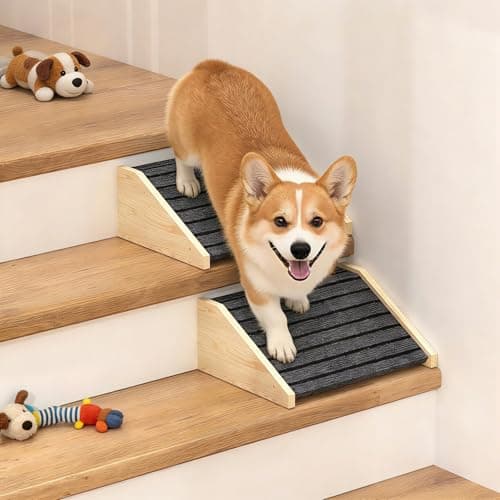
There is a reason this category looks confusing at fifty dollars. Dog ramps are priced almost entirely by length, because length is what buys a gentle angle, and a long rigid panel with rails and a grip surface is an expensive object to make and ship. Steps are priced by materials and capacity, which are much cheaper. So under $50 the shelf tilts hard toward foam step sets and short wooden stair ramps, and away from anything that reaches a car.
That is not a problem. For most senior dogs the expensive movement of the day is not getting into the car - it is the jump down off the bed or the sofa, repeated several times a day, landing on front legs that are already sore. That is exactly the job this budget does well. What follows is the honest map of what $50 covers, what it does not, and the five picks we would actually spend it on.
What $50 actually buys, and what it does not
Two limits on this budget, and both are worth knowing before you shop rather than after.
It does not buy a car ramp. This is the one to be clear about. A tailgate or an SUV load lip sits high enough that a safe slope needs a long run - and the ramps that reach that height without turning into a slide start above this budget and climb steeply from there. Every car ramp on our best dog ramps for the car page sits above $50, and the gap is not us being precious: a short ramp propped against a tailgate is a steep ramp, and a steep ramp is the thing a nervous old dog refuses and a confident one falls off. What a dog ramp costs breaks the tiers down if you want to see where the money goes. If the car is your problem, save up rather than buying down.
It is mostly a small-and-medium-dog budget. Foam steps compress under weight - that is physics, not a defect - and the short wooden stair ramps in this tier are listed by their makers for small and medium dogs. If your dog is a labrador or bigger, read ramps and steps for a big, heavy dog instead and plan on spending more. A step set that sinks when your dog puts weight on it is worse than no step set at all, because it removes confidence at the exact moment your dog needs it.
What $50 does buy, properly: the bed, the couch, a two-step back door, and the one or two indoor steps between rooms. Those are the heights where this tier is not a compromise at all - a foam step set that reaches a standard bed is doing the same job as a set costing three times as much, just with less capacity behind it.
What we ranked these on
Everything in this tier is cheap enough that the usual question - is it worth the money - mostly answers itself. So the ranking is about fit, in this order:
The height it actually reaches. This is the measurement that decides everything and the one almost nobody takes. Measure from the floor to the top of the mattress or the sofa cushion with weight on it, because a mattress compresses and a sofa cushion compresses a lot. A set of steps that stops two inches short does not reduce the jump - it moves it higher up.
Steps or slope. These are not interchangeable. A ramp keeps the spine straight and suits a long-backed or very wobbly dog; steps are easier to place in a small room and suit a dog that is stiff but still coordinated. We separate the two properly in ramp vs stairs, and if your dog is dachshund-shaped the answer is usually a ramp.
Capacity, which is where the price shows. Under $50 you are buying foam or thin plywood. Check the listed capacity against your dog's actual weight, with margin - a dog lands on a step rather than stepping onto it, and landing loads a structure far harder than standing on it.
Whether it stays put. The commonest failure in this tier is a light step set skidding away from the bed on a hard floor. A non-slip base helps; pushing it firmly against the bed frame helps more; a rug underneath helps most.
Whether the cover comes off. Senior dogs leak, shed and track mud. A zip-off washable cover is the difference between a step set you keep for three years and one you bin in six months.
The order to solve this in
Before you spend anything, one free fix is worth more than any purchase on this page: if your dog is slipping as well as struggling, the slip is the more urgent problem. A dog that scrabbles at the base of a ramp will not use the ramp. Fixing the floor your dog launches from often costs nothing more than moving a rug, and it makes everything else work.
Then take the measurement. Then pick the shape. The product comes last, which is why the picks sit below the criteria rather than above them.
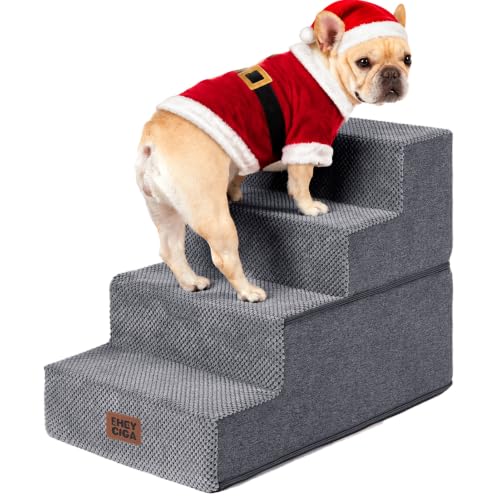
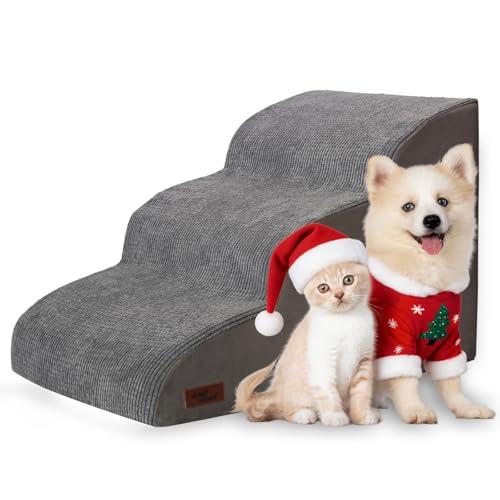
Foam steps that reach an ordinary bed height without the price of a rigid frame. Soft on the paws, quiet at 2am, and light enough to shift out of the way.
The five-step version, for the small dog whose problem is a tall bed rather than a couch. More steps at the same shallow rise, instead of fewer and steeper ones.
#ad · Live prices from the Amazon Product API, as of November 22, 2026. Where we have no verified live price we show none — we would rather leave a gap than print a number that has rotted.
In detail
The picks, in full
01
Couch height, small dogs
Aodisman 3-Step Pet Stairs & Ramp
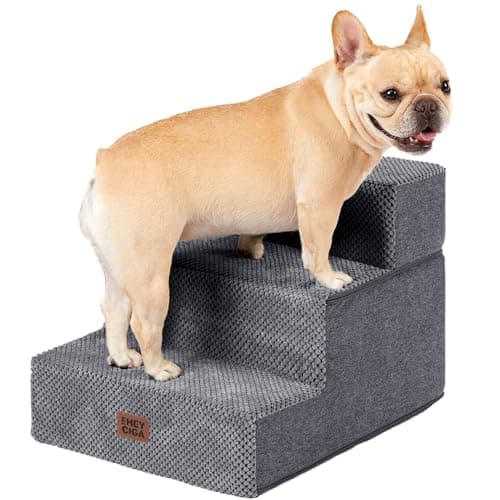
3 stepsSized for small dogs and catsNon-slip step surfacesFor bed or couch access
8.4/10
Three shallow steps for a small dog getting onto the couch — low enough that a long-backed dog does not have to arch its spine to make the climb.
Riser height
9
Stability
7.5
Grip
8
Footprint
8.5
Value
9
Pros
+Riser height is genuinely small — that is the whole design brief
+Light enough to move between the couch and the bedroom
+Cheap enough to buy two and leave one at each spot
Cons
−Small dogs only — it will not take a labrador
−Three steps tops out at couch height, not a high bed
Don't buy this if…
…your dog is long-backed and unsteady rather than simply short — a ramp keeps the spine straighter than any staircase can.
18 in total heightFour foam stepsRemovable washable coverNon-slip base
7.5/10
Foam steps that reach an ordinary bed height without the price of a rigid frame. Soft on the paws, quiet at 2am, and light enough to shift out of the way.
Gentle incline
7.5
Grip surface
8
Weight capacity
6.5
Portability
8.5
Stability
7
Pros
+Foam edges are forgiving if a paw catches
+Cover unzips and washes — worth more than it sounds with a senior dog
+Light enough to move one-handed
Cons
−Foam compresses under a heavy dog
−Steps can shuffle away from the bed unless pushed firmly against it
Don't buy this if…
…your dog is over about 50 pounds — the steps will sink and feel unstable exactly when your dog needs confidence.
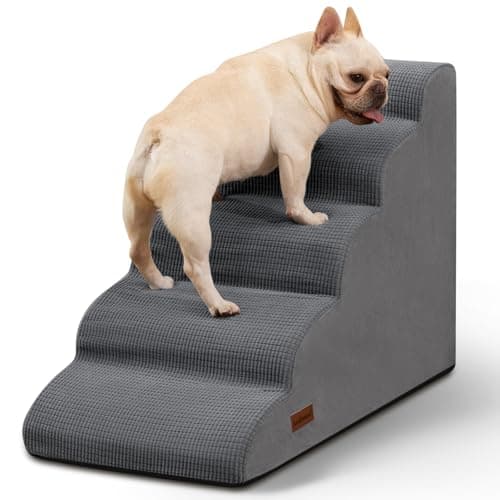
5 stepsFor high bedsSized for small dogs and catsNon-slip surfaces
7.8/10
The five-step version, for the small dog whose problem is a tall bed rather than a couch. More steps at the same shallow rise, instead of fewer and steeper ones.
Riser height
8.5
Stability
7.5
Grip
8
Footprint
6.5
Value
8.5
Pros
+Keeps the per-step rise low by adding steps rather than height
+Reaches a bed height that three-step sets cannot
+Same small-dog footprint discipline as the 3-step
Cons
−Five steps is a long run — it juts out into the bedroom
−Still a small-dog product; check the capacity
Don't buy this if…
…you have no floor space beside the bed — a taller three-step set fits the gap, but your dog pays for it in riser height.
Getting a cheap step set to behave like an expensive one
Most of the complaints about budget steps are solvable, and all of the fixes are free.
Put a rug under it. A light step set on laminate will walk away from the bed the first time a dog pushes off it. A thin rug under the base, or the corner of an existing one, stops the skid and quiets the whole thing down at two in the morning. Our non-slip rugs and runners page covers which backings actually hold on hard floors.
Shove it hard against the frame. Leave a two-inch gap at the top and your dog has to stretch across it on the way down, which is the exact movement you bought the steps to prevent. Flush against the bed frame, every time.
Treat the top step as the landing, not the last step. The top surface should sit level with - or a touch below - the mattress under load. If it ends up above, your dog steps down onto the bed, which is worse than the jump.
Wash the cover before your dog decides it smells wrong. A new cover smells of the factory. A wash makes it smell of your house instead, which matters to a dog already suspicious of the new object in the bedroom.
Expect to replace foam steps eventually. Foam under repeated impact packs down, the same way bed foam stops supporting. Press the top step with your palm every few months. If it bottoms out easily, your dog has been landing on the floor through it.
Teaching your dog to use it, which is the part people skip
A set of steps your dog ignores has cost you the full price for nothing, and it is the commonest way this purchase fails. Dogs do not understand furniture; they understand that a strange object has appeared where they used to jump.
The short version: leave it in place for a day without asking anything of it, then lure your dog up it with food one step at a time, then let it come down in its own time - downward is always the scarier direction and the one a stiff dog has least control over. Never lift your dog onto the top and expect it to work out the descent. The full method, including what to do with a dog that has already decided against it, is in how to teach a senior dog to use a ramp and what to do when your dog refuses.
Three things worth more than another $20 on the steps
Blocking the jump you are not watching. Steps help the trips you supervise. The damaging jumps are often the ones that happen while you are out of the room. Closing a bedroom door, or a gate at the top of the stairs, removes the unsupervised fall entirely.
A bed that has not gone flat. If your dog is choosing your bed over its own, the surface it owns may have stopped supporting it. An inexpensive orthopedic bed sometimes solves the ramp problem by removing the reason the dog climbs - and if you have a little more to spend, the beds under $100 reach real foam depth.
Nail length. Overgrown nails change how a dog loads its toes and make every ramp surface less grippy than it is. It is free to fix and it changes more than people expect.
How we chose
We haven't lab-tested these
We compiled the published specifications, manufacturer manuals and aggregated owner reviews, then scored each product against a published rubric. The scores are judgments from that research — they are not measurements we took in a lab, because we don't have one and we won't pretend we do. Prices are pulled live from Amazon; where we can't verify one, we say "check price" rather than print a stale number.
Questions
Frequently asked
Can you get a decent dog ramp for under $50?+
For indoor steps, a low sofa or a two-step back door, yes - the short wooden stair ramps and foam step sets in this tier do that job properly. For a car, no. Tailgate height needs a long run to keep the slope gentle, and ramps long enough to do that start above this budget. A short ramp against a tailgate is a steep ramp, which is the version dogs refuse or fall off.
Are foam dog steps strong enough for a big dog?+
Generally not. Every foam set in this price range is listed by its maker for small or small-to-medium dogs, and foam compresses under weight - a heavy dog sinks in, the step feels unstable, and the dog stops trusting it. Check the listed capacity against your dog's weight with margin, because landing on a step loads it far harder than standing on it. For a large dog, a rigid ramp is the safer shape.
Should I buy steps or a ramp for the bed?+
Steps if your dog is stiff but coordinated and floor space is tight; a ramp if your dog is long-backed, unsteady on its back end, or has any disc history, because a ramp keeps the spine straighter than a staircase can. Steps are also easier to fit beside a bed, since a gentle ramp has to run a long way out into the room.
How tall do dog steps need to be for a bed?+
Measure floor-to-mattress with weight on the mattress, because it compresses. Yours is the only number that matters. Three-step sets in this tier generally reach couch height; reaching a tall bed takes four or five steps, which is why the taller sets jut further out into the room.
My dog will not use the new steps. What now?+
Almost always placement or training rather than the product. Check it is flush against the bed and that the top surface sits level with the mattress under load, put something non-slip underneath so it cannot shift, then lure your dog up one step at a time with food and let it come down in its own time. Never carry the dog to the top. If it still refuses after a week, the shape is probably wrong for its body - a wobbly back end usually wants a slope, not risers.
Is it worth buying two cheap sets instead of one good one?+
Often, yes - and it is the strongest argument for this whole price tier. A senior dog usually has two or three problem heights (the bed, the sofa, the back step), and a step set that lives in the wrong room does nothing. Two cheap sets that stay put beat one expensive set you drag around, because the one you drag around eventually stops being dragged.
We don't run a testing lab, and we don't pretend to. Product facts are compiled from manufacturer listings and manuals; health facts are cited to reputable veterinary sources. Where we couldn't verify something, we say so on the page rather than quietly leaving it out. Read our full method.