Some dogs simply will not wear socks. For those dogs there's a whole category of grip that attaches to the nail or the pad itself — and nothing for the dog to shake off.
We earn a commission when you buy through our Amazon links, at no extra cost to you. It never changes our rankings, and we say so when the cheaper product is the better buy. How this works.
If you've already tried socks and watched your dog kick them across the kitchen within ninety seconds, this page is for you. Everything here works on the same principle: the grip attaches to the dog rather than covering it, so there is nothing to shake off, nothing to twist round the paw, and nothing your dog has to tolerate wearing.
There are two quite different products in this category, and they're worth separating before you spend anything.
Toe grips — rubber rings on the nails
These are small rubber rings that slide onto the nail. The idea is that dogs naturally grip with their claws on grass and dirt, but on hardwood and tile the nail is the part that slides — so putting rubber where the nail meets the floor restores the grip the dog is instinctively reaching for. Dr. Buzby's is the original and by far the best-known version, created by a veterinarian.
The pad stays completely bare, which is why so many dogs accept them without complaint. They stay on for days or weeks at a time. Against that: fitting the first set is fiddly, they need enough healthy nail to hold onto, and you will lose the occasional one and need to replace it.
Adhesive pads — rubber stuck to the paw pad
These are self-adhesive rubber stickers applied directly to the paw pads. They put grip exactly where the foot touches the floor, and — unlike toe grips — they don't depend on your dog having good nails, which matters for dogs with brittle claws or nails worn short.
The catch is honest and simple: they're consumable. They wear off over a few days, they need the fur around the pad trimmed to stick properly, and you'll be buying them again. Whether that's acceptable depends on how you feel about an ongoing small cost versus a one-off purchase.
The short version: Dr. Buzby's ToeGrips if your dog has decent nails — it's the one-time buy with the longest track record. The Aqumax pads if your dog's nails are short or brittle. The Padshld pads if you have a big dog with big paws, since that's where most of this category quietly runs out of sizes. The VALFRID pads as the cheapest way to test whether your dog will accept anything on its feet at all.
Rubber rings that sit on the nails and grip the floor, leaving the pad bare — the answer for a dog that won't tolerate socks. A vet-created product with a long track record.
Adhesive rubber pads that stick straight onto the paw pad. All the grip of a sock with none of the sock — which is the point for a dog that kicks footwear off within a minute.
Adhesive pads that go up to genuinely large paw sizes, which is where most of this category quietly stops. If you have a big dog scrambling on tile, that matters more than anything else here.
The same self-adhesive idea in a thinner, cheaper pad. Slightly less grip than the chunkier stickers, but a good way to test whether your dog will accept anything on its feet at all.
#ad · Live prices from the Amazon Product API, as of October 20, 2026. Where we have no verified live price we show none — we would rather leave a gap than print a number that has rotted.
In detail
The picks, in full
01
Dogs that won't wear socks
Dr. Buzby's ToeGrips
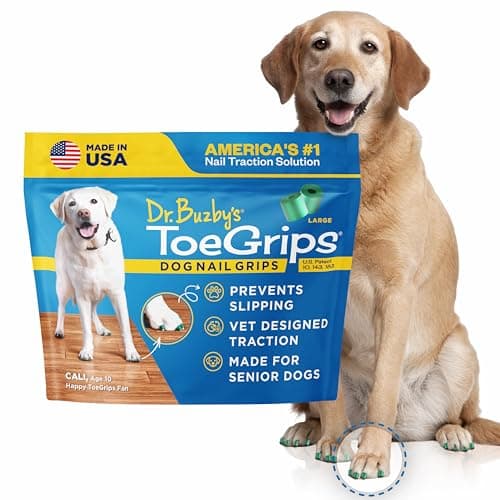
Rubber rings on the nailsPad stays uncoveredSized to the nailVet-created brand
8.3/10
Rubber rings that sit on the nails and grip the floor, leaving the pad bare — the answer for a dog that won't tolerate socks. A vet-created product with a long track record.
Grip
8
Stays on
8.5
Comfort
9
Value
7.5
Pros
+Nothing on the pad — many dogs forget they're wearing them
+Stay on for days at a time once fitted
+Created by a veterinarian, with strong owner following
Cons
−Need correctly sized, healthy nails to grip
−Fiddly first fitting; they can be lost one at a time
Don't buy this if…
…your dog has brittle nails or very short claws — there may be too little nail for the grips to hold.
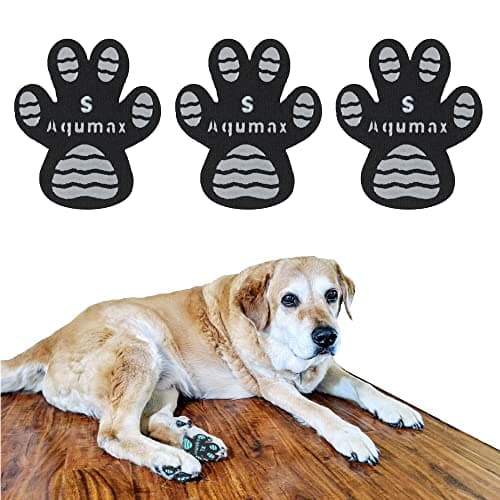
Self-adhesive traction padsApplied directly to the paw padSold in multi-packsSized by paw
8.0/10
Adhesive rubber pads that stick straight onto the paw pad. All the grip of a sock with none of the sock — which is the point for a dog that kicks footwear off within a minute.
Grip
8.5
Stays on
7
Comfort
9
Value
7.5
Pros
+Nothing to fall off or twist around the foot
+Grip lands exactly where the paw touches the floor
+Multi-packs make ongoing replacement cheap
Cons
−Consumable — they wear off and need replacing every few days
−Fur around the pad has to be trimmed for them to stick
Don't buy this if…
…you want a one-time purchase. These are an ongoing cost, unlike toe grips or a tin of wax.
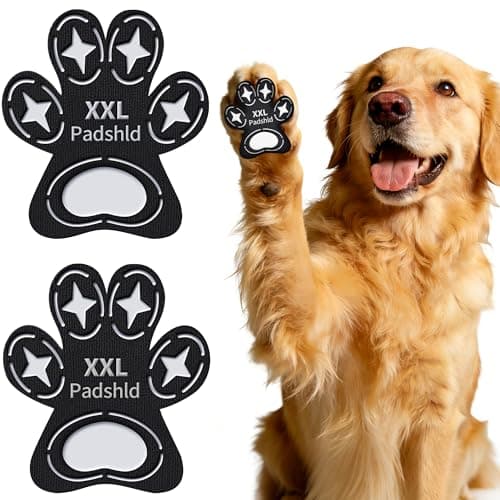
Self-adhesive paw padsSizes up to XXLTextured grip face24-piece sets
7.8/10
Adhesive pads that go up to genuinely large paw sizes, which is where most of this category quietly stops. If you have a big dog scrambling on tile, that matters more than anything else here.
Grip
8
Stays on
7
Comfort
8.5
Value
7.5
Pros
+Actually available in large-dog sizes
+Textured face rather than flat rubber
+Covers the whole contact surface of a big pad
Cons
−Consumable, like every adhesive pad
−Needs a clean, dry, trimmed pad to adhere well
Don't buy this if…
…your dog is small — you'll be trimming pads to fit, and the smaller-sized brands are cheaper anyway.
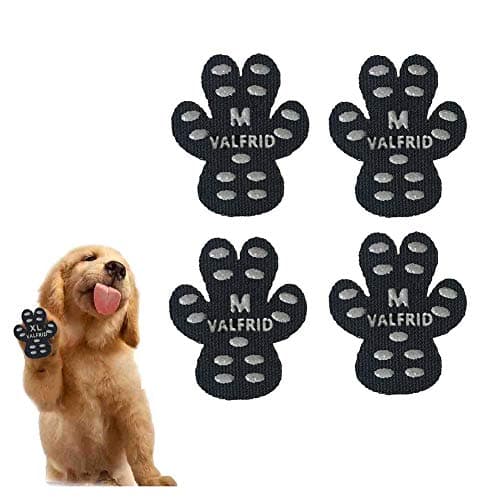
The same self-adhesive idea in a thinner, cheaper pad. Slightly less grip than the chunkier stickers, but a good way to test whether your dog will accept anything on its feet at all.
Grip
7.5
Stays on
6.5
Comfort
9
Value
8.5
Pros
+Cheapest way into adhesive traction
+Thin profile — most dogs don't react to them
+Comes in enough sizes to fit small and large paws
Cons
−Thinner pads wear through faster than the thicker ones
−Disposable by design — the cost never stops
Don't buy this if…
…your dog is slipping badly right now. Start with something with more bite — socks, toe grips, or the thicker pads.
Four metrics on this hub: grip, whether it stays on, comfort for the dog, and value. Scores are judgments compiled from published product information and aggregated owner reviews, not measurements from a lab — see the methodology.
Trim the nails first — it's free and it matters
Overgrown nails change how a dog's foot meets the floor: the nail hits first, the toe is pushed back, and the pad — the grippy part — makes less contact. Long nails are one of the most common reasons an old dog starts sliding, and shortening them costs nothing. Whatever else you buy, get the nails to a sensible length first. Toe grips need enough nail left to hold, so do this before you order rather than after. If you do not have a tool you trust for that, our nail grinder and clipper picks cover which one suits a thick senior nail and an owner whose hands are not what they were.
Trim the fur between the pads too
Hair growing over the pads acts like a little sledge. Clipping the tufts between and around the pads flush with the pad surface improves grip immediately, and it's also what makes adhesive pads stick properly. Blunt-nosed scissors, a calm dog, no drama.
Fitting toe grips: the practical version
Do a couple of nails a day rather than all sixteen in one sitting. Sit with your dog rather than looming over it, work on whichever foot it minds least, and treat generously. Expect to lose one or two in the first fortnight while you learn which size actually fits. And check them when you check the nails — a grip on a nail that has grown long enough to need a trim isn't doing much.
Where these fit in the whole fix
Grip on the dog is one half. The other half is the floor: runners along the routes your dog actually walks, a rug where it gets up from, and something non-slip at the bottom of any step. That part is free or nearly free, and it usually does more than any product on this page — we set it out room by room in the home traction setup guide.
How we chose
We haven't lab-tested these
We compiled the published specifications, manufacturer manuals and aggregated owner reviews, then scored each product against a published rubric. The scores are judgments from that research — they are not measurements we took in a lab, because we don't have one and we won't pretend we do. Prices are pulled live from Amazon; where we can't verify one, we say "check price" rather than print a stale number.
Questions
Frequently asked
Do dog toe grips really work?+
For many dogs, yes — rubber rings on the nails restore grip on smooth floors while leaving the pad uncovered, which is why dogs that reject socks usually accept them. They need healthy nails of a reasonable length to hold on, so they're less suited to dogs with brittle or very short claws.
Toe grips or stick-on paw pads — which is better?+
Toe grips are a one-time purchase and stay on for days or weeks, but need decent nails. Adhesive pads put grip directly under the pad and work regardless of nail condition, but they wear off within days and are an ongoing cost. Choose on your dog's nails and on whether you'd rather pay once or keep paying.
How long do dog toe grips last?+
Typically days to weeks per set, depending on how much your dog walks and on hard surfaces outdoors. You'll lose the odd one, which is normal — most sets come with enough spares for that. Re-check them whenever you trim the nails.
We don't run a testing lab, and we don't pretend to. Product facts are compiled from manufacturer listings and manuals; health facts are cited to reputable veterinary sources. Where we couldn't verify something, we say so on the page rather than quietly leaving it out. Read our full method.