The best stair gates for an old dog, top and bottom
Gating the stairs is the cheapest fall prevention there is for an unsteady dog, as long as the gate at the top is not the thing that trips you. Here is which gate goes where, and the ones worth the drill holes.
We earn a commission when you buy through our Amazon links, at no extra cost to you. It never changes our rankings, and we say so when the cheaper product is the better buy. How this works.
Almost every page on this site that deals with stairs ends the same way: gate them. Put a gate at the top and the bottom, and make the stairs something your dog does with you rather than on its own at two in the morning. It is advice that sounds finished until you stand in front of a wall of gates and find that half of them say, in small print, never to use them where you were planning to put them.
The advice itself is not controversial. The AKC's guide to making a home accessible for a senior dog says that if your dog has mobility issues, gates are a good way to restrict access to the stairs and avoid the risk of a fall. VCA's page on setting up a home for a mobility-compromised dog puts it this way: "Your veterinarian may recommend that your pet avoid all unnecessary stairs. In those cases, installing baby gates may be the best solution." And Canine Arthritis Resources and Education says where: "Place baby gates at the bottom and the top of the stairs to prevent your dog from using them when they are unsupervised."
What none of them tell you is that the top and the bottom of a staircase call for different gates. That is what this page is for.
The top and the bottom are different purchases
The US Consumer Product Safety Commission does not hedge on this. Its childproofing guide says: "For the top of stairs, only use gates that screw to the wall." Consumer Reports' safety gate buying guide says the same, and adds two exclusions people miss: do not use a pressure-mounted gate at the top of stairs even with wall cups that are screwed into the wall, and do not use a retractable gate there either.
The reason is mechanical. A pressure-mounted gate holds itself in place by pushing outward against the walls on either side. Consumer Reports' explainer on the two types says pressure gates are easier to dislodge, which makes them a poor choice anywhere security is paramount, and it names the top of the stairs as the example. For a dog, the picture to keep in mind is a heavy, unsteady animal leaning its weight into the gate. At the bottom of a flight, a gate that pops out lands on the floor. At the top, the gate and the dog go down the stairs together.
At the bottom of the stairs, and in level doorways, the same Consumer Reports piece says a pressure-mounted gate is acceptable. That is where the cheaper, no-drill gates belong, and three of the six picks on this page are ranked for exactly that job. Two of them say so on their own listings.
The bar across the floor
Many walk-through gates have a frame member that runs across the floor under the door. It stays there when the door is open, and you step over it every time you go through. Consumer Reports' advice for a top-of-stairs gate is to choose one without a threshold or a bar you have to step over, because it could be a tripping hazard.
On a parenting site that sentence is about an adult carrying a child. On this site it describes two people at once:
You, going through the gate with a dog in your arms or a hand on a rear-support sling, looking at the dog rather than at your feet.
Your dog, if its back feet have started to drag or knuckle over. A dog that scuffs the tops of its paws on a flat floor will catch a raised bar, and at the top of the stairs the place it catches it is the edge of the drop.
So we weighted the bar more heavily than a gate review written for parents would, and it is the reason the auto-closing gate on this page is ranked for the bottom of the stairs only, even though its listing offers a hardware mount for stairways.
Which way it swings
Consumer Reports says to choose a gate that opens out onto the landing, not back toward the stairs. Our three top-of-stairs picks handle this in three different ways: the Toddleroo lets you select its swing direction, the KidCo has a stop pin that prevents outward swings over the stairs, and the Cardinal Gates model opens both ways with an optional one-way stop bracket. Whichever you buy, set it up so the gate cannot open over the drop, and test it again after the first week of daily use.
What we scored these on
Top-of-stairs safe. Screwed to the wall, nothing to trip on, and a way to stop it swinging over the stairs. Gates whose own listings say bottom of stairs only score low here by design. That is a statement about where they go, not about their quality.
No trip bar. Whether anything crosses the floor that you or your dog have to step over.
Easy to get through. The latch and the opening, judged for the reader this site is written for. A one-hand latch matters when your other hand is on a dog. A press-and-lift button or a two-step handle is harder on arthritic fingers than a lever. And a swing gate opens its whole width, where a door set into a frame can be too narrow for you and a dog in a sling side by side.
Fits your stairs. Listed width range, banister and angle options, and what has to be bought separately. Consumer Reports advises avoiding gates that have to be extended to their maximum width to fit, so a generous range is worth something.
Value. What you get for the price bracket, including the kits some staircases will force you to add.
Scores are judgments from the live listings, Cardinal Gates' own product page and the safety guidance cited at the foot of this page, in line with our methodology. We have not installed or pushed against any of these gates. Where a measurement appears, it is the manufacturer's and the copy says so. Every pick was resolved live and confirmed in stock before publication.
The short version: for the top of a standard staircase, the Toddleroo. If the top of your stairs ends at a banister or meets the wall at an angle, the Cardinal Gates Stairway Special. If you want to lift the gate out of the way for assisted trips, the KidCo. For the bottom of the stairs: the Cumbor if your household leaves gates open, the Carlson if your dog is tall, and the Regalo if you want the least expensive option and your dog is small or medium.
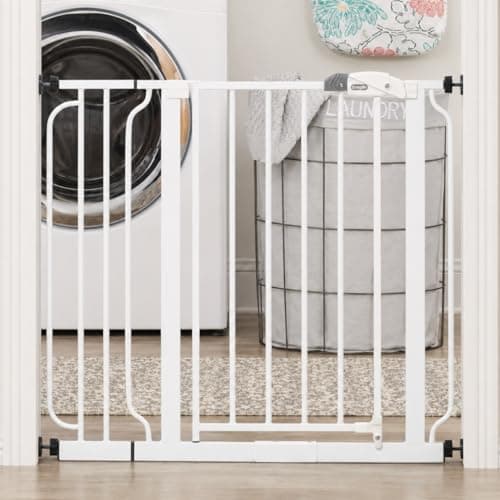
The gate we would put at the top of most staircases. It screws to the wall, there is nothing across the floor to trip on, you choose which way it swings, and it covers the widest range of openings on this page, at a mid-range price.
The gate for awkward stairs. Cardinal says it mounts at angles up to 30 degrees and opens both ways, with a stop bracket to block the stair side, which is what a landing that ends at a banister or a slanted wall actually needs. It costs more, and banister clamps cost extra again.
A staircase that ends at a banister or an angled wall
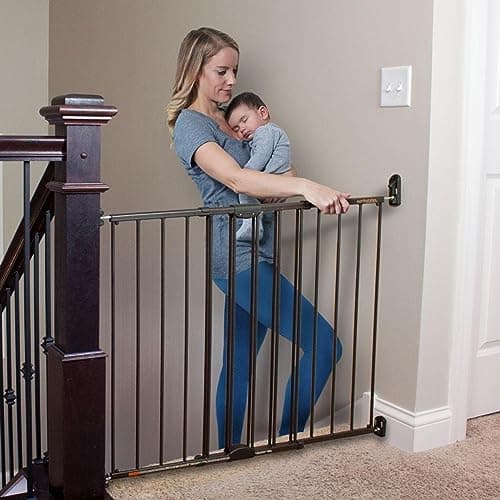
A top-of-stairs gate you can lift off its brackets. A stop pin keeps it from swinging out over the stairs, there is no bottom bar, and quick-release hardware lets you take the whole gate away on the days you are running assisted trips up and down, then drop it back in.
A gate you want out of the way for assisted stair trips
The gate that shuts itself, for the household where somebody always forgets, which matters more than it sounds when the point is keeping a dog off the stairs. But it has a support bar across the floor, so it belongs at the bottom of the flight or in a doorway, not at the top.
The tall one, for the bottom of the stairs. At a listed 36 inches it is the pick for a big dog that still puts its front feet up on a barrier, and it installs by pressure with no drilling. It is a pet gate with a pet door in it, and that cuts both ways.
The cheapest sensible way to gate the bottom of a staircase: pressure mounted with wall cups, a walk-through door, certified to a child-safety standard. Measure first, though — there is a band of opening widths it does not fit, and it is listed for small to medium pets.
The bottom of the stairs on a budget, with a small or medium dog
#ad · Live prices from the Amazon Product API, as of Sep 22, 2026. Where we have no verified live price we show none — we would rather leave a gap than print a number that has rotted.
In detail
The picks, in full
01
The top of a standard wall-to-wall staircase
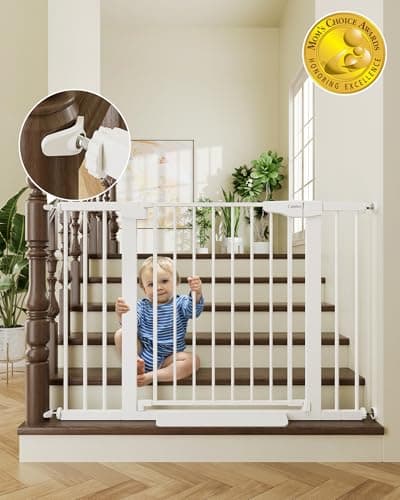
Toddleroo Easy Swing & Lock Gate for Top of Stairs
Hardware mount (drilling required)Listed 28.68-47.85 in wide31 in tall, no thresholdOne-hand latch, swing control
9.0/10
The gate we would put at the top of most staircases. It screws to the wall, there is nothing across the floor to trip on, you choose which way it swings, and it covers the widest range of openings on this page, at a mid-range price.
Top-of-stairs safe
9.5
No trip bar
10
Easy to get through
8
Fits your stairs
8.5
Value
9
Pros
+Ticks the three things the safety guidance asks of a top-of-stairs gate: screwed to the wall, no bar across the floor, and it can be set never to swing out over the stairs
+The widest listed width range here, so most landings fit without extension pieces
+The whole gate swings out of the way, so you are not squeezing a dog in a sling through a narrow door in a frame
+Certified to the child-gate standard, so it still does its job if a grandchild visits
Cons
−The latch is press-and-lift, which is two motions from one thumb — fine for most hands, harder for a thumb with arthritis in it
−No auto-close is listed, so the gate is only ever as shut as the last person left it
−You have to drill, and the screws need to find wood or a stud rather than bare drywall
−The finish we resolved is bronze; if it clashes with white trim, check the other colors before ordering
Don't buy this if…
…the top of your stairs ends at a banister post or meets the wall at an angle — the Cardinal Gates Stairway Special is built for exactly that layout.
Price as of Sep 22, 2026. Prices change — Amazon's is the one that counts.
#ad · we may earn a commission from this link to Toddleroo Easy Swing & Lock Gate for Top of Stairs
02
A staircase that ends at a banister or an angled wall
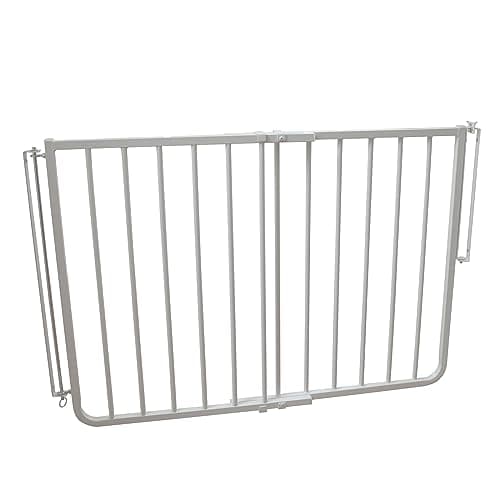
Cardinal Gates SS30 Stairway Special Gate
Per maker: 27-42.5 in wide29.5 in tall, aluminumAngle mount up to 30° (per maker)Two-way swing + stop bracket
8.7/10
The gate for awkward stairs. Cardinal says it mounts at angles up to 30 degrees and opens both ways, with a stop bracket to block the stair side, which is what a landing that ends at a banister or a slanted wall actually needs. It costs more, and banister clamps cost extra again.
Top-of-stairs safe
9.5
No trip bar
9.5
Easy to get through
8
Fits your stairs
9.5
Value
7
Pros
+Angle mounting solves the landing that a straight wall-to-wall gate cannot, which is the usual reason people give up on gating the top
+The stop bracket lets it swing both ways where that is safe and locks out the stair side where it is not
+JPMA certified per the manufacturer, so it is built to a child-gate standard and still does its job if a grandchild visits
+A swing gate, so the full width opens for you and the dog together
Cons
−The Amazon listing publishes almost no specifications — everything above is from Cardinal's own product page, which is worth reading before you order
−Among the most expensive gates here, and the banister clamps most awkward staircases need are a separate purchase
−At 29.5 in it is the shortest gate on the page, which only matters for a tall dog that still stands up against a barrier
−No auto-close listed
Don't buy this if…
…your stairs meet two flat, square walls — the Toddleroo does that job for less money.
A gate you want out of the way for assisted stair trips
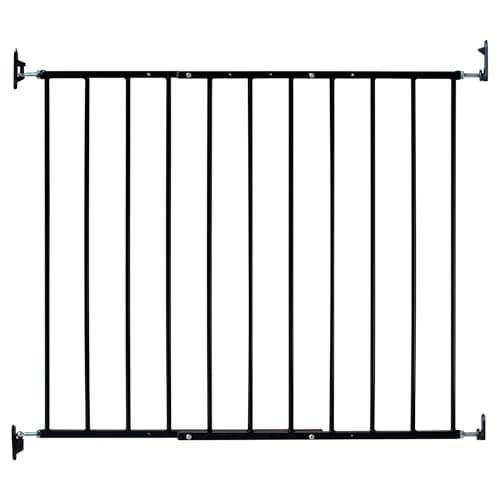
KidCo Safeway Walk Through Gate for Stairs and Doorways
Hardware mount with stop pinNo bottom barListed 24.75-42.5 in wide, 30.5 in tallQuick-release removal
8.4/10
A top-of-stairs gate you can lift off its brackets. A stop pin keeps it from swinging out over the stairs, there is no bottom bar, and quick-release hardware lets you take the whole gate away on the days you are running assisted trips up and down, then drop it back in.
Top-of-stairs safe
9.5
No trip bar
10
Easy to get through
7
Fits your stairs
7.5
Value
8
Pros
+The stop pin deals with the swing-over-the-stairs problem in hardware rather than relying on you to set it up right
+Quick-release means a clear stairway when you are guiding a dog up in a harness, without unscrewing anything
+Fits the narrowest openings of any gate here, down to a listed 24.75 in
+Steel frame and a lifetime warranty per the listing
Cons
−The listing does not describe the latch action, so we cannot tell you it is one-handed — check before relying on it with your hands full
−Listed as designed for flat surfaces; banisters and uneven stairs need the separately sold K12 kit
−A gate that lifts out is a gate someone eventually leaves out
−No auto-close listed
Don't buy this if…
…the top of your stairs is a banister and you do not want to buy an extra kit — the Cardinal Gates Stairway Special is designed around that case.
Price as of Sep 22, 2026. Prices change — Amazon's is the one that counts.
#ad · we may earn a commission from this link to KidCo Safeway Walk Through Gate for Stairs and Doorways
04
The bottom of the stairs in a busy household
Cumbor 30-46 in Auto Close Gate for Stairs and Doorways
Auto-close, one-hand latchPressure or hardware mountBottom bar with ramp pieceListed 30-46 in wide, 30.5 in tall
6.5/10
The gate that shuts itself, for the household where somebody always forgets, which matters more than it sounds when the point is keeping a dog off the stairs. But it has a support bar across the floor, so it belongs at the bottom of the flight or in a doorway, not at the top.
Top-of-stairs safe
5
No trip bar
4
Easy to get through
8.5
Fits your stairs
8.5
Value
6.5
Pros
+Auto-close fixes the most common way a stair gate fails: left open by someone in a hurry
+Mounts either way, so it can be pressure-fit at the bottom of the stairs now and screwed in later
+Wide listed range, with banister adapters included rather than sold separately
+A heavy steel gate that feels like a barrier rather than a suggestion
Cons
−The bottom bar is a trip hazard — for you carrying a dog, and for a dog that drags or knuckles its back paws — which is why we would not fit it at the top of a flight even hardware-mounted
−A double-lock release is two actions by design, and a stiff grip may find it fiddly
−Among the most expensive gates here
−The listing asks you to measure both the top and bottom of the opening, so out-of-square walls can catch it out
Don't buy this if…
…the only place you need a gate is the top of the stairs — pick one with no bar across the floor.
Price as of Sep 22, 2026. Prices change — Amazon's is the one that counts.
#ad · we may earn a commission from this link to Cumbor 30-46 in Auto Close Gate for Stairs and Doorways
05
The bottom of the stairs with a tall dog
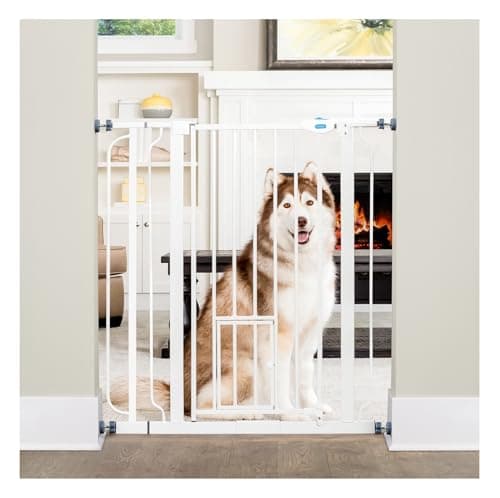
Carlson 36 in Extra Tall Walk Through Dog Gate
Listed 36 in tall, 29-36.5 in wide16.5 in door, lever handlePressure mount, bottom of stairs onlySmall pet door built in
5.7/10
The tall one, for the bottom of the stairs. At a listed 36 inches it is the pick for a big dog that still puts its front feet up on a barrier, and it installs by pressure with no drilling. It is a pet gate with a pet door in it, and that cuts both ways.
Top-of-stairs safe
2
No trip bar
5
Easy to get through
7
Fits your stairs
6
Value
8.5
Pros
+Several inches taller than every other gate here, for the large dog that leans over a gate rather than walking into it
+A lever handle rather than a squeeze or a thumb button — the kindest latch style for a stiff hand
+No drilling, so it suits a rental or a staircase you do not want to mark
+One of the cheaper picks on the page
Cons
−Bottom of stairs only, per its own listing; it is not a top-of-stairs gate
−A 16.5 in door is tight for you and a dog in a sling side by side
−The small pet door exists to let small pets through, so it is no stair barrier for a small dog unless that door stays shut
−It is sold as a pet gate, and CPSC says pet gates should never be used as child safety gates — relevant if grandchildren visit
Don't buy this if…
…your dog is small enough to fit the pet door, or you need a gate a visiting toddler can rely on.
The bottom of the stairs on a budget, with a small or medium dog
Regalo Easy Step Walk Through Gate, Bottom of Stairs & Doorways
Listed 29-38.5 in wide, 30 in tallWon't fit 32-35.5 in openingsPressure mount with wall cupsNever for top of stairs (listing)
5.6/10
The cheapest sensible way to gate the bottom of a staircase: pressure mounted with wall cups, a walk-through door, certified to a child-safety standard. Measure first, though — there is a band of opening widths it does not fit, and it is listed for small to medium pets.
Top-of-stairs safe
2
No trip bar
5
Easy to get through
6.5
Fits your stairs
5
Value
9.5
Pros
+The lowest price on the page for a certified walk-through gate
+No drilling beyond the wall cups
+The listing is unusually plain about where it does not belong and what it does not fit
+Certified to a child-safety standard, unlike a pet-only gate
Cons
−Does not fit a 32 to 35.5 in opening at all, so measure before ordering
−Listed for small to medium pets; a large dog leaning on a pressure-fit gate is the wrong match
−Reviewed.com described its handle as an odd two-step action, which is the wrong direction for stiff fingers
−Bottom of the stairs and doorways only
Don't buy this if…
…your dog is large, your opening is 32 to 35.5 inches wide, or the gate is going at the top of the stairs.
Price as of Sep 22, 2026. Prices change — Amazon's is the one that counts.
#ad · we may earn a commission from this link to Regalo Easy Step Walk Through Gate, Bottom of Stairs & Doorways
Measure before you buy
Measure the opening at the top and at the bottom. The Cumbor listing asks for both, because walls and banisters are rarely perfectly parallel, and a gate that fits at hand height can be loose at the floor. Then check your number against the listed range, and be wary of a gate that only fits at the very end of it — Consumer Reports advises avoiding gates that have to be extended to their maximum width.
Read the gaps in the range, too. The Regalo on this page does not fit openings between 32 and 35.5 inches at all. Its listing says so plainly, and a glance at the headline width would miss it.
Drilling, banisters and drywall
A top-of-stairs gate means screws, and what decides whether it holds is what the screws go into: wood trim, a stud or a solid banister post rather than drywall alone. The kits are where the price comparison changes. Cardinal Gates sells banister clamps and a drywall anchor kit separately. KidCo sells its K12 kit for banisters and uneven surfaces separately. Cumbor includes Y-bolt adapters for round banisters, for up to two of its four mounting points. Price the kit your staircase needs before deciding which gate is cheaper.
If the holes are what is stopping you, Consumer Reports' note is worth knowing: they can be filled with wood putty or wall-patching compound when you no longer need the gate. For a renter, that makes it a short conversation with the landlord.
Where the gate actually goes
At the top, mount the gate on the landing at the head of the flight, with level floor on both sides of it, and set the swing so it opens onto the landing. At the bottom, put it at the foot of the stairs with enough floor in front that you can open it without standing on the first step.
Then do the part that makes the gate unnecessary most of the time: put what your dog needs on the floor where it spends its day. A bed downstairs, water on both floors and the route outside on one level remove most of the reasons to attempt the stairs at all. Our room-by-room guide to senior-proofing covers the rest of the house, and a second bed on the other floor is often the cheapest way to take a flight out of the day.
A gate is not the whole stair plan
Gating turns the stairs into a supervised activity. It does not make them easy, and some trips still have to happen. Canine Arthritis Resources and Education notes that walking downstairs can be more problematic than walking up, particularly for dogs with elbow and wrist arthritis or shoulder or neck problems, because going down slowly increases the force on the front limbs. Its advice is to use a harness with a handle to help support and slow the ascent and, especially, the descent.
So the gate and the harness are a pair: one stops the unsupervised trip, the other makes the supervised one safer. Add grip to every tread while you are at it — our non-slip stair treads page ranks the options — and our guide to helping an old dog up and down the stairs covers the technique.
If grandchildren visit
CPSC's childproofing guide contains a sentence that matters in a lot of the homes this site is written for: "Pet gates should never be used as a child safety gate." The Carlson on this page is sold as a pet gate. The Toddleroo and Regalo listings each state a child-safety certification, and Cardinal Gates states JPMA certification for its gate. If a toddler is ever going to be on the other side of the gate, buy one of those rather than relying on a pet gate.
What about retractable and fabric gates?
They are popular because they roll out of sight when open and many need no drilling. Consumer Reports' guidance is not to use a retractable gate at the top of the stairs, so we have not ranked one. At the bottom of the stairs the choice is more open, but for a large dog that leans its weight into a barrier, our preference is a rigid gate.
How we chose
We haven't lab-tested these
We compiled the published specifications, manufacturer manuals and aggregated owner reviews, then scored each product against a published rubric. The scores are judgments from that research — they are not measurements we took in a lab, because we don't have one and we won't pretend we do. Prices are pulled live from Amazon; where we can't verify one, we say "check price" rather than print a stale number.
Questions
Frequently asked
Can I use a pressure-mounted gate at the top of the stairs for my dog?+
No. CPSC's guidance is to use only gates that screw to the wall at the top of stairs, and Consumer Reports says not to use a pressure-mounted gate there even with wall cups screwed in, and not to use a retractable gate there either. Pressure gates are fine at the bottom of the stairs and in level doorways. Two of the pressure gates on this page say bottom of stairs only on their own listings.
Should I put the gate at the top or the bottom of the stairs?+
Both, if your dog should not be using the stairs unsupervised — Canine Arthritis Resources and Education advises placing baby gates at the bottom and the top of the stairs for that reason. If you can only do one right away, start with the top. It is where an unsteady dog has the furthest to fall, and it is the location that needs the screw-in gate, so it takes the most planning.
How tall does a dog gate need to be for a senior dog?+
In our judgment, a standard gate of around 30 to 31 inches suits most old dogs, because the dogs this site is written for are rarely jumping barriers. Height matters more for a large dog that still stands up and puts its front feet on a gate. For that dog at the bottom of the stairs, the listed 36-inch Carlson is the tall option here. At the top, put a screw-in mount and no trip bar ahead of extra height.
Do I have to drill holes to gate the top of the stairs?+
For a gate that follows the safety guidance, yes — CPSC says to use gates that screw to the wall at the top of stairs. On a staircase that ends at a banister, clamp kits such as Cardinal Gates' banister clamps attach to the post. Consumer Reports notes that holes in a wall or doorframe can be filled with wood putty or patching compound when the gate comes down.
Is a baby gate or a pet gate better for an old dog?+
For the dog, the label matters less than the mount, the bar across the floor and the latch. The label matters for people: CPSC says pet gates should never be used as child safety gates. If children ever visit, buy a gate that states a child-safety certification. Several gates sold for babies are marketed for pets as well, including the Cardinal Gates and Regalo picks on this page.
We don't run a testing lab, and we don't pretend to. Product facts are compiled from manufacturer listings and manuals; health facts are cited to reputable veterinary sources. Where we couldn't verify something, we say so on the page rather than quietly leaving it out. Read our full method.