We earn a commission when you buy through our Amazon links, at no extra cost to you. It never changes our rankings, and we say so when the cheaper product is the better buy. How this works.
Buy a set of pet steps without checking the riser height and you will very likely hand your small dog a worse problem than the one you were solving. Three tall steps up to a couch ask a dachshund to lift its whole body height on each one — which is a bigger effort, and a bigger spinal compression, than the single hop it was doing before.
For a small senior dog, the numbers that matter run in this order: riser height, then stability, then grip, then how much floor it eats. Everything else is decoration.
Riser height is the whole game
A riser is the vertical distance between one step and the next. For a small dog, you want it low enough that the dog can place a front paw on the next step without lifting its chest — roughly no more than the height of its own elbow from the ground. That is why a five-step set to a high bed is often kinder than a three-step set to the same height: more steps means less rise per step.
It is also why we are cautious about the very compact folding sets. Compact means fewer, taller steps, and taller steps are exactly what a short dog cannot manage.
Long backs are a special case
Dachshunds, corgis, basset hounds and similar breeds carry a documented predisposition to intervertebral disc disease. For these dogs the general veterinary advice is to reduce jumping and repeated spinal compression, and that pushes the answer toward a ramp rather than steps wherever a ramp will fit — a slope keeps the spine level, where a staircase asks it to flex on every riser.
Stability, on a small scale
Light sets tip. A small dog stepping onto the outer edge of a lightweight staircase can shift it — and one wobble is usually enough to end the dog's willingness to use it permanently. Look for a wide base, and put the set against a wall or the side of the bed rather than free-standing in the middle of the room.
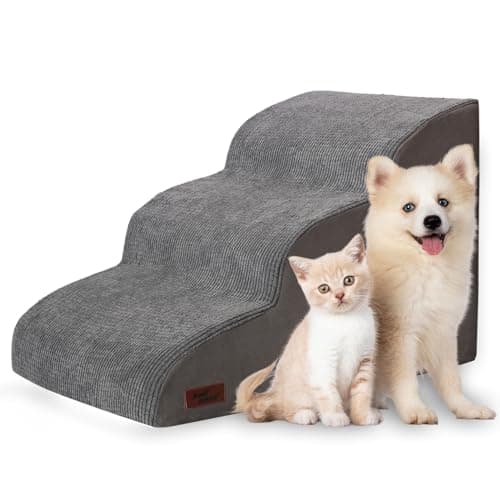
The short version: the Aodisman 3-step is the couch-height default; the EHEYCIGA 3-step is the sturdier build for a slightly bigger small dog; the Aodisman 5-step reaches a tall bed without steepening the risers; the PETMAKER foam set is the softest landing and the one for a dog that occasionally misjudges.
One group of small dogs should not be buying steps at all. For a long-backed, short-legged breed - a dachshund above all - a step asks the spine to flex and push off once per riser, which is the load you are trying to remove. Those dogs want a ramp, and the heights, lengths and training sequence are at ramps and steps for a dachshund.
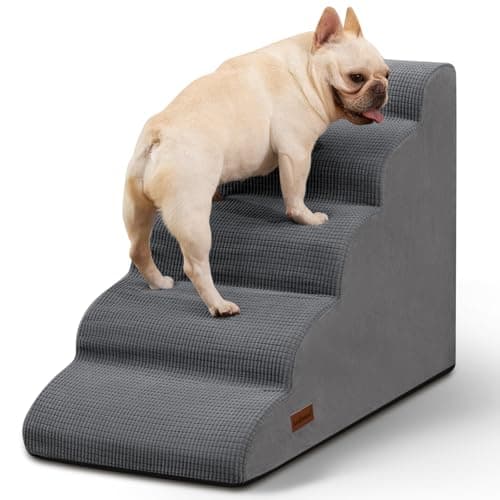
The five-step version, for the small dog whose problem is a tall bed rather than a couch. More steps at the same shallow rise, instead of fewer and steeper ones.
#ad · Live prices from the Amazon Product API, as of October 20, 2026. Where we have no verified live price we show none — we would rather leave a gap than print a number that has rotted.
In detail
The picks, in full
01
Couch height, small dogs
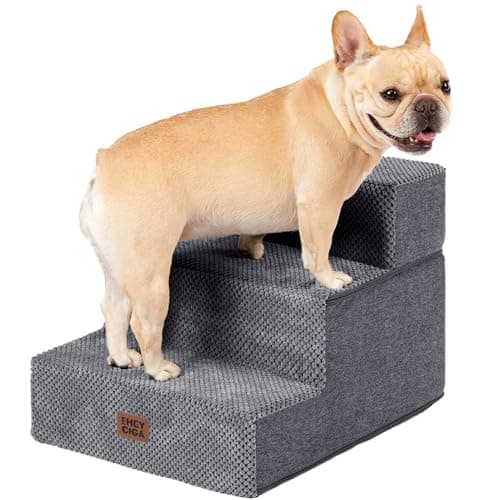
Aodisman 3-Step Pet Stairs & Ramp
3 stepsSized for small dogs and catsNon-slip step surfacesFor bed or couch access
8.4/10
Three shallow steps for a small dog getting onto the couch — low enough that a long-backed dog does not have to arch its spine to make the climb.
Riser height
9
Stability
7.5
Grip
8
Footprint
8.5
Value
9
Pros
+Riser height is genuinely small — that is the whole design brief
+Light enough to move between the couch and the bedroom
+Cheap enough to buy two and leave one at each spot
Cons
−Small dogs only — it will not take a labrador
−Three steps tops out at couch height, not a high bed
Don't buy this if…
…your dog is long-backed and unsteady rather than simply short — a ramp keeps the spine straighter than any staircase can.
5 stepsFor high bedsSized for small dogs and catsNon-slip surfaces
7.8/10
The five-step version, for the small dog whose problem is a tall bed rather than a couch. More steps at the same shallow rise, instead of fewer and steeper ones.
Riser height
8.5
Stability
7.5
Grip
8
Footprint
6.5
Value
8.5
Pros
+Keeps the per-step rise low by adding steps rather than height
+Reaches a bed height that three-step sets cannot
+Same small-dog footprint discipline as the 3-step
Cons
−Five steps is a long run — it juts out into the bedroom
−Still a small-dog product; check the capacity
Don't buy this if…
…you have no floor space beside the bed — a taller three-step set fits the gap, but your dog pays for it in riser height.
Measure three things. The height of the furniture from the floor. Your dog's elbow height when it is standing. And the free floor space beside the furniture. Then take total height divided by the number of steps and compare it to the elbow measurement — if the per-step rise is more than the elbow height, the set is too steep for that dog, however good it looks.
Ramp or steps, for a small dog
If you have the floor space and your dog is long-backed, take the ramp. If floor space is the constraint — and in a bedroom it usually is — take the steps with the lowest risers you can find, and place them so the dog approaches straight on rather than at an angle. Our ramp versus stairs comparison covers the decision in full.
Foam, plastic or wood?
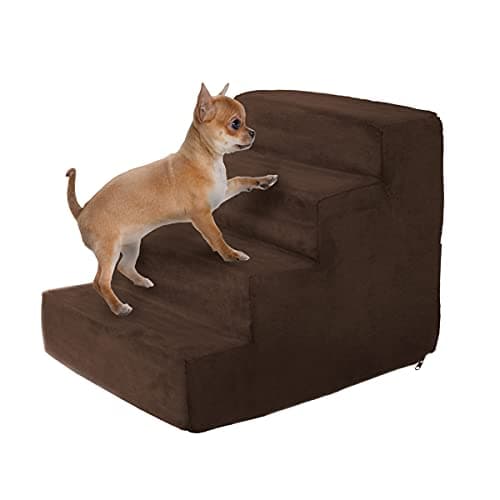
Foam sets are light, soft-edged and forgiving of a missed step, which suits an unsteady or partially-sighted dog. They compress over time and the covers need washing. Plastic sets are rigid and wipe clean, but they can slide on hard floors and their surfaces are often slicker than they look. Wood is the most stable and the least portable. For a small senior dog in a bedroom, foam is usually the right compromise.
The part everyone forgets: the landing
Your dog comes down these too, and coming down is when small dogs get hurt. Put a rug at the bottom. If the floor there is hardwood or tile, that rug is not optional — it is the difference between a controlled arrival and a slide. Our stop-slipping guide explains why the bottom of any step is a high-risk spot.
Training a small dog onto steps
Small dogs are often more suspicious of new furniture than big ones, because a wobble affects them more. Start with the set flat on the floor if it folds, reward standing on the bottom step only, and build up one step at a time over several days. Never lift and place a dog partway up — that teaches it the steps are something that happens to it. The full method is in our training guide.
Two sets beats one, if the budget allows
Small senior dogs typically have two destinations: the couch in the evening and the bed at night. One set that gets dragged between rooms will eventually not get dragged, and your dog will jump. At these prices, two is a reasonable answer.
If your dog is at the other end of the scale
Everything on this page is sized for a small dog, and most of it is the wrong answer for a big one: foam compresses under a heavy dog, and a narrow tread leaves a large paw hanging over the edge. For a dog of 60 pounds or more, our ramps and steps for large dogs starts from the listed weight capacity and the width of the walking surface instead.
How we chose
We haven't lab-tested these
We compiled the published specifications, manufacturer manuals and aggregated owner reviews, then scored each product against a published rubric. The scores are judgments from that research — they are not measurements we took in a lab, because we don't have one and we won't pretend we do. Prices are pulled live from Amazon; where we can't verify one, we say "check price" rather than print a stale number.
Questions
Frequently asked
What height should dog steps be for a small dog?+
Aim for a per-step rise no greater than your dog's elbow height when standing. Measure the furniture height, divide by the number of steps, and compare. If the number is higher than the elbow, choose a set with more steps rather than a more compact one — a compact set is compact because the risers are tall.
Are stairs or a ramp better for a dachshund?+
A ramp, where you have space for one. Long-backed breeds carry a known predisposition to disc disease, and a slope keeps the spine level where steps ask it to flex on every riser. If only steps will fit, prioritize the lowest possible riser height. Any dog with a diagnosed disc problem should follow its vet's restrictions first.
Will pet steps stop my small dog jumping off the bed?+
Only if the dog reliably uses them, which takes a few days of patient work and a set it trusts not to wobble. Placement helps: put the steps where your dog already jumps down, not where it is tidiest. Some owners also block the jump-down side with a cushion during the training period.
Are foam pet steps sturdy enough?+
For a small dog, yes — and the soft edges are an advantage if your dog occasionally misjudges a step. The trade-offs are compression over time and covers that need washing. For a heavier dog, foam compresses too much and a rigid set is the safer choice.
We don't run a testing lab, and we don't pretend to. Product facts are compiled from manufacturer listings and manuals; health facts are cited to reputable veterinary sources. Where we couldn't verify something, we say so on the page rather than quietly leaving it out. Read our full method.