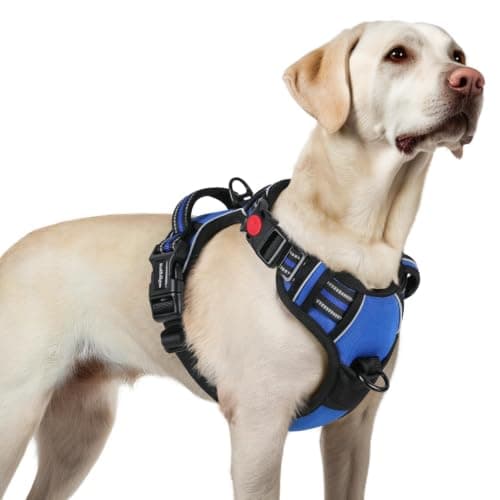
Every other harness page on this site is about lifting. This one is about the harness you clip a leash to twice a day - and the thing that actually decides it for an arthritic dog is whether it can be put on without asking the dog to lift a paw or push its head through a hole.
We earn a commission when you buy through our Amazon links, at no extra cost to you. It never changes our rankings, and we say so when the cheaper product is the better buy. How this works.
The verdict first. For most older dogs the right buy is a harness that opens out completely - the rabbitgoo three-buckle, which goes on around a standing dog and closes, with no paw lifted and no head pushed through a loop. If your dog still walks a long way and tolerates being handled, the Ruffwear Front Range is better made and better padded and will outlast three cheap ones. If you need a hand under the dog on a curb or a step, the Ruffwear Web Master has a handle designed for it. Small dogs are a different shape of problem and the Gooby Comfort X keeps pressure off a fragile windpipe. The PetSafe Easy Walk is last, and only for one dog: the old one that still tows you down the street.
This page exists because the rest of this hub does not cover it. Our rear-leg slings, full-body lift harnesses and sling-versus-harness guide are all about taking a dog's weight. None of them answers the ordinary question, which is what to clip a leash to on a dog whose shoulders hurt. The answer is not the same harness a young dog wears, and the reason is mechanical rather than medical.
How we chose: the four things that matter on an old dog
We ranked these on criteria that barely feature in a normal harness review, because the dog is the constraint rather than the walk.
How it goes on. The single biggest factor, and the one nearly every review ignores. There are three motions: over the head, step-in (two front paws through two holes), and fully opening (wrap and buckle). For an arthritic dog, fully opening beats step-in beats over the head - and for an owner with weak hands or a bad back, the same order holds. A harness that starts a daily argument gets abandoned, and an abandoned harness is worse than a cheap one.
Where the straps sit. Old dogs are bonier. A strap that crosses the point of the shoulder, or a thin band over a prominent sternum, rubs in a way it would not on a padded young dog. Padding is not a luxury here; neither is a wide strap.
Whether it restricts the shoulder. Dogs carry roughly two thirds of their weight on the front end, and a stiff dog needs its full stride. We are wary of anything whose stated mechanism is pressure across the shoulder, which is exactly what a front-clip no-pull harness is designed to do.
Whether there is something to hold. Not for lifting - for steadying. Most senior-dog walks have two or three moments in them: a curb, a step, a slippery threshold. A handle turns those into a non-event.
Two things we deliberately did not weight heavily: escape-proofing, which matters for a bolting young dog and rarely for an arthritic one, and looks.
The motion problem, in detail
Watch yourself put a normal harness on. You hold a loop open, your dog lowers its head through it, then you pick up one front leg and post the paw through a second hole, then the other. That asks the dog to flex its neck, balance on three legs, and let you flex a shoulder and an elbow through a range it may not have any more. On a dog with shoulder arthritis or a sore neck, it is the hardest thirty seconds of the walk.
A fully opening harness removes every part of that. The dog stands still; the harness goes around it like a coat; two or three buckles close. Nothing lifts, nothing bends, and you can do it with one hand against a wall. That is why our top pick is not the best-built harness on this page.
A step-in is a middle case, and it is genuinely fine for many small dogs - a 12 lb dog can be steadied with one hand while you place a paw. It is a poor fit for a big dog that cannot balance on three legs.
Harness or collar for an old dog?
A harness, in almost every case. A collar puts the whole force of a leash across the throat, and in an old dog that can mean coughing, gagging and pressure on a windpipe that may already be weakening - small breeds especially. A harness spreads that load over the chest. The exception is a dog that is genuinely never on a tight leash and finds anything around the body intolerable, which is a real dog but not a common one.
What a walking harness is not is a mobility aid. If you are reading this because you are holding your dog up, you want a rear sling or a full-body lift harness, and the difference between those two is set out at sling or lifting harness.
Sizing, which is where most of these go wrong
Harness returns are nearly all sizing, and the number people use is the wrong one. Weight is a proxy; the measurement that decides fit is the girth - the circumference of the chest at its deepest point, just behind the front legs - and on some harnesses the neck circumference as well. Measure with a soft tape over the coat, with the dog standing, and use the chart belonging to the harness you are buying rather than a generic one. Brands do not agree with each other.
Two senior-specific notes. An old dog's shape changes: muscle goes from the back end and the topline, and a harness that fitted last year may now slide. That is the argument for four adjustment points rather than two. And if your dog is losing muscle rather than gaining fat, read why an old dog loses muscle in its back legs - the harness is a symptom of that, not a fix for it.
Our full measuring walkthrough, written for slings but the same tape and the same points, is at how to measure your dog, and the troubleshooting for a harness that rubs or slides is at getting a harness to fit.
Five rules for the first week
Fit it indoors, twice, before a walk. On, adjusted, off. A dog that learns the harness means a fight will fight it for years.
Two fingers under every strap. Snug enough that it cannot rotate, loose enough for two fingers flat underneath.
Check the skin where the straps sit for the first few walks, especially behind the elbows. Thin old skin tells you about a rub before the dog does.
Take it off at home. Nothing stays on a sleeping dog. A harness left on all day is how you get a matted, rubbed patch under the chest strap.
Re-measure every few months. A changing old dog needs the straps moved, and nobody remembers to do it unless they decide to.
What a harness will not fix
Three things, and they are the commonest reasons an owner buys a harness and is still unhappy a week later.
Slipping indoors. A harness does nothing for grip. If the problem is a dog scrabbling on a hard floor, the answer is on the floor and on the feet: the best traction gear.
Getting into the car. Lifting a dog by a walking harness is how owners hurt their backs and their dogs. Use a ramp - dog ramps for the car - or a sling with a handle designed for load.
A dog that has stopped wanting to walk. That is pain, or a heart or a breathing problem, and it is a vet question. Start at signs your senior dog is in pain.
How long these should last
A well-made harness in daily use is a multi-year item; a budget one is a one-to-two-year item, and the parts that go are the hook-and-loop (which stops gripping once it fills with hair) and the stitching at the D-ring. Check the ring and the stitching around it every few months by pulling on it hard with your hands - that is the point the whole thing depends on. Replace rather than repair anything that takes leash load.
The one harness here that does not ask your dog to do anything. Three buckles mean it opens out flat, goes on around a standing dog and closes — no paw lifted, no head pushed through — which is the whole problem for an arthritic dog and almost the only thing that matters.
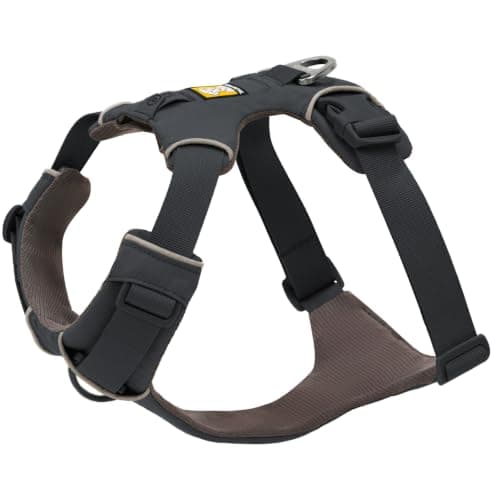
The best-made everyday harness in this group and the one we would buy for a dog that still walks a long way. Four adjustment points and real foam padding mean it sits where you put it instead of rubbing a bony old chest.
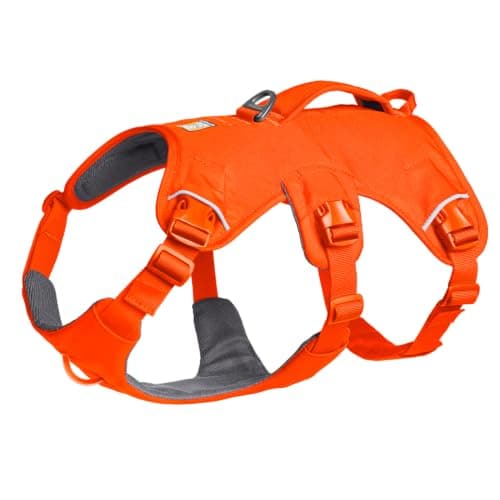
A walking harness with a proper handle built into it, for the dog that walks on its own most of the time and needs a hand over the curb, the step or the last ten yards. This is the overlap between a harness and a sling, and it is the right tool for exactly that in-between stage.
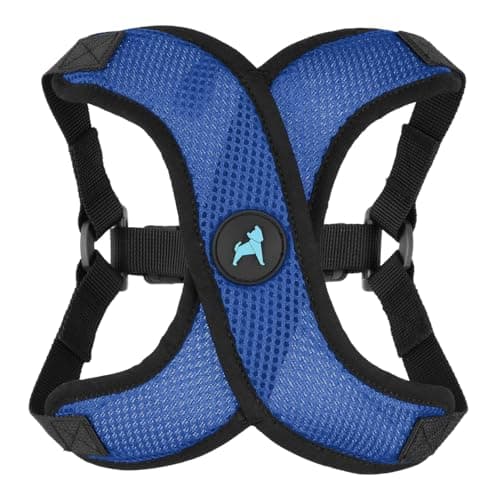
The small-dog answer. A step-in X-frame sits across the chest instead of around the throat, which is what you want on a little old dog with a collapsing windpipe or a fragile neck — and the mesh is light enough that a 10 lb dog does not notice it.
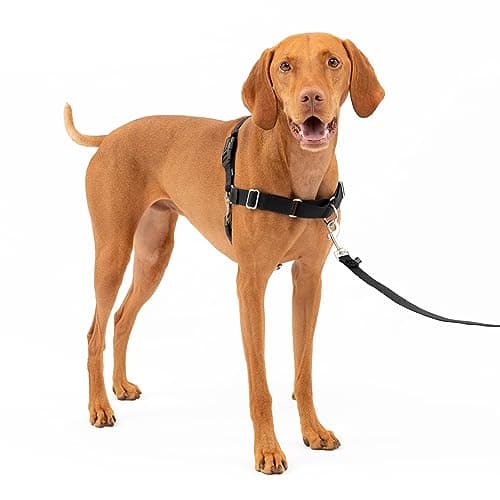
The answer to one specific problem: an old dog that still pulls, and an owner who is being towed. The front-chest clip turns the dog rather than letting it lean into the leash, and it stops the gagging you get from a collar.
#ad · Live prices from the Amazon Product API, as of October 25, 2026. Where we have no verified live price we show none — we would rather leave a gap than print a number that has rotted.
In detail
The picks, in full
01
A stiff dog that hates being dressed
rabbitgoo Easy On & Off Dog Harness (3 buckles)
Three buckles, opens fully (listed)Two leash clips, front and back (listed)Control handle on the back (listed)Soft padded, reflective (listed)
8.3/10
The one harness here that does not ask your dog to do anything. Three buckles mean it opens out flat, goes on around a standing dog and closes — no paw lifted, no head pushed through — which is the whole problem for an arthritic dog and almost the only thing that matters.
Easy to put on
9.5
Comfort on old joints
8
Adjustability
8
Build quality
6.5
Value
9.5
Pros
+Fully opening design is genuinely easier on a dog that cannot lift a front paw or duck its head, and easier on an owner doing it one-handed
+The back handle gives you something to hold on a curb or a step without buying a second piece of kit
+Front clip is there for the days your old dog still pulls
+Cheapest harness on this page by a wide margin, so a sizing mistake does not hurt
Cons
−Three buckles means three things to adjust the first time, and getting it even takes a go or two
−The handle is for steadying, not for lifting — it is stitched to a nylon vest, not to a load-bearing frame
−Budget hardware: the buckles and stitching are fine for a walk and are not what we would trust on a dog that hauls
Don't buy this if…
…you need to take real weight off your dog — that is a lift harness or a sling, not a walking harness.
Price as of October 25, 2026. Prices change — Amazon's is the one that counts.
#ad · we may earn a commission from this link to rabbitgoo Easy On & Off Dog Harness (3 buckles)
02
A senior dog that still does proper walks
Ruffwear Front Range Dog Harness
Four points of adjustment (listed)Foam padded for all-day wear (listed)Two leash attachment points (listed)ID pocket and reflective trim (listed)
8.3/10
The best-made everyday harness in this group and the one we would buy for a dog that still walks a long way. Four adjustment points and real foam padding mean it sits where you put it instead of rubbing a bony old chest.
Easy to put on
6.5
Comfort on old joints
9
Adjustability
9.5
Build quality
9.5
Value
7
Pros
+Four adjustment points is the difference between a harness that fits a changing old dog and one that nearly fits
+Padding is thick enough to matter over a prominent sternum or a thin-skinned chest
+Holds its shape and its fit over years, which is why it turns up on so many long-term owner reports
+Both a chest clip and a back clip, so one harness covers a pulling day and a plodding one
Cons
−Goes on over the head. For a dog with neck arthritis or a dog that resents being handled, that is the wrong motion and the rabbitgoo is the better buy
−Three to four times the price of the budget picks here
−Not a support harness — the webbing across the back is not a lifting handle and should not be used as one
Don't buy this if…
…your dog flinches when you move its head or neck — buy something that opens out flat instead.
Three-strap design, resists backing out (listed)Handle for lift and assist (listed)Side-release neck buckle (listed)Three leash attachment points (listed)
8.2/10
A walking harness with a proper handle built into it, for the dog that walks on its own most of the time and needs a hand over the curb, the step or the last ten yards. This is the overlap between a harness and a sling, and it is the right tool for exactly that in-between stage.
Easy to put on
7.5
Comfort on old joints
8.5
Adjustability
9
Build quality
9.5
Value
6.5
Pros
+The handle is designed and stated for assistance rather than bolted on, which is not true of most vest handles
+Three straps spread the load and stop a shrinking old dog reversing out of it
+The neck buckle releases, so it does not have to go over the head like the Front Range
+Does two jobs, which means one harness on the dog instead of changing kit halfway round
Cons
−Most expensive thing on this page, and overkill for a dog that only needs a leash attachment
−A single mid-back handle lifts the middle of the dog — for a back end that has genuinely gone you want a rear sling that lifts the hips
−More straps to get right, and a poor first fit undoes the point of it
Don't buy this if…
…you are lifting your dog's back end several times a day — a rear-support sling is built for that and this is not.
The small-dog answer. A step-in X-frame sits across the chest instead of around the throat, which is what you want on a little old dog with a collapsing windpipe or a fragile neck — and the mesh is light enough that a 10 lb dog does not notice it.
Easy to put on
7.5
Comfort on old joints
8
Adjustability
7
Build quality
7.5
Value
8.5
Pros
+Keeps pressure off the throat, which matters more on small breeds — collapsing trachea and a reversing cough are common in exactly this group
+Light mesh rather than webbing, so there is very little harness on a very small dog
+One buckle to close once it is on, and the whole thing dries fast after a wet walk
Cons
−Step-in means two front paws have to go into two holes, which is the one motion an arthritic shoulder or a dog that cannot balance on three legs finds hard
−The listing describes a contracting fit that tightens if the dog pulls — fine on a 10 lb dog, not a mechanism we would want on a sore chest
−Small sizes only in practice; this is not a large-dog harness
Don't buy this if…
…your dog cannot lift its front paws or balance while you thread them — a fully opening harness goes on around the dog instead.
The answer to one specific problem: an old dog that still pulls, and an owner who is being towed. The front-chest clip turns the dog rather than letting it lean into the leash, and it stops the gagging you get from a collar.
Easy to put on
7
Comfort on old joints
5.5
Adjustability
7.5
Build quality
7
Value
8.5
Pros
+Genuinely stops a strong dog towing a smaller or older owner, which is a safety problem and not a manners problem
+Front clip takes all the pressure off the throat — the listing's own point about preventing gagging is the real benefit for an old dog
+Cheap, widely stocked, and sized in a lot of steps
Cons
−The maker's own stated mechanism is gradual pressure across the SHOULDER. On a dog with shoulder or elbow arthritis that is the last place you want a corrective force, and it is the reason this is not our overall pick
−The martingale tightens when the dog pulls, so it is a training tool with a job to do rather than something to leave on a pottering dog
−No handle, no back clip, and the straps are thin — nothing here is padded for a bony old chest
Don't buy this if…
…your dog has a sore shoulder or elbow, or has stopped pulling anyway — then this solves a problem you no longer have and presses on one you do.
Most older dogs: the rabbitgoo, because it opens flat and the fight disappears.
A dog that still walks miles: the Front Range, for the padding and the four adjustment points - if your dog does not mind the over-the-head motion.
A dog that needs a hand now and then: the Web Master, for a handle that is actually built for assistance.
A small dog: the Gooby, to keep the leash off a fragile throat.
An old dog that still pulls: the Easy Walk - with our caveat about shoulder pressure understood, and only while the pulling lasts.
Prices move, so every figure on this page is pulled live from the listing with the date it was checked beside it. We have not walked dogs in all five of these; the scores are judgments from the makers' published specifications and aggregated owner reports against our published rubric, and the honest cons on each pick are the part we would want read first.
How we chose
We haven't lab-tested these
We compiled the published specifications, manufacturer manuals and aggregated owner reviews, then scored each product against a published rubric. The scores are judgments from that research — they are not measurements we took in a lab, because we don't have one and we won't pretend we do. Prices are pulled live from Amazon; where we can't verify one, we say "check price" rather than print a stale number.
Questions
Frequently asked
What is the best harness for an older dog with arthritis?+
For most arthritic dogs, one that opens out fully and wraps on - our pick is the rabbitgoo three-buckle, because it needs no paw lifted and no head pushed through a loop. That single feature matters more on a stiff dog than padding, branding or price. If your dog is comfortable being handled and walks a long way, the Ruffwear Front Range is better made and better padded.
Is a harness or a collar better for a senior dog?+
A harness, in nearly every case. A collar concentrates leash force on the throat, which in an older dog can mean gagging, coughing and pressure on a weakening windpipe - a particular issue in small breeds. A harness spreads the same force across the chest. The front-clip designs go further and specifically prevent gagging, which is their real benefit for an old dog.
Are no-pull harnesses bad for arthritic dogs?+
They are worth being careful with. A front-clip no-pull harness works by applying pressure across the chest and shoulder when the dog leans into the leash - PetSafe states gradual shoulder pressure as the Easy Walk's own mechanism. On a dog with shoulder or elbow arthritis, that is the wrong place for a corrective force, and it is why we rank it last here despite it doing its job well. If your old dog genuinely still pulls hard enough to be a safety problem, the trade can be worth making - deliberately, and not forever.
How do I get a harness on a dog that cannot lift its legs?+
Buy one that does not ask it to. A fully opening harness - three buckles rather than two fixed loops - goes around a standing dog like a coat and closes, so nothing has to be lifted, bent or threaded. Failing that, have the dog lie on its side on a bed and fasten it there, which is often easier than fighting gravity with a standing dog.
Can I lift my dog by its walking harness?+
For a steady on a curb, yes, if the harness has a handle stated for assistance - the Web Master does. For genuinely taking your dog's weight, no. A vest handle stitched to nylon is not built for load, a mid-back handle lifts the middle of the dog rather than the hips, and this is how owners injure their own backs. For real lifting, buy a rear-support sling or a full-body lift harness.
How should a dog harness fit?+
Size on girth - the chest circumference at its deepest point just behind the front legs - rather than on weight, using the chart for that specific harness. Once it is on, you should be able to slide two fingers flat under every strap, and the harness should not rotate when you tug it. Re-measure an old dog every few months: muscle loss changes the shape a harness was fitted to.
We don't run a testing lab, and we don't pretend to. Product facts are compiled from manufacturer listings and manuals; health facts are cited to reputable veterinary sources. Where we couldn't verify something, we say so on the page rather than quietly leaving it out. Read our full method.