Socks are the cheapest fix for a slipping old dog and the one most likely to end up under the sofa. Here is what separates a pair that works from a pair your dog kicks off in a minute.
We earn a commission when you buy through our Amazon links, at no extra cost to you. It never changes our rankings, and we say so when the cheaper product is the better buy. How this works.
Non-slip socks are the first thing most owners try when an old dog starts scrabbling on the hardwood, and they are the right first thing to try: they cost very little, they work immediately, and they need no training. They also fail more often than any other product on this site, and almost always for the same two reasons.
The first is that the sock rotates on the paw, so the grip ends up on top and the smooth fabric ends up on the floor. The second is sizing — a sock loose enough to be comfortable is a sock that comes off, and a sock tight enough to stay on can restrict a paw. Get both right and socks are excellent. Get either wrong and you have wasted an afternoon.
What we ranked on
Grip. How much traction the sole actually adds, and — critically — whether the sock still grips when it has twisted. Double-sided grip is the design that solves this properly, and it is the feature we weighted most heavily.
Stays on. Straps, elastic and cuff design. A sock that only stays on while the dog stands still is not a traction product.
Durability. Socks live on a floor and go through the wash constantly. Thin ones wear through within weeks under a heavy dog.
Comfort. Old dogs have thin pads and sometimes arthritic toes. A stiff or over-tight sock is a new problem, not a fix.
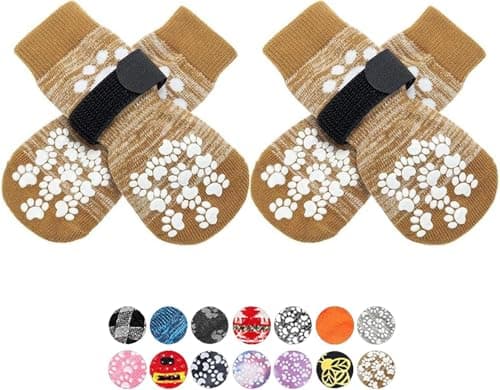
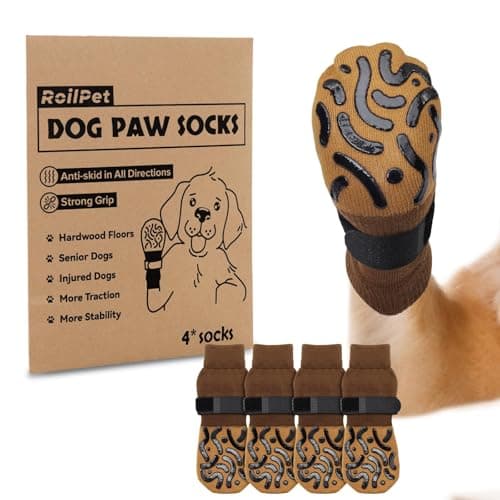
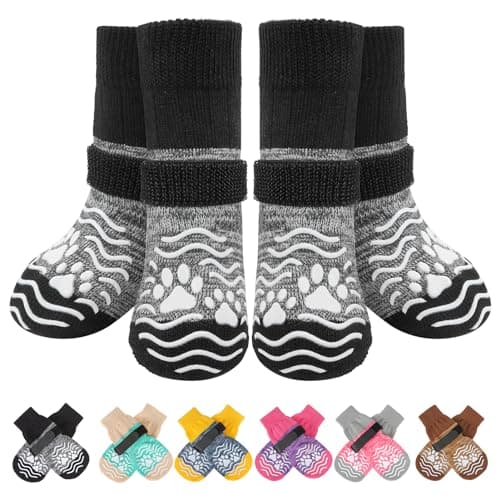
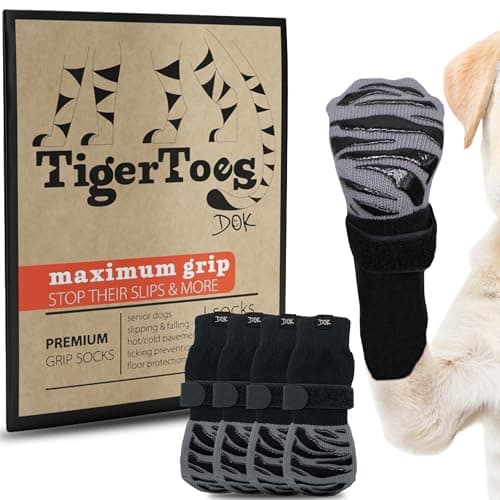
The short version: the DOK TigerToes are the ones we would buy, because they grip whichever way they have twisted; the EXPAWLORER are the reliable mid-price all-rounder; the Roilpet are the cheap double-sided pair to keep as spares; the PUPTECK are the ones to buy first if you have no idea whether your dog will tolerate socks at all.
Worth knowing if you are buying these as a present rather than for your own dog: socks are one of the few genuinely useful things in this category that fit in a stocking and cost almost nothing. We have collected that end of the site at stocking stuffers for an old dog.
The question that usually arrives alongside this one is whether a boot would be better than a sock. For indoor slipping the answer is normally no - but there are three situations where it is yes, and they are set out at dog socks vs boots.
Sizing is the other thing that decides whether a sock works, and it bites hardest at the small end: measure the paw on paper rather than reading a weight chart, because small-dog sizing tends to run tight. The picks and the measuring method for a little dog are at traction gear for small dogs.
The whole-paw fix. Socks cover the pad with a grippy sole, which is the fastest way to give a scrambling dog traction on the whole foot — if your dog tolerates wearing them.
#ad · Live prices from the Amazon Product API, as of October 20, 2026. Where we have no verified live price we show none — we would rather leave a gap than print a number that has rotted.
In detail
The picks, in full
01
A dog that twists its socks
DOK TigerToes Premium Non-Slip Dog Socks
Extra-thick grip surfaceGrips even when twistedListed as helping prevent paw lickingMultiple sizes
8.3/10
Thick-gripped socks built for the failure everyone hits: the sock twists round the paw and the grip ends up on top. These grip either way up.
Grip
9
Stays on
8.5
Durability
8.5
Comfort
8
Value
7.5
Pros
+Grip works whichever way the sock has rotated — the single most useful feature in this category
+Thick enough to last more than a fortnight of daily wear
+Also covers a paw a dog is licking raw
Cons
−Thicker fabric is warmer than thin socks in a hot house
−Priced above the throwaway multipacks
Don't buy this if…
…your dog kicks socks off within seconds — no sock design survives that dog, and toe grips are the answer.
The whole-paw fix. Socks cover the pad with a grippy sole, which is the fastest way to give a scrambling dog traction on the whole foot — if your dog tolerates wearing them.
Grip
8.5
Stays on
7
Comfort
8
Value
9
Pros
+Covers the entire pad — grip everywhere the foot lands
+Straps help them stay on better than plain socks
+Cheap enough to keep spare pairs
Cons
−Some dogs dislike socks and shake them off
−Need the right size and periodic re-fitting
Don't buy this if…
…your dog won't keep anything on its feet — toe grips or paw wax leave the pad bare.
Do not size by your dog's body weight. Measure the paw: stand your dog on a piece of paper, press the paw flat, and mark the width at the widest point and the length from the back of the pad to the tip of the longest nail. Compare that against the maker's chart. Two dogs of the same weight routinely take different sock sizes.
Front and back paws are frequently different sizes on the same dog — front paws are usually larger. If a set comes as four identical socks and your dog is between sizes, fit the fronts first.
Making them stay on
Trim the fur between the pads. Long paw fur makes the sock slide off and reduces the dog's own grip at the same time. This is a two-for-one job.
Keep the nails short. Long nails push through sock fabric and change how the paw sits inside it. They also change how the paw meets the floor in the first place, which is why we mention nails on every traction page.
Put them on with the strap at the front of the leg. A strap that ends up behind the dewclaw tends to work loose.
Give it three days. Most dogs do the high-stepping-marionette walk for the first few minutes. Distract with a short walk or a meal rather than watching them.
When socks are the wrong answer
Some dogs will not accept anything on their feet, and no amount of patience changes that. Others chew them off within seconds. For those dogs the answer is grip that attaches to the nail or the pad instead — rubber toe grips or stick-on pads, both covered on our toe grips page and compared head-to-head in toe grips versus socks.
Socks are also a poor choice for a dog with an open sore, a hot spot or an infection on the paw — the covering keeps moisture in. And they should not go on a dog with a bandaged foot unless your vet has said so.
Socks are half the answer at most
Even the best socks only add grip where the dog's foot lands. They do nothing about the fact that the route from bed to water bowl is a sheet of polished wood. The cheapest and most effective fix in this whole hub is a continuous grippy path through the house — we lay that out room by room in our floor setup guide, and the stairs get their own treatment on our stair treads page.
Washing and rotation
Buy two sets. Grip socks pick up everything off the floor and lose traction when they are dirty, and a dog with no socks while the only pair is in the wash is a dog slipping. Wash them on a cool cycle and air-dry — hot drying degrades the rubberized grip faster than anything else you can do to them.
How we chose
We haven't lab-tested these
We compiled the published specifications, manufacturer manuals and aggregated owner reviews, then scored each product against a published rubric. The scores are judgments from that research — they are not measurements we took in a lab, because we don't have one and we won't pretend we do. Prices are pulled live from Amazon; where we can't verify one, we say "check price" rather than print a stale number.
Questions
Frequently asked
Do non-slip dog socks really work on hardwood floors?+
Yes, for dogs that will keep them on. The rubberized sole adds real traction where the dog's own pads have gone smooth. The two failure modes are the sock rotating so the grip faces upward — which double-sided designs solve — and the sock coming off, which is usually a sizing problem rather than a product one.
How do I stop my dog's socks falling off?+
Measure the paw rather than sizing by body weight, trim the fur between the pads, keep the nails short, and fit the strap at the front of the leg. If a correctly-sized sock still comes off within minutes, your dog is probably a toe-grip candidate rather than a sock candidate.
Can a dog wear non-slip socks all day?+
It is better to use them for periods rather than continuously. Check the paws each time you take them off, looking for swelling, redness or cold toes, and do not leave them on an unattended dog for long stretches. Anything that wraps a limb can restrict circulation if it is too tight, and an older dog may not show discomfort clearly.
Socks or toe grips for a senior dog?+
Socks cover the whole paw and give the most traction, but only if your dog tolerates them. Toe grips are rubber rings on the nails that leave the pad bare, so there is nothing to shake off — but they need reasonably healthy, long-enough nails to hold. Try socks first because they are cheaper; move to grips if your dog removes them.
We don't run a testing lab, and we don't pretend to. Product facts are compiled from manufacturer listings and manuals; health facts are cited to reputable veterinary sources. Where we couldn't verify something, we say so on the page rather than quietly leaving it out. Read our full method.