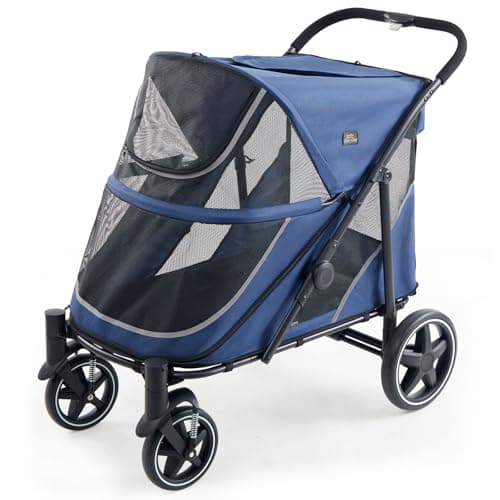
Strollers and wagons for the dog whose walk got too long
There is a stretch of a dog's life where the walk still matters but the distance no longer works. A stroller buys back the part your dog actually wants — the smells, the street, the outing — without the last half mile that costs them two days.
We earn a commission when you buy through our Amazon links, at no extra cost to you. It never changes our rankings, and we say so when the cheaper product is the better buy. How this works.
You usually notice it on a specific day. The dog turns for home at the corner instead of the park, or makes it round and then cannot get up the next morning. So the walks get shorter, then shorter again, until what is left is a trip to the end of the driveway and back — and the dog stands at the door anyway, because the walk was never really about the exercise.
A stroller is the piece of gear that gets that outing back. It is also the one owners feel most self-conscious about buying, which is why it is worth being clear about what it does and, just as importantly, what it must not be allowed to replace.
What a stroller is genuinely for
The AKC's chief veterinary officer, Dr. Jerry Klein, puts the case plainly: older dogs may have underlying mobility issues, arthritis or other health conditions that make it hard for them to walk for extended periods. The article's point is that a ride still delivers the sights, sounds and smells a dog goes out for. The sniffing is the walk. The mileage is mostly for us.
That is the honest case. A stroller converts a walk your dog cannot finish into an outing your dog can — a park they have not smelled in a year, a slow lap of the block at dusk, a seat in the shade while the household does something. For a dog whose world has been shrinking room by room, that is not indulgence.
And the part the marketing leaves out
The same AKC article is unusually blunt about the downside, and we are going to repeat it rather than bury it. Excessive or exclusive stroller use prevents a dog from exploring the world the way it would on a regular walk, and the article links that to a higher likelihood of anxiety and reactivity. It also says a stroller should not stand in for exercise, because some form of motion is needed to keep muscles and joints in tone.
VCA makes the same point about arthritic joints in four words: dogs need to use it or lose it. A stiff dog that stops moving gets stiffer, loses muscle over the joints that most need support, and gains weight — and weight is the single biggest lever you have. VCA is direct that maintaining a lean body condition is one of the best ways to reduce stress on arthritic joints.
So the rule this page is built on: walk out, ride back. Your dog walks the distance it can comfortably manage, and the stroller covers the distance it cannot. The stroller is what makes the outing longer than the dog's legs, not what replaces them. If yours starts getting into the stroller at the front door every day, something has changed and it is worth a conversation with your vet rather than a longer route. Our guide to gentle exercise for a stiff dog covers what the walking half should look like.
Small dogs, big dogs, and a number worth knowing
General stroller advice is written for small dogs. The AKC quotes Dr. Hunt saying dogs under 30 pounds are usually the ideal size for riding in strollers, and for the mainstream category that is fair — most strollers on a shelf are built around a 25 to 30 pound ceiling, and the Pet Gear pick below is rated to 25 pounds by its own manufacturer.
But this site is mostly about big old dogs, and there is now a real category of large-dog strollers and wagons rated well past 100 pounds. They work. What changes above 30 pounds is not whether the dog fits — it is that every constraint moves from the dog to you. A 110-pound-capacity stroller is a 30-pound object that folds to something the size of a suitcase, and you have to load it into a car, take it out again, and do that on the days you are already helping the dog. That is why half our scoring is about you.
What we scored these on
Listings compete on cup holders and fabric denier. None of that decides whether the thing gets used by March. These five do:
Easy entry. The height the dog has to clear to get in, or whether there is a ramp instead of a step. This is the criterion that separates a stroller your dog loads itself into from one you have to lift a stiff, heavy, sore animal into several times an outing. Manufacturers who publish a chassis or step-in height are telling you the most useful number on the listing.
Room inside. Floor length against your dog lying stretched out, and interior height against your dog sitting up. Most of these are lie-down boxes. A dog that likes to sit and watch needs a taller cabin, and a dog with a bad back needs a floor long enough to lie flat rather than curled against a wall.
Fold and lift. The stroller's own weight and its folded dimensions. The gap between the lightest and heaviest pick here is more than 25 pounds, which is the difference between a thing you take to the park and a thing that lives in the garage.
Ride quality. Wheel size, suspension and brakes, judged against real ground rather than a showroom floor. Six-inch wheels are for smooth sidewalks. Grass, gravel and curb cuts want eight inches or more, and a brake that locks properly matters most at the moment the dog is climbing in or out.
Value. What the money buys in capability, not in trim. The most expensive pick here is the best-designed one for an old dog and also the one we would hesitate to recommend to anyone loading a car alone.
Scores are judgments from published manufacturer specifications and listings, in line with our methodology. We have not measured a chassis height or weighed a folded frame, and where a figure appears below it is the manufacturer's and we say so. Every ASIN here was resolved live and confirmed in stock before publication, and every price on the page comes from our live price feed rather than a number typed into the article.
The one that solves the two problems a stiff dog actually has: a listed 10.5-inch chassis to step over, and doors at both ends so the dog walks straight through instead of turning around inside.
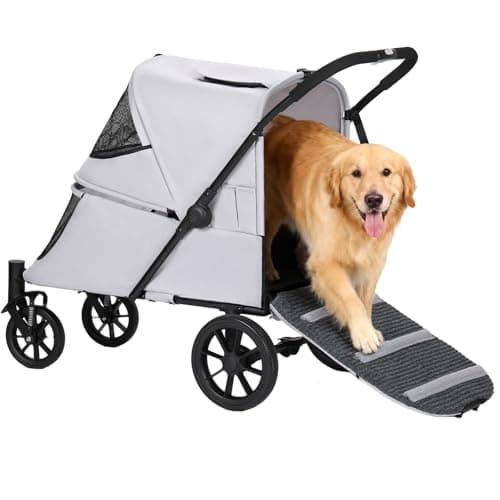
A built-in non-slip ramp instead of a step. For a dog that cannot lift its back legs over anything, that is the difference between loading itself and being carried in.
A long, low, lie-down box with the best handle adjustment here — five heights, set forward or back. If the person pushing has a bad back or is short, that adjustment is not a luxury.
A dog that rides lying down, and an owner who needs the handle to fit
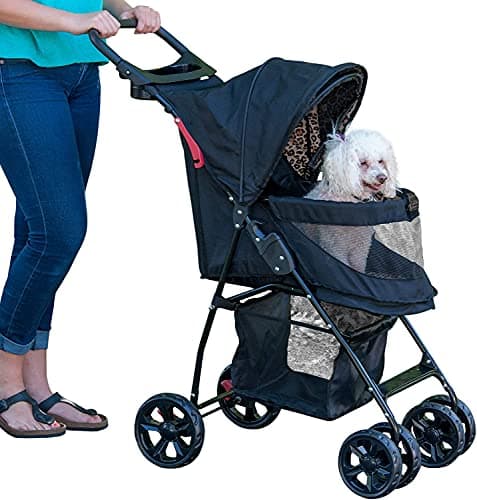
The small-dog answer, and quietly the best one here for an owner with weak hands: the entry latches and unlatches instead of zipping, and the whole stroller is a listed 11.5 lb.
A small senior dog, or an owner who cannot manage zippers
The only pick here whose listing was clearly written around elderly and injured dogs — a very low frame, a spinal-support pad, a canopy that lowers slowly, and a ramp you can add later.
A big dog with a bad back, if the budget stretches
#ad · Live prices from the Amazon Product API, as of October 19, 2026. Where we have no verified live price we show none — we would rather leave a gap than print a number that has rotted.
In detail
The picks, in full
01
Most medium and large senior dogs
CANINE CANYON All-Terrain Pet Stroller
Listed ultra-low chassis, 10.5 in off the groundFront and rear dual-door accessListed capacity up to 130 lb8 in front / 11 in rear wheels, one-foot brake
8.3/10
The one that solves the two problems a stiff dog actually has: a listed 10.5-inch chassis to step over, and doors at both ends so the dog walks straight through instead of turning around inside.
Easy entry
8.5
Room inside
8.5
Fold & lift
7.5
Ride quality
8.5
Value
8.5
Pros
+Walk-through doors mean a dog with a sore back never has to pivot inside a confined box
+The low chassis is the number that decides whether your dog loads itself or you lift it
+Removable, washable foam cushion — the part that gets muddy first
+One-button fold you can do with a leash still in the other hand
Cons
−At a listed 28.6 lb it is still a two-hands-and-a-knee job into a car trunk
−Folds to a listed 38 inches long — measure your trunk before you buy
−No ramp: the dog still has to make a 10.5-inch step, which some dogs cannot
−A recent listing with a short review history, so long-term durability is unproven
Don't buy this if…
…your dog can no longer lift a paw over a low curb — at that point you want a ramp, not a low step.
Non-slip entry ramp, listed as designed for senior and recovering dogsListed capacity up to 132 lbOne-pull cord fold; listed folded size 37.4 x 9.8 x 23.2 inShock-absorbing front wheels, rear locking brakes, integrated harness
8.3/10
A built-in non-slip ramp instead of a step. For a dog that cannot lift its back legs over anything, that is the difference between loading itself and being carried in.
Easy entry
9.5
Room inside
7.5
Fold & lift
8.5
Ride quality
8
Value
8
Pros
+The ramp removes the step entirely — the only entry a badly arthritic dog will manage unaided
+Folds thin (a listed 9.8 in) rather than merely short, which is what actually fits a car
+Locking rear brakes matter more with a ramp: the stroller must not roll as the dog walks up
+A sewn-in harness point, so you are not improvising a tether
Cons
−The listing publishes no interior floor length, so you cannot check it against your dog first
−A ramp adds a deploy-and-stow step to every single outing
−It only works on level ground — on a cambered sidewalk the ramp lands crooked
Don't buy this if…
…your dog still steps up onto a curb happily — you are paying for, and fighting with, a ramp you do not need.
A dog that rides lying down, and an owner who needs the handle to fit
Zoosky Pet Stroller for Large Dogs
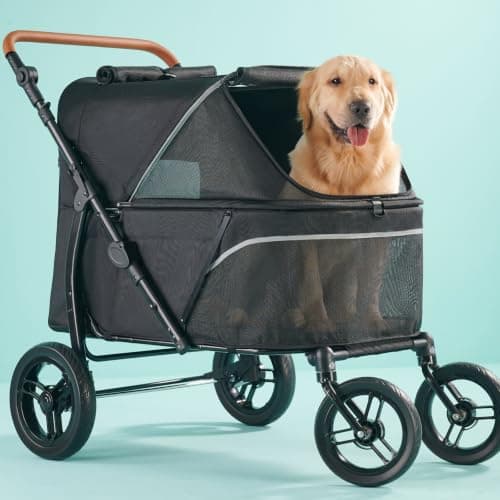
Listed interior 33 x 20 x 12 in; capacity up to 110 lbListed low entry, 12 in from the ground, with a rear mesh doorHandle listed with 5 heights from 38.6 to 44 in, forward or backward9 in front / 11 in rear wheels; 1680D Oxford body
7.9/10
A long, low, lie-down box with the best handle adjustment here — five heights, set forward or back. If the person pushing has a bad back or is short, that adjustment is not a luxury.
Easy entry
8.5
Room inside
8
Fold & lift
6.5
Ride quality
8.5
Value
8
Pros
+33 inches of floor is enough for a big dog to lie stretched out rather than braced
+The handle range is the accessibility feature nobody else lists — it is what stops you walking hunched
+A rear door means the dog enters from behind and never has to turn around inside
+Reflective strips and a wipeable base pad, both used more than you would expect
Cons
−12 inches of interior height means a tall dog cannot sit up — this is a lying-down ride
−Folds to a listed 47 x 30 x 19 in, the biggest folded footprint on this page
−The listing publishes no weight for the stroller itself, so you cannot judge the car lift in advance
Don't buy this if…
…your dog likes to sit up and watch the world go by — the low roof makes this the wrong shape for a curious dog.
A small senior dog, or an owner who cannot manage zippers
Pet Gear No-Zip Happy Trails Lite Pet Stroller
Easy-locking No-Zip entry — no zippers to workListed maximum capacity 25 lbListed stroller weight 11.5 lb6 in wheels, front shock absorbers, 3-position canopy
7.7/10
The small-dog answer, and quietly the best one here for an owner with weak hands: the entry latches and unlatches instead of zipping, and the whole stroller is a listed 11.5 lb.
Easy entry
7.5
Room inside
6
Fold & lift
9.5
Ride quality
7
Value
8.5
Pros
+A latch you push rather than a zipper you pinch — the most arthritis-friendly detail on this page
+Light enough that one person can lift it into a car without planning the move
+Removable liner and a safety tether come in the box
+An established brand with a long listing history, which is unusual in this category
Cons
−The listed 25 lb ceiling rules out most of the dogs this site is written for
−6-inch wheels are a sidewalk design — grass, gravel and curbs are hard work
−No ramp and a raised floor, so even a small stiff dog still has to be lifted in
Don't buy this if…
…your dog is over about 25 lb — read that capacity as a real limit, not a suggestion, and buy one of the large-dog picks instead.
A big dog with a bad back, if the budget stretches
ibiyaya Grand Cruiser Large Dog Stroller
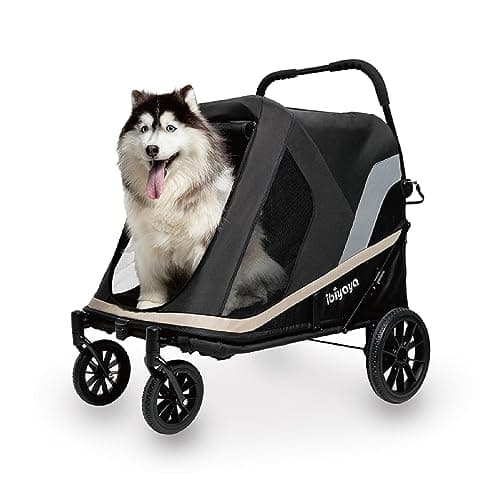
Listed low-lying frame, 23 cm from the ground, on 8 in front / 11 in rear wheelsInner pad listed as 4D air fiber for spinal supportAccessible dog ramp available as a separate purchaseCanopy locks at multiple angles with a slow-descend action
7.7/10
The only pick here whose listing was clearly written around elderly and injured dogs — a very low frame, a spinal-support pad, a canopy that lowers slowly, and a ramp you can add later.
Easy entry
9
Room inside
8.5
Fold & lift
5.5
Ride quality
9
Value
6.5
Pros
+The lowest listed frame on this page, and frame height is what decides self-loading
+A pad specified for spinal support rather than plushness — the right priority for an old back
+The slow-descend canopy stops a lid dropping on a dog that cannot move out of the way
+Wheels pull off for cleaning, which matters once mud and urine are part of the routine
Cons
−A listed 37.5 lb — the heaviest here, and the number most likely to defeat whoever loads the car
−The ramp that makes it fully step-free is sold separately, so the real price is above the sticker
−Costs several times the mid-range picks, and the extra buys refinement rather than capability
Don't buy this if…
…you have to load it into a car on your own — at this weight the stroller becomes the mobility problem.
Returns in this category are miserable — the box is enormous and half of them arrive partly assembled. Fifteen minutes with a tape measure prevents almost all of it.
Your dog, lying stretched out, nose to base of tail. That number has to fit inside the listed interior floor length, not the listed exterior size. A dog forced to curl in a short cabin is a dog that will not settle, and curling is exactly what a stiff spine does not want to do for half an hour.
The step your dog can currently clear. Watch it get into the car or over a threshold and note roughly how high that is. If your dog is already struggling with a 10-inch step, a 10.5-inch chassis is not a low entry for your dog — you want the ramp model. Our measuring guide for mobility gear covers how to take these numbers without wrestling the dog.
Your trunk opening, height and depth. Large-dog strollers fold to somewhere between three and four feet long. The listings publish folded dimensions; most buyers never look at them, and then discover the stroller only fits with a back seat down.
Stroller or wagon — the difference that matters
The two words are used almost interchangeably in listings, and the marketing distinction is mostly about wheel arrangement and how upright the cabin is. The one that changes anything for a senior dog is the back panel. A wagon-style body usually has a fold-down rear tailgate, and on several models that tailgate doubles as a ramp — which is the single feature that turns a stroller from something you lift a dog into to something a dog walks into.
If your dog can still make a modest step up, a low-chassis stroller is simpler, faster at the curb, and has one less thing to deploy. If your dog cannot lift its back legs over anything — the pattern you see when the hips have really gone — go straight to a ramp model and accept the extra thirty seconds at each end. The failure mode we would avoid is buying the ramp version for a dog that does not need it: it is one more thing to unclip in the rain, and things that take effort stop getting used.
Read the capacity number for what it is
A 130-pound rating is a statement about the frame, not a promise that a 130-pound dog will be comfortable. Frame capacity and usable space are different constraints, and the space runs out first: a 100-pound dog fits the weight rating of nearly every large pick here and the floor length of only some of them. Buy on interior dimensions, then check the weight rating has headroom.
The same logic applies at the small end, in reverse. A 25-pound ceiling on a lightweight stroller is a real engineering limit — the frame, the wheels and the fabric were designed around it. Loading a 40-pound dog into it does not gently degrade the ride; it bends things.
The lift is what decides whether you keep using it
This is the part almost no review mentions, and it is the reason plenty of these end up listed secondhand within a year. To use a stroller you have to get it out of the house, into the car, out of the car, unfolded, and then do the whole sequence backwards while managing a dog that may also need help walking. Do that with a 37-pound stroller and the outing has two hard physical tasks in it instead of one.
If you are the person doing the lifting and lifting is the problem — an older owner, a smaller owner, someone managing a shoulder or a back — weight it far above the features list. The lightest pick on this page weighs a manufacturer-listed 11.5 pounds, roughly a third of the heaviest, and for the right household that single number outranks everything else on the spec sheet. Our guide to managing a big dog when you cannot lift goes through the same trade-off across the rest of the gear.
Getting a dog to actually use it
Some dogs step in and lie down. Plenty do not, and a stroller a dog refuses is an expensive mistake. The AKC's advice is the ordinary, correct kind: start slowly with anything new, make every experience positive, and use treats during the ride — and for a genuinely nervous dog it mentions dog appeasing pheromone spray as an aid to settling into stroller travel.
In practice that means the stroller sits open in the living room for a few days before it ever moves. Feed a meal in it. Push it two houses down and come back. The failure pattern is identical to the one we describe on our page about a dog that will not use its ramp: the first experience was long, loud and unfamiliar, and the dog decided about the object in the first thirty seconds.
Heat, shade and the enclosed cabin
A mesh-canopied cabin sitting still in the sun is warmer than the sidewalk beside it, and the dog inside is not walking, so it is not generating airflow either. Every pick here has roll-up or zip-open mesh — use it, park in shade rather than sun when you stop, and treat a hot day in a stroller with the same caution as a hot day on a walk. Our guide to keeping a senior dog comfortable in summer covers the signs worth watching for.
The other job these do: the vet trip
The use case that surprises people is not the park. It is the veterinary clinic — a parking lot, a curb, a waiting room floor and a scale, all of which are hard on a dog that cannot walk far or stand for long, and all of which usually involve someone carrying it. A stroller turns that into a wheeled trip with the dog resting the whole time, and it gives an anxious dog somewhere of its own to be in a waiting room full of strangers. If the vet run is the hardest outing in your month, read taking an arthritic dog to the vet alongside this page — the two problems solve together.
How we chose
We haven't lab-tested these
We compiled the published specifications, manufacturer manuals and aggregated owner reviews, then scored each product against a published rubric. The scores are judgments from that research — they are not measurements we took in a lab, because we don't have one and we won't pretend we do. Prices are pulled live from Amazon; where we can't verify one, we say "check price" rather than print a stale number.
Questions
Frequently asked
Are dog strollers bad for dogs?+
Not in themselves — but the AKC warns that excessive or exclusive stroller use stops a dog exploring the world as it would on a walk, which it links to a higher likelihood of anxiety and reactivity, and says a stroller should not replace physical activity because some form of motion keeps muscles and joints in tone. VCA puts it as use it or lose it. Used as an extension of a shortened walk rather than a substitute for it, a stroller is a good buy; used to avoid walking, it makes a stiff dog stiffer.
What size dog can ride in a stroller?+
The AKC quotes a rough guide of dogs under 30 pounds as the ideal size for the mainstream stroller category, and most lightweight models are rated around 25 pounds by their own manufacturers. Large-dog strollers and wagons rated to 110 to 130 pounds are now a real category and they work — but check the listed interior floor length against your dog lying stretched out, because usable space runs out before frame capacity does.
Is a wagon or a stroller better for a senior dog?+
The useful difference is the back panel. Wagon-style bodies often have a fold-down rear tailgate, and on several models that tailgate is a ramp — so the dog walks in instead of being lifted. If your dog can still manage a modest step up, a low-chassis stroller is quicker and simpler at the curb. If it cannot lift its back legs over anything, buy the ramp version and accept the extra half-minute at each end.
How do I get my dog used to a stroller?+
Slowly, and before you need it. The AKC's advice is to start slowly with anything new and make sure each experience is positive, using treats during rides — and for a nervous dog it suggests dog appeasing pheromone spray. In practice: leave it open in the house for a few days, feed a meal in it, then push it a short distance and come home. Dogs decide about a new object in the first thirty seconds, so make the first thirty seconds boring and rewarding.
Should I buy a stroller or a wheelchair?+
They answer different questions. A wheelchair is for a dog that still wants to move under its own power and has lost the back end to do it — it gives independence back. A stroller is for a dog whose stamina or comfort has run out rather than its legs, and it gives range back. Plenty of households eventually own both, and the order is usually stroller first. Our page on when a dog needs a wheelchair works through that decision properly.
We don't run a testing lab, and we don't pretend to. Product facts are compiled from manufacturer listings and manuals; health facts are cited to reputable veterinary sources. Where we couldn't verify something, we say so on the page rather than quietly leaving it out. Read our full method.