Traction gear for a big dog: what actually holds under 80 pounds
A large dog does not slip the way a small one does. More weight means more shear through a smaller contact patch, and most grip gear is designed and reviewed on dogs half that size.
We earn a commission when you buy through our Amazon links, at no extra cost to you. It never changes our rankings, and we say so when the cheaper product is the better buy. How this works.
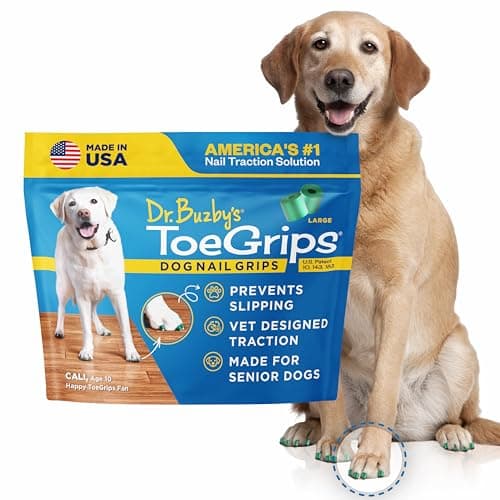
The short answer for a big dog: start with Dr. Buzby's ToeGrips, because they attach to the nail and there is nothing for a heavy dog to shear off; add EXPAWLORER non-slip socks for the floors and the trips where grips are not enough; and put a Madane hallway runner down on the route, because changing the floor is the only fix that does not depend on your dog cooperating. Those three cover most big-dog households. The two further picks below are for stairs and for paw-pad care.
Here is why a separate page. Traction gear is overwhelmingly designed around, and reviewed on, medium and small dogs. Put the same sock on an 85-pound labrador and two things change at once: the force trying to twist it off the paw roughly doubles, and the dog has far less margin for error when it does slip - a big dog going down on a hard floor lands harder, and gets back up with more difficulty. The published veterinary advice is the same for both sizes. The gear that satisfies it is not.
What changes when the dog is big
1. Shear, not grip, is what fails
A sock does not usually fall off a big dog. It twists. The dog pushes off, the fabric rotates around the paw, and the grippy underside ends up on top of the foot. Anything that relies on friction against the dog's own leg to stay in place - a short cuff, a thin elastic band - loses that argument faster on a heavy dog. The things that hold are a long cuff with a real strap, or a product that does not cover the paw at all.
2. The contact patch is smaller than you think
A big dog is not a scaled-up small dog; its paw area does not grow in proportion to its weight. That is the single sentence behind this whole page, and it is why nail-mounted grips do relatively better here: they work by giving the nail something to bite with rather than by covering a pad that is already overloaded.
3. Your dog weighs more than your floor covering
A light rug under a heavy dog slides. VCA's guide to a comfortable home for a mobility-compromised dog is explicit that rugs and runners must be non-slip and free of raised corners or edges that could trip your dog. On a big dog both halves of that sentence get harder: more force to move the rug, and a bigger stride length to catch a lifted edge with.
4. The stairs are the dangerous part
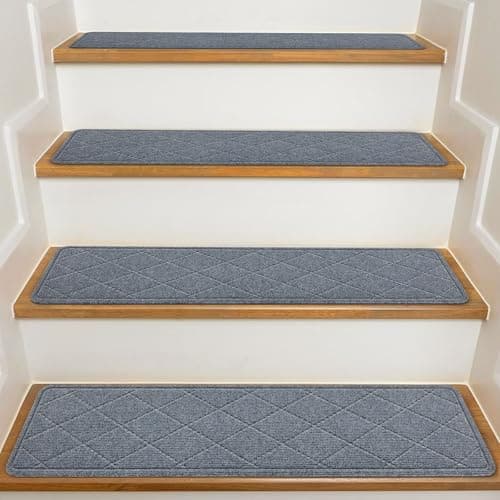
A large dog descending stairs arrives at the bottom with its weight thrown forward over the front legs. Canine Arthritis Resources and Education advises carpet or non-slip treads on the stairs plus carpet or a rug at the base of them, and on a heavy dog the landing matters at least as much as the treads.
5. You may not be able to catch your dog
This is the owner half, and it is this site's buyer. Nobody catches an 80-pound dog mid-slip. For a big dog, prevention has to be passive - already on the nails, already on the floor - because the version that depends on you reacting does not exist. If you are also lifting, read lifting a dog when you can't lift.
Which fix for which problem
The problem
For a big dog, buy
Scrabbling as it stands up on hardwood
Nail-mounted toe grips, plus a mat at the bed
Skating across tile or laminate on the daily route
A rubber-backed runner, end to end - not one rug in the middle
Socks that twist off within minutes
A long-cuff strapped sock, or stop using socks and use grips
The stairs
Treads, and a rug at the bottom - see stair treads
Cracked, dry pads on a dog that is outdoors a lot
Paw wax for pad care - it is not a traction product indoors
Nails long enough to touch the floor when standing
Every pick below is already recommended somewhere on this site; what this page does is rank them for a heavy dog, which changes the order. In short:
Dr. Buzby's ToeGrips - for the big dog that will not tolerate anything on its feet. Nothing to shear off, because nothing covers the paw.
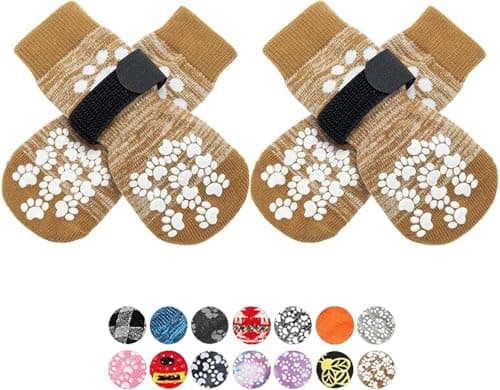
EXPAWLORER non-slip socks - for the dog that will wear socks, and for the floors and outings a rug cannot cover.
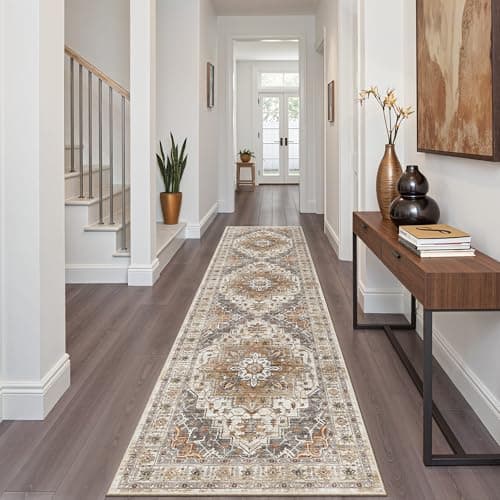
Madane hallway runner - for the route. The fix that works whether or not your dog cooperates.
KOOTETA stair treads - for the staircase, which is where a big dog's slip costs the most.
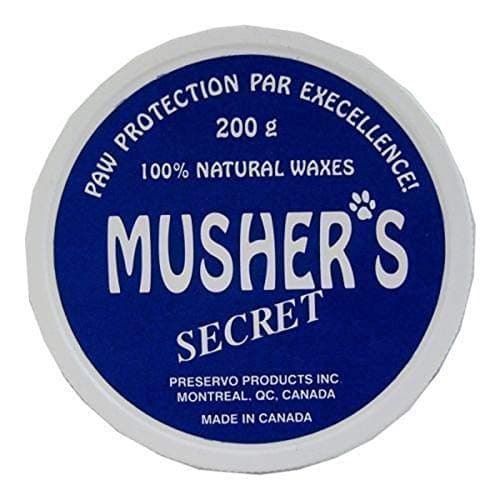
Musher's Secret paw wax - for pad condition on an outdoor dog. Note that the maker's own FAQ says it does not provide traction on slippery indoor floors, and we rank it here for what it does do.
What we have and have not done
We have not measured a coefficient of friction and we have not weighted a dog's paw in a rig. We do not have a lab, and our methodology page says so in those words. What follows is the manufacturers' own published claims, kept at claim level, read against the published veterinary advice on flooring and footing for an arthritic dog, and re-ranked for weight. Prices render live from the Amazon listing on the date shown.
One caveat on the ranking above: it is a general ranking, and a big dog changes it. Weight roughly doubles the force trying to twist a sock around a paw, and a heavy dog has less margin when it does slip. If your dog is 70 pounds or more, read traction gear for a big dog, where the same picks are re-ordered for what survives the shear.
The question most people actually arrive with is not which grips to buy but whether the idea works at all - and how long a set lasts before it grows off the nail. We have answered both, with the three dogs they will not help, at do toe grips actually work?
If the grips side of this comparison is where you are leaning, the next question is usually whether they genuinely work and how often you will be replacing them - which is governed by nail growth rather than by the calendar. That is answered at do toe grips actually work?
Rubber rings that sit on the nails and grip the floor, leaving the pad bare — the answer for a dog that won't tolerate socks. A vet-created product with a long track record.
The whole-paw fix. Socks cover the pad with a grippy sole, which is the fastest way to give a scrambling dog traction on the whole foot — if your dog tolerates wearing them.
The cheapest honest version of the right idea: eight feet of low-pile, machine-washable runner with a non-skid backing, for about the price of a bag of good treats. One covers a hallway; two cover a hallway and the turn into the kitchen, which is usually where the slip happens.
The lightest-touch option. A natural wax you rub on the pads for a little extra tack — not as grippy as socks or grips, but there's nothing to wear and dogs don't mind it.
#ad · Live prices from the Amazon Product API, as of October 20, 2026. Where we have no verified live price we show none — we would rather leave a gap than print a number that has rotted.
In detail
The picks, in full
01
Dogs that won't wear socks
Dr. Buzby's ToeGrips
Rubber rings on the nailsPad stays uncoveredSized to the nailVet-created brand
8.3/10
Rubber rings that sit on the nails and grip the floor, leaving the pad bare — the answer for a dog that won't tolerate socks. A vet-created product with a long track record.
Grip
8
Stays on
8.5
Comfort
9
Value
7.5
Pros
+Nothing on the pad — many dogs forget they're wearing them
+Stay on for days at a time once fitted
+Created by a veterinarian, with strong owner following
Cons
−Need correctly sized, healthy nails to grip
−Fiddly first fitting; they can be lost one at a time
Don't buy this if…
…your dog has brittle nails or very short claws — there may be too little nail for the grips to hold.
The whole-paw fix. Socks cover the pad with a grippy sole, which is the fastest way to give a scrambling dog traction on the whole foot — if your dog tolerates wearing them.
Grip
8.5
Stays on
7
Comfort
8
Value
9
Pros
+Covers the entire pad — grip everywhere the foot lands
+Straps help them stay on better than plain socks
+Cheap enough to keep spare pairs
Cons
−Some dogs dislike socks and shake them off
−Need the right size and periodic re-fitting
Don't buy this if…
…your dog won't keep anything on its feet — toe grips or paw wax leave the pad bare.
2 x 8 ft runner (listed)0.24 in pile height (listed)Machine washable (listed)Non-skid backing (listed)
8.3/10
The cheapest honest version of the right idea: eight feet of low-pile, machine-washable runner with a non-skid backing, for about the price of a bag of good treats. One covers a hallway; two cover a hallway and the turn into the kitchen, which is usually where the slip happens.
Grip on a hard floor
7.5
Covers the route
9
Trip-safe edges
6.5
Cleanable
9
Value
9.5
Pros
+Long enough to be a path rather than an island — the point of a runner is that your dog never has to step off it mid-stride
+The listing says it is machine washable and tested to take repeated washes, which matters on a floor used by a dog that sometimes leaks
+Low pile, so a dragging toe is less likely to catch and the ends sit under a door
+Cheap enough that covering two routes is a realistic decision rather than a redecoration
Cons
−The listing warns it ships folded and creases can take one to two weeks to relax — a lifted end is exactly the trip hazard you are trying to remove, so weight it down or pin the corners for the first two weeks
−The backing is described as non-skid without naming the material, and on a very smooth tile floor a backing like that usually still needs a pad or corner grippers
−A no-track-record Amazon brand rather than a flooring company, so there is nothing published about how the backing behaves after twenty washes
−Two feet wide suits a corridor, not a big dog turning around in a doorway
Don't buy this if…
…your floor is polished tile or sealed concrete — start with a rug pad underneath, or go straight to a stick-down tile, because a thin backing on glass-smooth tile is a rug that travels.
Listed as a dense barrier wax, 200g tinListed as 100% non-toxic natural waxesNothing worn on the footAlso conditions dry pads; reapply as needed
7.6/10
The lightest-touch option. A natural wax you rub on the pads for a little extra tack — not as grippy as socks or grips, but there's nothing to wear and dogs don't mind it.
Grip
6.5
Stays on
6
Comfort
9.5
Value
8.5
Pros
+Zero tolerance issue — it's just balm on the pads
+Conditions cracked, dry senior pads at the same time
+A 200g tin lasts a long time on indoor paws
Cons
−Least grip of the three tools — helps, doesn't transform
−Wears off and needs reapplying
Don't buy this if…
…your dog is slipping badly and needs real traction now — start with socks or grips and use wax as a supplement.
We took the five picks this site already stands behind in the traction category and asked a different question of each: what happens to it under a dog twice the weight the category is designed around? That reordering is the entire contribution of this page. Nail-mounted grips move up, because shear is the failure mode and they are not exposed to it. Thin socks and light rugs move down. Paw wax stays in the list but for pad care, not grip, because the maker says so itself.
We did not invent a large-dog product line. Everything here is an existing pick with an existing verified listing, and we have not featured anything on this page that we would not recommend on its own category page.
Layer it. Do not pick one
Households that solve this for a big dog almost always end up with two layers, not one: the floor and the dog. Floor coverings do the heavy lifting because they are passive and your dog does not have to agree to them. Something on the dog covers the rest of the house, the yard, and the vet's waiting room. If you can only do one thing this week, cover the route - our runners and rug pads roundup is the shopping list for that, and the room-by-room setup guide shows where it goes.
Three free things first
None of this is the first move, and that is worth saying on a page with buy buttons on it. Before you spend anything: trim the nails, because a nail long enough to touch the floor when your dog stands is levering the pad off the surface that grips; trim the hair between the pads, which turns a paw into a skid; and clear the clutter off the route so the path is a path. Our nail length guide is the detail on the first one, and it is deliberately the one page in this hub with nothing to sell.
Sizing for a big dog
Two size mistakes dominate the returns in this category. For socks, measure the paw width at its widest weight-bearing point and buy to the chart on that specific listing rather than to your dog's breed - sizes are not standardized across brands, and a large dog at the top of one chart is a medium on another. For toe grips, the nail has to be long enough to hold a grip and short enough not to be lifting the pad, which is a narrower window than it sounds; get the nails to a sensible length before ordering. Our toe grips page covers that window, and keeping socks on covers the shear problem in detail.
Why this matters more on a big dog
VCA's osteoarthritis guidance describes the loop you are trying to break: a dog on flooring it cannot trust adopts a careful, shortened gait, moves less as a result, and stiffens because it is moving less. On a heavy dog that loop runs faster, because the cost of each movement is higher and the consequence of a fall is worse. Traction is cheap, and it is one of the few interventions that buys movement back without asking anything of the dog.
How we chose
We haven't lab-tested these
We compiled the published specifications, manufacturer manuals and aggregated owner reviews, then scored each product against a published rubric. The scores are judgments from that research — they are not measurements we took in a lab, because we don't have one and we won't pretend we do. Prices are pulled live from Amazon; where we can't verify one, we say "check price" rather than print a stale number.
Questions
Frequently asked
What is the best traction for a large dog on hardwood floors?+
For a heavy dog we would start with nail-mounted toe grips rather than socks, because the failure mode on a big dog is shear - the sock twisting around the paw - and grips are not exposed to it. Then cover the route with a rubber-backed runner, because a floor covering works whether or not your dog cooperates. Socks are still worth having for the floors and trips a rug cannot cover.
Why do dog socks keep twisting off my big dog?+
Because the force trying to rotate them scales with your dog's weight, and most socks hold on by friction against the leg. Look for a long cuff with a real strap rather than a thin elastic band, size by measured paw width on that specific listing, and accept that on some large dogs socks are simply the wrong tool - that is what toe grips exist for. We go through the whole problem in our guide to keeping socks on.
Will a rug stay put under an 80 lb dog?+
Not on its own, on a slick floor. Use a dual-sided rug pad underneath, or corner grippers, or both - and check for lifted edges weekly, because VCA's guidance names raised corners and edges as a trip hazard specifically. A big dog has a longer stride to catch a lip with and more force to shift the rug in the first place.
Does paw wax help a large dog grip indoors?+
No, and we would rather say so than sell it as something it is not. Musher's Secret's own FAQ states its wax does not provide traction on slippery floors; it is a barrier product for pad condition, snow, salt and hot pavement. It belongs in a big-dog kit for pad care. The grip comes from the nails, the socks or the floor.
Are toe grips strong enough for a large dog?+
They are a reasonable first choice for a large dog precisely because they do not depend on staying wrapped around a paw. The limit is the nail: it needs enough length to hold a grip, without being long enough to lever the pad off the floor. Expect to replace them as the nails grow out, and get the nails to a sensible length before you order.
We don't run a testing lab, and we don't pretend to. Product facts are compiled from manufacturer listings and manuals; health facts are cited to reputable veterinary sources. Where we couldn't verify something, we say so on the page rather than quietly leaving it out. Read our full method.