Dog ramps for a truck: why most car ramps are too short
A sedan trunk is about 18 inches off the ground. A pickup tailgate is nearer 34, and a lifted truck more. The same ramp that is gentle at the first height is a climb at the second - and length is the only thing that fixes it.
We earn a commission when you buy through our Amazon links, at no extra cost to you. It never changes our rankings, and we say so when the cheaper product is the better buy. How this works.
The short answer: buy the PetSafe Happy Ride telescoping ramp. It extends rather than folding, so at a tailgate height you can run it out to its full length and keep the slope walkable - which is exactly what a bi-fold ramp cannot do. If your dog balks at smooth slopes, the Gen7Pets Natural Step is long and textured like stairs, which some hesitant dogs read better. The Pet Gear Travel Lite is the grippiest all-rounder if your vehicle is nearer SUV than truck height, and the Happy Ride folding ramp is the light one - good for a back seat or a low tailgate and, we will say it plainly, too short for a full-height pickup bed.
Here is the geometry, because it is the whole page. Ramp angle is decided by two numbers: the height you are climbing and the length of the ramp. A 72-inch ramp to an 18-inch trunk is a gentle walk. The same 72-inch ramp to a 34-inch tailgate is roughly twice the slope, and for an arthritic dog that is the difference between walking up and scrambling up. Owners buy the ramp their friend recommended for a station wagon, put it against a truck, and conclude their dog will not use ramps. The dog is refusing the angle, not the idea.
How much ramp you actually need
Measure the height from the ground to the loading surface with the vehicle parked where you normally park it, then use this as a working guide. These are our rule-of-thumb figures for an arthritic senior dog rather than a published standard - no veterinary body publishes a maximum ramp angle for dogs, and we would rather tell you that than invent a citation.
Vehicle
Typical load height
Ramp length we would want
Sedan trunk or back seat
About 18-22 in
60-72 in is plenty
Crossover or small SUV tailgate
About 24-28 in
70 in and up
Full-size SUV or van
About 28-32 in
Telescoping, run out long
Pickup tailgate
About 32-36 in
The longest you can store - telescoping
Lifted truck
Higher again
A ramp alone may not be enough; consider a step as well
The practical consequence: at truck height, a telescoping ramp is not a luxury feature, it is the mechanism. A bi-fold ramp has one length. A telescoping ramp has a range, and the top of that range is what you are buying.
The five things that decide a truck ramp
1. Usable length, extended
Read the extended length, not the folded one. The folded figure tells you whether it fits behind your seat; the extended figure tells you whether your dog will use it.
2. Grip, because the angle is already working against you
On a steeper ramp the dog needs more purchase, not less. A high-traction walking surface stops being a nice-to-have at truck height. Wet weather makes this worse, and a truck ramp lives outdoors.
3. Side rails, for a wobbly dog on a narrow plank
A long ramp is also a high ramp at its top end. A dog that drifts sideways near the top of a 34-inch climb needs a raised edge to correct against, and a nervous dog needs to be able to see one.
4. Weight rating against your actual dog
The dogs that need truck ramps are disproportionately big dogs - that is who rides in trucks. Check the listed capacity against your dog's real weight with a margin, because a dog pauses, shifts and sometimes lands on a ramp rather than walking it.
5. Whether you can lift it
A long ramp is a heavy ramp, and this site's reader is often an older owner. A ramp you have to wrestle out of the bed twice a day is a ramp that gets left at home. If your own lifting is the constraint, take the lighter ramp and park somewhere lower - or read lifting a dog when you cannot lift for the harness route instead.
The picks, and who each one is for
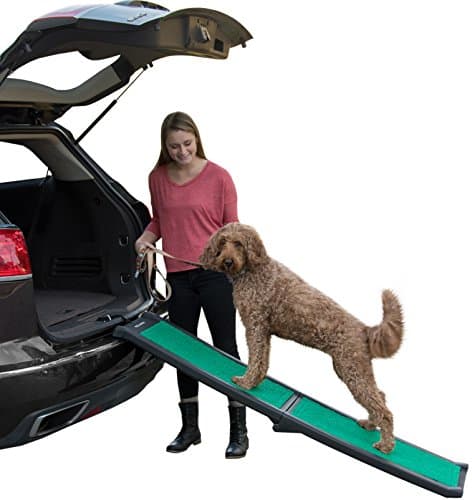
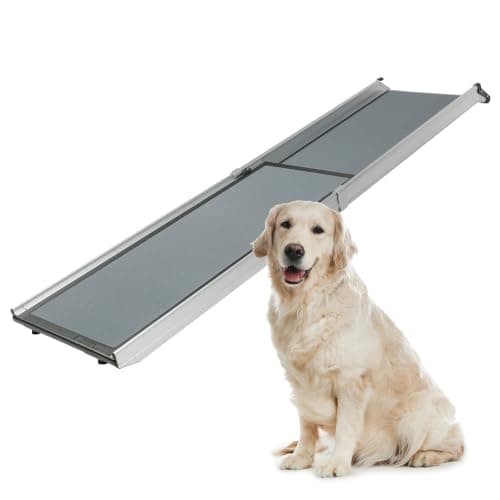
PetSafe Happy Ride Telescoping - the pick for a pickup or a tall SUV. Extends long, grippy surface, side rails, and collapses to store.
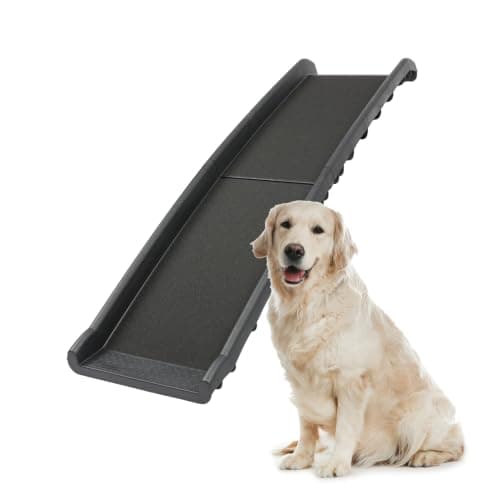
Gen7Pets Natural Step - long and low with a stair-textured surface, for the dog that distrusts a smooth slope. Takes more storage space.
Pet Gear Travel Lite - the grippiest surface here and rated for a big dog. Our pick at SUV rather than pickup height.
PetSafe Happy Ride Folding - the light one. Right for a back seat, a low tailgate, or an owner who cannot handle a long ramp. Too short for a full-height pickup bed, and we would rather say that than sell it to you twice.
What we have and have not done
We have not measured these ramps with a protractor against a truck, and we do not publish angles we have not calculated from the makers' own stated lengths. There is no lab here and our methodology page says so. The vehicle heights in the table above are typical figures given as a working guide, not manufacturer data for your specific truck - measure yours. Prices render live from the Amazon listing on the date shown.
The one we'd buy for the car. It extends long enough to keep the incline gentle even at SUV height, and the high-traction surface gives a nervous senior dog grip to trust.
A long, gentle ramp with a stair-textured surface that reads as steps to a dog unsure about a smooth slope — a good bridge for a dog that balks at ramps.
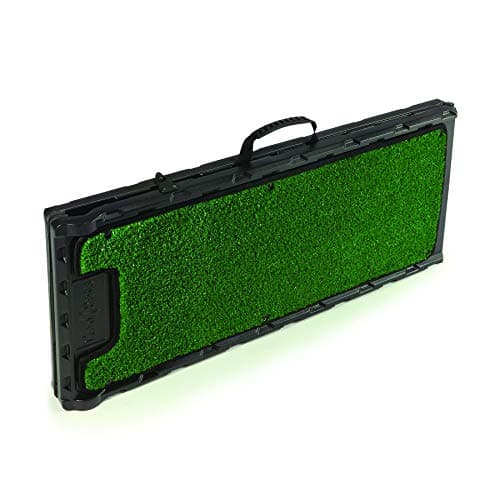
The lighter, simpler car ramp. It folds in half like a suitcase and weighs little, so an owner who has to lift the ramp too will actually keep using it.
#ad · Live prices from the Amazon Product API, as of October 19, 2026. Where we have no verified live price we show none — we would rather leave a gap than print a number that has rotted.
In detail
The picks, in full
01
SUVs and tall vehicles
PetSafe Happy Ride Telescoping Dog Ramp
Telescoping lengthHigh-traction surfaceSide railsFolds to store
8.4/10
The one we'd buy for the car. It extends long enough to keep the incline gentle even at SUV height, and the high-traction surface gives a nervous senior dog grip to trust.
Gentle incline
9
Grip surface
9
Weight capacity
8.5
Portability
7
Stability
8.5
Pros
+Extends long, so a tall tailgate stays a walk rather than a climb
+Grippy walking surface and raised side rails for a wobbly dog
+Collapses down to sit in the trunk
Cons
−Heavier than a folding ramp when fully built
−Long when extended — needs clear space behind the car
Don't buy this if…
…you have a low car and a small dog — a shorter folding ramp is lighter and plenty for a sedan.
Long, low inclineStair-textured surfaceRated for large dogsFolds flat
8.2/10
A long, gentle ramp with a stair-textured surface that reads as steps to a dog unsure about a smooth slope — a good bridge for a dog that balks at ramps.
Gentle incline
9
Grip surface
8.5
Weight capacity
8.5
Portability
6.5
Stability
8.5
Pros
+Extra length keeps the slope shallow
+Textured 'steps' give a hesitant dog visual footing
+Supports large dogs
Cons
−Long footprint — needs room to deploy
−Bulkier to store than a compact bi-fold
Don't buy this if…
…you're tight on space — a telescoping or bi-fold ramp packs down smaller.
The lighter, simpler car ramp. It folds in half like a suitcase and weighs little, so an owner who has to lift the ramp too will actually keep using it.
Gentle incline
7.5
Grip surface
9
Weight capacity
8
Portability
9.5
Stability
8
Pros
+Genuinely light — easy for an older owner to set up and stow
+Folds flat to a slim panel
+Grippy surface with rails
Cons
−Fixed length means a steeper angle at very tall tailgate heights
−Shorter usable run than the telescoping version
Don't buy this if…
…you have a tall SUV — you'll want the telescoping ramp's extra length to keep the slope gentle.
We took the vehicle ramps this site already recommends and re-ranked them on one axis: what happens at 34 inches rather than 18? That single question reorders the category. Telescoping designs move to the top, because length is the only variable that reduces the angle. Long fixed ramps hold their place. Short bi-folds drop, not because they are bad - they are the right answer for a sedan - but because a short ramp at truck height is the problem this page is about. We did not add a product to the registry for this page.
Park for the ramp
Free, and it makes more difference than any upgrade. Back up to a kerb and load from the high side; that can take four to six inches off the climb before the ramp is even out. Avoid loading on a downhill slope, which steepens the ramp at the same time as making the footing worse. On a pickup, loading over the tailgate is usually gentler than through a side door, because the tailgate gives you a flat landing to walk onto rather than a sill to step over.
Training a dog onto a steep ramp
A long ramp at a shallow angle is where you start, not where you finish. Lay the ramp flat on the ground first and walk the dog over it for treats until it is boring. Then prop it at a very low angle - a kerb, a bottom step - and repeat. Only then go to the vehicle. If your dog has already refused a ramp once, assume you are retraining rather than training, and go slower. Our full method is at how to train a dog to use a ramp, and the specific case of a dog that has decided against it is when a dog won't use the ramp.
Ramp safety at truck height
The consequences of a slip scale with the height, so the safety habits matter more here than at a car. Set the ramp with its top lip properly seated on the tailgate and check it does not shift when you push it. Stand on the downhill side of your dog, within reach, every single time. Keep a hand on the harness for the top third. Never let the dog turn around on the ramp. And do not leave the ramp propped unattended with the dog loose nearby. The full checklist is at dog ramp safety.
When a ramp is the wrong answer for a truck
Two cases. The first is a lifted truck, where even a long telescoping ramp leaves an angle we would not ask an arthritic dog to walk - there, a step at the bottom of the ramp or a different vehicle for dog trips is the honest answer. The second is a dog that can no longer bear weight on its back end; a ramp assumes the dog walks, and at that point you are looking at a harness and a lift rather than a slope. Read lift harnesses for a big dog and, if the trips are the problem rather than the loading, car travel with a senior dog.
Storage, which is why people buy the wrong one
The temptation is to buy the ramp that stows smallest, and in a truck you usually have the bed to spare. Prioritise extended length over folded size: the ramp lives in the bed or the back seat footwell, and it only needs to be out twice a trip. If storage genuinely is the constraint, a telescoping ramp collapses shorter than a long fixed one, which is the other reason it tops this page.
How we chose
We haven't lab-tested these
We compiled the published specifications, manufacturer manuals and aggregated owner reviews, then scored each product against a published rubric. The scores are judgments from that research — they are not measurements we took in a lab, because we don't have one and we won't pretend we do. Prices are pulled live from Amazon; where we can't verify one, we say "check price" rather than print a stale number.
Questions
Frequently asked
How long does a dog ramp need to be for a truck?+
As long as you can manage, and realistically that means telescoping. A pickup tailgate is typically around 32-36 inches off the ground - roughly twice a sedan trunk - so a ramp that gives a gentle slope at a car gives roughly double the angle at a truck. Measure your own load height with the vehicle parked where you normally park it, and buy for the extended length rather than the folded size.
Will a folding dog ramp work for a pickup?+
For a low tailgate or a back seat, yes. For a full-height pickup bed we would not recommend it - a bi-fold ramp has one length, and at that height the angle is steeper than an arthritic dog should be asked to walk. Buy telescoping, and run it out to its full length each time rather than part way.
What is the best dog ramp for a tall SUV?+
The PetSafe Happy Ride telescoping ramp, for the same reason it tops this page: it extends, so you can trade storage length for a gentler slope at the moment you need it. If your SUV is nearer 24-28 inches and you want the grippiest surface instead, the Pet Gear Travel Lite is the stronger all-rounder.
Should I use a ramp or steps for a truck?+
A ramp, at truck height. Steps tall enough to reach a tailgate are a small staircase, and a stiff dog climbing steep steps is loading each joint in turn rather than walking a slope. Steps earn their place at bed and couch height, where there is no floor space for a ramp - that comparison is at ramp vs stairs.
How do I stop my truck ramp slipping on the tailgate?+
Seat the top lip squarely on the tailgate and push down on it before the dog steps on, so you find any movement yourself. Load on level ground, not a slope. Many ramps have a rubberized or hooked top edge - check it is sitting on the tailgate rather than on the lip or a tonneau rail. And stand on the downhill side of your dog with a hand on its harness for the top third of the climb, every time.
We don't run a testing lab, and we don't pretend to. Product facts are compiled from manufacturer listings and manuals; health facts are cited to reputable veterinary sources. Where we couldn't verify something, we say so on the page rather than quietly leaving it out. Read our full method.