The hock is the ankle, and it is the joint owners notice last. These are the four wraps worth buying, ranked on whether you get one leg or two and how many straps you have to fasten - plus the honest limit on all of them.
We earn a commission when you buy through our Amazon links, at no extra cost to you. It never changes our rankings, and we say so when the cheaper product is the better buy. How this works.
The hock is your dog's ankle - the sharply angled joint low on the back leg, above the paw and below the knee. VCA describes it as seven small tarsal bones arranged in a row, joining the tibia above to the metatarsals below, with most of the movement happening where the talus meets the tibia. It is a small joint carrying a lot of leverage, and in an old dog it is usually the last place an owner looks, because the hip gets the blame for everything that happens at the back end.
If you are here because that joint looks swollen, feels thick, or because your dog has started standing with its hocks sunk closer to the floor than they used to be, a wrap is a reasonable thing to try. But read the next section before you buy one, because one of those two things is a wrap problem and the other is not.
The one stance that means the vet, not the wrap
There is a specific posture worth knowing the name of. If your dog's hock sinks so far that the back of the ankle approaches the ground and the foot goes flat, that is a plantigrade stance, and it is a classic sign of a problem in the Achilles tendon - the common calcaneal tendon, which the American College of Veterinary Surgeons describes as the combined tendons of several hind-limb muscles. ACVS lists a plantigrade stance and a "crab claw" stance among the signs, along with lameness and swelling around the injury.
The reason this matters for shopping is that ACVS's own list of treatments for it is orthotics, casts or splints or surgery - and it notes that the external-support route needs regular appointments for maintenance and adjustment. That is a professionally fitted device under supervision. It is not a twenty-dollar neoprene sleeve, and no wrap in this roundup will hold a dropped hock up. ACVS also lists hypothyroidism and Cushing's disease among the non-traumatic causes, which is a second reason the first stop is an examination rather than a cart.
A stiff hock is a different story. Arthritis in the tarsus is real: the Merck Veterinary Manual associates hock osteoarthritis with Bullmastiffs, Labradors and Rottweilers, and gives hock osteochondrosis the poorest prognosis of the joints it affects. For a dog whose ankle is simply sore, thick and slow to loosen up in the morning, warmth and gentle compression are a sensible and cheap thing to add on top of whatever pain management your vet has you doing. That is the dog these four products are for.
Worth knowing before you shop: joint pain in an old dog often shows up as something other than a limp. Panting at rest is one of the signs owners are least likely to read as pain, and why a senior dog pants so much goes through it alongside the four other explanations.
What we ranked these on
Every consumer hock brace sold on Amazon is essentially the same object: adjustable fabric, usually neoprene, that wraps the joint and fastens with hook-and-loop straps. None of them has a hinge. None of them is load-bearing. We have written about this at length across the whole brace category - price does not buy you a more capable device here, it buys materials and adjustment. So the ranking is not about support, because support is roughly equal and roughly modest across all four. It is about these four things:
One leg or two. Hind-leg stiffness in an old dog is rarely one-sided. A pack that contains two wraps for what others charge for one is the single biggest practical difference in this category.
How many fastenings. You are fastening this while your dog stands on three legs and would rather not. More straps means more adjustment and a slower job. If your own hands are arthritic - and on this site that is a real and common situation - fewer straps wins.
Whether it stays put on a leg with no muscle. A hock on a wasted back leg has very little shape to grip. Thicker neoprene with an anti-slip face holds better than thin fabric, which is the honest advantage of spending a little more.
What the listing claims versus what the device is. Several of these listings carry ACL and CCL wording. The cruciate ligaments are in the knee, not the ankle, and a knee problem needs a knee brace - or more likely a veterinary conversation. We marked that down where we found it.
Not sure the hock is even the joint involved? Work backwards from what you can see from the sofa in which leg brace does my dog need, which separates hip, knee, wrist and ankle by the posture each one produces.
What a hock wrap is actually doing
It is worth being precise, because the category is sold with a lot of implied engineering. Three mechanisms are plausible for a soft wrap on a sore joint, and only the first two are things we would put money on:
Warmth. Neoprene traps heat against the joint. VCA's rehabilitation material describes superficial warming as improving flexibility before activity, which is the same reason heat suits a chronically stiff joint and cold suits a freshly aggravated one. If your dog's hock is worst first thing in the morning, this is the mechanism you are buying.
Proprioceptive feedback. Pressure around a joint gives the dog more information about where that leg is. It does not hold the leg anywhere, but a dog that knows where its foot is places it better.
Mechanical support. Essentially none, and any listing implying otherwise is overselling. There is no rigid component, so there is nothing to resist the joint bending further than it should.
That is not a reason to skip the category. It is a reason to buy at the bottom of it first and judge by what your dog does, which is exactly how our picks are ordered.
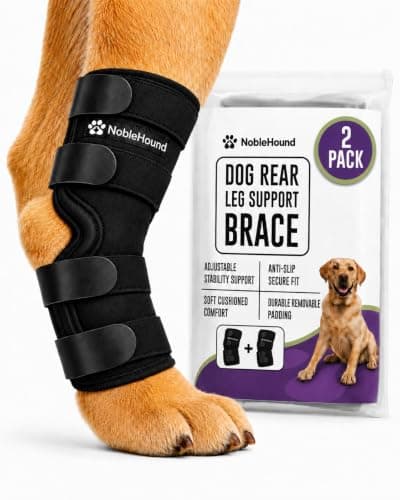
Two wraps in the box, which is the right quantity for a problem that is almost never one-legged. Anti-slip neoprene, four straps per wrap and a removable pad — the most adjustment available at this price.
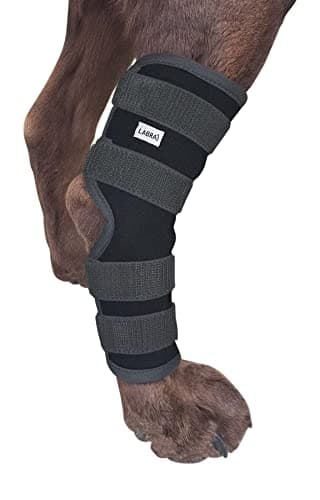
The simplest thing in the category and the one we would put on first: a single sleeve, listed by the maker as hind-leg support for senior dogs, with the fewest fastenings of anything here.
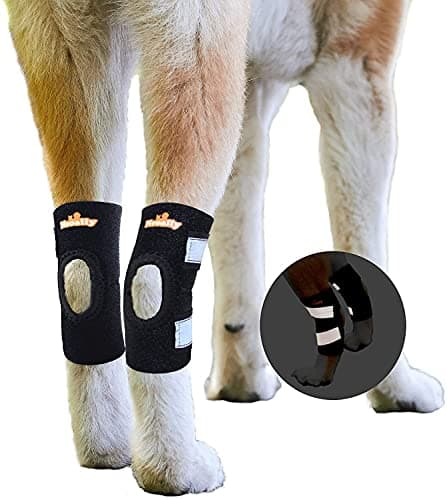
A pair of rear ankle braces with reflective straps, from the brand whose elbow pads we already rank. The reflective detail is not a gimmick on a dog that still gets walked at dusk in winter.
The cheapest honest way to find out whether a wrap helps your dog at all — and since fit decides the outcome and fit is free, starting cheap here is not a compromise.
#ad · Live prices from the Amazon Product API, as of November 22, 2026. Where we have no verified live price we show none — we would rather leave a gap than print a number that has rotted.
In detail
The picks, in full
01
Both back ankles at once
NobleHound Dog Hock Brace, 2 Pack
Sold as a 2-pack — one wrap per rear legAdjustable anti-slip neopreneFour straps per wrapRemovable pad
8.0/10
Two wraps in the box, which is the right quantity for a problem that is almost never one-legged. Anti-slip neoprene, four straps per wrap and a removable pad — the most adjustment available at this price.
Support
6.5
Fit range
8
Comfort
8
Stays put
8
Value
9.5
Pros
+A pair for roughly the price of a single wrap elsewhere — and hind-leg weakness usually arrives on both sides
+Four straps mean you can tighten where the leg actually needs it instead of taking the one tension the wrap gives you
+The pad comes out, so you can start thin and add bulk only if the wrap slides
Cons
−Four straps is four fastenings per leg — slower than a single-strap wrap if your hands are the weak link
−Compression and warmth only; it does not hold a collapsing hock up
Don't buy this if…
…your dog's hock is dropping to the floor and the paw is flat — that pattern points at the Achilles tendon and needs a veterinary exam, not a neoprene wrap.
Single wrap — one leg per packAdjustable compression sleeveListed for weak back legs and joint discomfortLarge size listed
7.7/10
The simplest thing in the category and the one we would put on first: a single sleeve, listed by the maker as hind-leg support for senior dogs, with the fewest fastenings of anything here.
Support
6
Fit range
7.5
Comfort
9
Stays put
7.5
Value
8.5
Pros
+Fewest straps in this roundup — the easiest wrap here to get on one-handed while a dog stands on three legs
+Same compression-sleeve design as the Labra front wrap we already recommend, so the sizing behaves predictably
+Doubles as a lick barrier over a joint the dog keeps worrying at
Cons
−One leg per pack — a dog weak on both hocks needs two orders
−No splints or stays, so there is no structure to it at all
Don't buy this if…
…you want the wrap to change how the leg loads. It will not. This warms and squeezes a joint and nothing more.
Sold as a pairRear leg hock supportSafety reflective strapsListed for sprains and arthritis, and for protecting healing wounds
7.3/10
A pair of rear ankle braces with reflective straps, from the brand whose elbow pads we already rank. The reflective detail is not a gimmick on a dog that still gets walked at dusk in winter.
Support
6.5
Fit range
7
Comfort
8
Stays put
8
Value
7
Pros
+A pair in the box, so both hocks get the same device at the same tension
+Reflective straps are the only visibility feature in this category and the walks that matter are the slow dark ones
+Doubles as a cover over a healing graze on the back of the hock, which is where old dogs scuff themselves
Cons
−The most expensive option here, and the support it gives is the same compression as the cheapest
−Sized per pair — no mixing a large and a medium for a dog that is not symmetrical
Don't buy this if…
…you only need one leg covered. You are paying for two and the second one sits in a drawer.
Compression wrap for the rear hock and ankleListed for back-leg injury and sprain protectionNamed for elderly dogs and arthritis on the listingLarge size listed
7.2/10
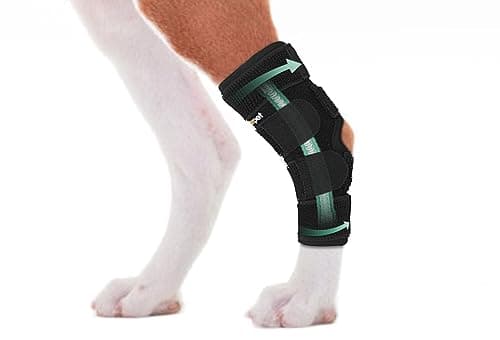
The cheapest honest way to find out whether a wrap helps your dog at all — and since fit decides the outcome and fit is free, starting cheap here is not a compromise.
Support
5.5
Fit range
7
Comfort
7.5
Stays put
7
Value
9
Pros
+Lowest price in the category, and the mechanism is identical to wraps costing twice as much
+Same brand as the splinted carpal brace we rank for front wrists, so the sizing charts read the same way
+Cheap enough that a dog who refuses to wear it has not cost you much
Cons
−Thin compared with the neoprene wraps — less warmth, and less to grip on a leg with no muscle left
−Single wrap, and the listing leans on torn-ligament language this device cannot deliver on
Don't buy this if…
…the listing's ACL and CCL wording is why you are buying. A cruciate problem is a knee problem and this wrap goes on the ankle.
Fitting a hock wrap so it helps instead of harming
A compression wrap on a back ankle is one of the easier things to get wrong, because the leg narrows sharply above the joint and a wrap that is comfortable standing still can bind when the dog bends it. Five rules, in order of how often they get broken:
Measure the leg, do not guess from the dog's weight. Every one of these runs on a circumference chart. Two dogs of the same weight can be two sizes apart at the hock, especially when one of them has lost muscle behind it. Our measuring guide covers how to take the measurement without a second pair of hands.
Two fingers under the strap. If you cannot slide two fingers between the strap and the leg, it is too tight. The hock sits at the far end of the limb's circulation, so a wrap that is too tight here shows up as a puffy paw.
Check the skin daily for the first week. You are looking for rub marks at the top edge and over the point of the hock, the bony prominence at the back where the Achilles tendon attaches. Any sore spot means the wrap comes off until the skin is intact.
Take it off indoors. These are activity-and-rest-period devices, not all-day clothing. Continuous wear traps moisture, and a warm damp joint is a skin problem waiting to happen. If your vet has said otherwise for your dog, do what your vet said.
Give the dog a week to stop noticing it. Most dogs accept a soft wrap within a walk or two. A dog still trying to chew it off on day seven is telling you it is the wrong size, in the wrong place, or that the joint hurts more than you thought.
Three things that help a sore hock more than a brace does
We would rather say this plainly than sell four wraps and stop talking. If your dog's back ankle is sore, these three move the needle further than any sleeve:
Footing. The hock is the joint that works hardest when a dog scrabbles for grip. VCA's own post-operative advice for a fused tarsus includes non-slip surfaces, which tells you what the joint is being protected from. Rugs and runners on the routes your dog actually uses remove the slip that loads it, and the wider slipping problem is worth fixing at the same time.
Not jumping down. Landing is where a hock takes its worst load. A bed ramp or a set of steps removes the single most damaging movement in a dog's day, and it does more for a sore ankle than anything you can wrap around it.
Weight, and a vet's pain plan. Those are the two interventions with the strongest evidence behind them for any arthritic joint, and neither is for sale here. Our senior weight guide and what actually helps arthritis at home cover both.
When the hock is not really the problem
Three patterns are worth separating out, because all three get mistaken for an ankle problem.
If the paw is scuffing or knuckling over, the hock may look wrong while the actual fault is further up, in the nerves. That pattern belongs with degenerative myelopathy and its relatives, and the gear that helps is boots that protect the top of the paw rather than a wrap around the joint.
If the back legs are simply getting thinner, a sinking hock is a consequence of lost muscle rather than a joint failing on its own, and the thing to interrupt is the disuse loop - see losing muscle in the back legs. Note too that a leg losing muscle changes the circumference you fitted the wrap to, so re-measure every few weeks.
If the back end is no longer taking the dog's weight at all, a wrap is the wrong category entirely. That is what a rear support sling is for, and the decision between the two is laid out in sling or lift harness.
How we chose
We haven't lab-tested these
We compiled the published specifications, manufacturer manuals and aggregated owner reviews, then scored each product against a published rubric. The scores are judgments from that research — they are not measurements we took in a lab, because we don't have one and we won't pretend we do. Prices are pulled live from Amazon; where we can't verify one, we say "check price" rather than print a stale number.
Questions
Frequently asked
Do dog hock braces actually work?+
For a stiff, arthritic hock, a wrap provides warmth and gentle compression, and plenty of owners find their dog moves more freely in one. For an unstable or dropped hock, no - the consumer wraps sold for this are soft neoprene with no rigid structure, and the external support ACVS lists for a damaged Achilles tendon is an orthotic, cast or splint fitted and maintained professionally. Be clear which of the two dogs you have before you spend anything.
Where is a dog's hock?+
Low on the back leg - the sharply angled joint between the knee and the paw, equivalent to your ankle. VCA describes it as seven small tarsal bones joining the tibia above to the metatarsals below. The bony point at the back of it is the calcaneus, where the Achilles tendon attaches.
Why are my old dog's hocks sinking or dropping?+
Two common explanations, and they need different responses. Lost muscle behind the leg lets the whole back end sit lower, which is gradual and usually symmetrical, and is addressed by interrupting the disuse loop rather than by a wrap. A genuinely dropped hock with a flat foot - a plantigrade stance - points at the Achilles tendon and is a veterinary problem, which ACVS links to trauma, repetitive injury, hypothyroidism and Cushing's disease. A sudden change on one leg is the version to take seriously fastest.
How long should my dog wear a hock brace?+
Treat it as something you put on for activity and take off for rest, unless your vet has told you otherwise for your dog specifically. Continuous wear traps heat and moisture against the skin, and the joint underneath still needs to move. Check the skin at the top edge and over the point of the hock every day for the first week.
Can a hock brace replace surgery?+
Not one of these. VCA lists tarsal arthrodesis - surgically fusing the joint - for severe osteoarthritis, unrepairable tarsal fractures, dislocation and a handful of other causes, and describes four to eight weeks in a soft splinted support bandage or cast afterwards with activity strictly restricted. A compression wrap is not in that conversation. What it can do is sit alongside a veterinary pain plan for a joint that is sore rather than unstable.
Should I buy one wrap or a pair?+
A pair, in most cases. Rear-leg stiffness in an old dog is usually bilateral even when one side looks worse, and fitting only the bad leg tends to shift load onto the other. The 2-pack and the pair-sold options here cost little more than the single wraps, which is why they rank where they do.
We don't run a testing lab, and we don't pretend to. Product facts are compiled from manufacturer listings and manuals; health facts are cited to reputable veterinary sources. Where we couldn't verify something, we say so on the page rather than quietly leaving it out. Read our full method.