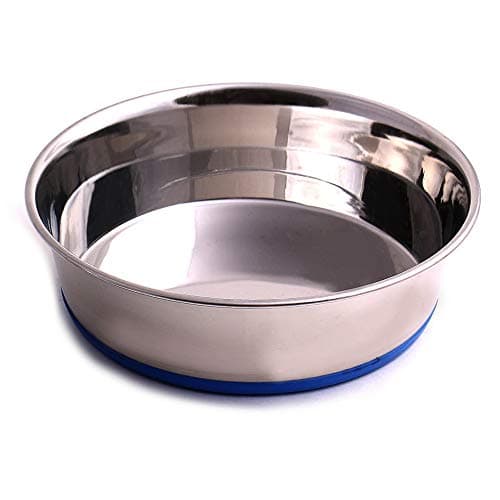
Raised bowls for an old dog, and when to leave the bowl on the floor
This is the one comfort upgrade on this site where the honest answer for a lot of our readers' dogs is: don't. Here is what the evidence says, and what to buy in each case.
We earn a commission when you buy through our Amazon links, at no extra cost to you. It never changes our rankings, and we say so when the cheaper product is the better buy. How this works.
Somewhere in the first month of an old dog slowing down, someone suggests raising the food bowl. It sounds obviously kind: the dog is stiff, bending hurts, so bring the food up to the dog. Nearly every article you will find agrees, usually while selling you a stand.
We are going to disagree, carefully, for a specific group of dogs — and this site's readers own a lot of them. Then we will tell you when raising the bowl is the right call, and what to buy in either case.
What the evidence actually says about raised bowls
There are two studies people argue about and one reasonable summary of both, and it is worth seeing them separately rather than as a vibe.
Glickman and colleagues, 2000. Found a significant effect of feeder height, with large and giant breeds fed from raised feeders at increased risk of bloat compared with floor-fed dogs. The detail people skip: the risky height differed by dog size, with large breeds showing increased risk at bowls up to about a foot and giant breeds at bowls above a foot.
Pipan and colleagues, 2012. A later case-control study that found no increased risk of bloat from raised feeders at all.
The Knowledge Summary that appraised both. Its clinical bottom line is quotable and we will quote it rather than paraphrase: "the safest option in the absence of further evidence is to advise that owners of ‘at risk’ dogs feed from a feeder on the floor. This may not reduce the risk of GDV, but there is no evidence to suggest that it will increase the risk."
Cornell's Riney Canine Health Center does not hedge. Its bloat page lists "Using a raised food bowl" among the risk factors, and its prevention advice says plainly: "Avoid raised food bowls."
VCA, for balance, is the source that cuts the other way. Its bloat page lists the risk factors it considers established — feeding only one meal a day, family history, rapid eating, being thin or underweight, an anxious temperament, and being middle-aged to older — and does not mention elevated bowls at all. That is a real disagreement between reputable sources and we are not going to pretend it is settled.
Which leaves you with an asymmetry, not a certainty
Read those together and the practical shape is clear even though the science is not. There is no evidence that a raised bowl helps prevent bloat. There is contested evidence that it might make it more likely. So for a dog in the at-risk group, raising the bowl is a bet with no upside on that specific question. Floor feeding costs you nothing and risks nothing.
One line from VCA's risk list deserves its own sentence, because it is easy to skim past on a site about old dogs: middle-aged to older is the highest-risk age group. If your dog is the reason you are reading this site, your dog is in it.
So who is in the at-risk group?
Both Cornell and VCA describe it the same way: large, deep-chested dogs. VCA names Great Danes, Saint Bernards, Weimaraners, Irish setters, Gordon setters, standard poodles, basset hounds, Doberman pinschers and Old English sheepdogs. Cornell adds that dogs fed once daily or a large volume per meal are predisposed.
If that is your dog, the answer to "should I raise the bowl?" is no, unless a vet who has examined your dog gives you a specific reason to. Buy a good floor bowl and put the money into the changes both sources agree on.
And when raising the bowl is genuinely the right call
There is a real case, and dismissing it would be as lazy as the articles that ignore the bloat literature. Raising the bowl is worth considering when:
Your dog has diagnosed neck or cervical pain and visibly braces, shuffles its front feet, or lowers itself in stages to reach the floor. Watch the neck, not the hips — a dog with sore hips can still drop its head fine.
Your dog is small or medium and not deep-chested. The bloat literature is about large and giant breeds. A twelve-pound terrier is not the dog those studies were counting.
A vet has told you to, for a swallowing or regurgitation problem where upright feeding is part of the management plan. That is a medical instruction and it outranks anything on this page.
Notice that none of those is "my dog is old and stiff". Stiffness alone is not a reason, and it is the reason nearly everyone buys one.
If you do raise it, raise it as little as helps. Glickman's own finding was height-dependent, so a stand set at four inches is a different object from the same stand set at fourteen. The picks below are ordered with that in mind.
What we scored these on
Stays put. Weight and base material. A bowl that skates across tile is a bowl an unsteady dog chases, and chasing it on a slick floor is its own hazard — our guide to floor grip covers that half.
Easy to clean. Dishwasher-safe, and whether the shape traps wet food. This gets done twice a day forever.
Neck-friendly. How much it reduces the reach for a dog that struggles to lower its head. Floor bowls score low here by definition, and that is the trade.
Low bloat risk. Floor-level and slow-feeding score highest; tall stands score lowest. This is the criterion nobody else publishes and it is the reason this page exists.
Value. These are cheap objects. The expensive mistake here is buying the wrong category, not overpaying within it.
Scores are judgments from published specifications and the veterinary sources cited at the foot of this page, in line with our methodology. We have not weighed a bowl or measured a stand; where a figure appears it is the manufacturer's and the copy says so. Every pick was resolved live and confirmed in stock before publication.
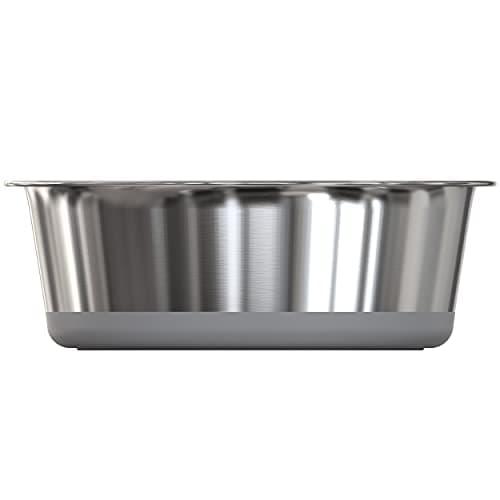
The bowl we would put in front of most big old dogs, and the cheapest thing on this page. A full rubber base rather than a ring, heavy enough not to travel, and it keeps the food where Cornell says it should be for a deep-chested dog: on the floor.
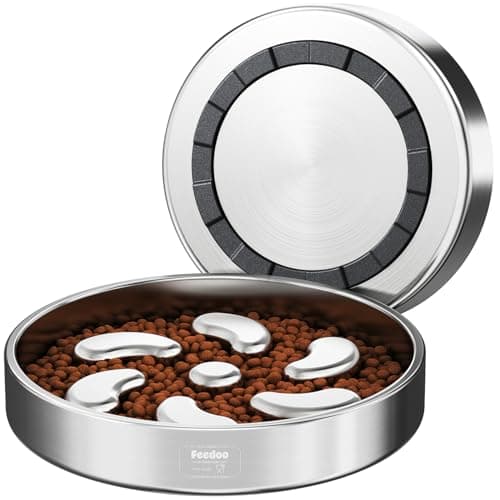
If you are worried about bloat, this is the intervention with actual support behind it. Rapid eating is on both Cornell's and VCA's risk-factor lists; bowl height is the contested one. Slowing the meal is the change worth making first.
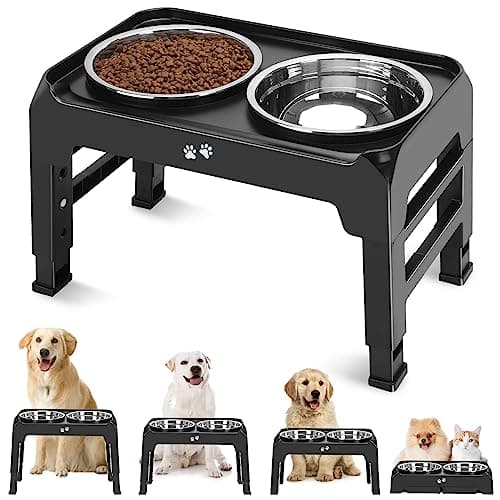
The stand to buy if you have decided with your vet that raising the bowl is right, because its lowest setting is a listed 3.7 inches. That matters: it lets you raise the food the least amount that helps rather than the most the box allows.
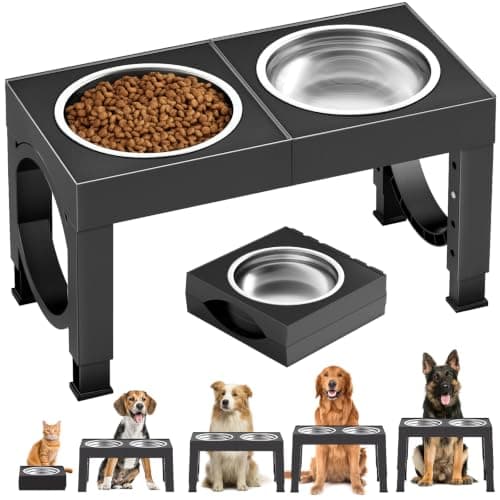
The taller option, for a genuinely big dog whose owner has made the call to raise the bowl. Be aware that the listing contradicts itself on the height range, so measure rather than trusting the number in the title.
A tall dog, once the decision to raise is already made
For the dog that shoves its bowl around the kitchen. A steel weight bonded into the base solves at floor level the problem most people solve by buying a stand they may not want.
#ad · Live prices from the Amazon Product API, as of October 20, 2026. Where we have no verified live price we show none — we would rather leave a gap than print a number that has rotted.
In detail
The picks, in full
01
Most large and deep-chested senior dogs
Max and Neo Heavyweight Non-Skid Stainless Steel Dog Bowl
Listed 80 oz, 9.5 in diameter (large size)Listed as 204 stainless steel; large bowl listed at 1.2 lbFull rubber bottom, not just an outer ringBrand donates a bowl to a rescue for every bowl sold
7.9/10
The bowl we would put in front of most big old dogs, and the cheapest thing on this page. A full rubber base rather than a ring, heavy enough not to travel, and it keeps the food where Cornell says it should be for a deep-chested dog: on the floor.
Stays put
8.5
Easy to clean
9
Neck-friendly
3
Low bloat risk
9.5
Value
9.5
Pros
+Keeps a bloat-risk dog eating at floor level, which is the conservative position in every source we cite
+The full rubber base is the detail — a rubber ring lets a determined dog skate the bowl anyway
+Heavy gauge steel, so it does not deform or hold a dent like a thin bowl
+Nothing to assemble, adjust, or eventually break
Cons
−Does nothing for a dog that genuinely struggles to lower its head — that is the whole case for a stand
−A wide shallow bowl pushes kibble to the rim, which a short-muzzled dog finds fiddly
−Stainless shows every water mark, so it looks grubby faster than it is
Don't buy this if…
…your dog has diagnosed neck or cervical pain and visibly braces to reach the floor — a low stand is the kinder answer there, with your vet's read on the bloat trade-off.
Price as of October 20, 2026. Prices change — Amazon's is the one that counts.
#ad · we may earn a commission from this link to Max and Neo Heavyweight Non-Skid Stainless Steel Dog Bowl
02
A fast eater, which is a documented risk factor
Feedoo Slow Feeder Dog Bowl, Large Breeds
Listed 3 to 3.5 cup capacity, sized for medium and large breedsFood-grade stainless steel, listed as dishwasher safeDouble-wall construction; non-slip rubber baseListed 8.5 x 8.19 x 2.01 in
6.9/10
If you are worried about bloat, this is the intervention with actual support behind it. Rapid eating is on both Cornell's and VCA's risk-factor lists; bowl height is the contested one. Slowing the meal is the change worth making first.
Stays put
8.5
Easy to clean
6.5
Neck-friendly
3
Low bloat risk
9
Value
7.5
Pros
+Attacks the risk factor the evidence actually agrees on rather than the one it argues about
+Steel rather than the usual molded plastic maze, so it survives a dishwasher and does not scratch up
+Double wall makes it heavy enough to stay put without a separate mat
+Stays at floor level, so it does not trade one risk for another
Cons
−A maze bowl frustrates some dogs into giving up on a meal, which is the opposite of what you want in a thin senior
−Harder to clean than a plain bowl — wet food gets into the channels
−3 to 3.5 cups is one meal for a big dog, so a twice-daily feeder may want two
Don't buy this if…
…your dog is underweight or already picks at food — slowing an unenthusiastic eater down further is not a win.
COMESOON Elevated Dog Bowls, 4-Height Adjustable Stand
Listed heights 3.7, 9.2, 10.75 and 12.36 inTwo listed 50 oz thickened stainless steel bowlsAnti-skid foot pads and rubber edging; listed 3.2 lbFolding legs, no assembly listed
7.7/10
The stand to buy if you have decided with your vet that raising the bowl is right, because its lowest setting is a listed 3.7 inches. That matters: it lets you raise the food the least amount that helps rather than the most the box allows.
Stays put
7.5
Easy to clean
8.5
Neck-friendly
8
Low bloat risk
6
Value
8.5
Pros
+A 3.7-inch setting is close to a compromise — some relief for a stiff neck without committing to a tall stand
+Bowls lift out for the dishwasher rather than needing to be fished from underneath
+Four real settings, so you can lower it again if your dog does not take to it
+Folds flat, which makes it easy to abandon if you change your mind
Cons
−Every raised stand carries the unresolved bloat question — read the caution above before buying one for a deep-chested dog
−The manufacturer's neck, spine and digestion claims are marketing, not evidence, and we are not repeating them as fact
−Two bowls in one frame means water gets kibble in it, which some dogs mind
−A folding frame is less rigid than a fixed one under a dog that leans on it
Don't buy this if…
…your dog is a large deep-chested breed with no neck problem — Cornell's prevention advice is to avoid raised bowls, and you have no reason to overrule it.
Price as of October 20, 2026. Prices change — Amazon's is the one that counts.
#ad · we may earn a commission from this link to COMESOON Elevated Dog Bowls, 4-Height Adjustable Stand
04
A tall dog, once the decision to raise is already made
XiaZ Elevated Dog Bowls, Adjustable Stand for Large Breeds
Title lists 9/11/12/14 in; the feature bullets list 3.15, 9.09, 10.63, 12.20 and 13.78 inTwo listed stainless bowls, 7.87 x 2.56 inNon-slip pads and a silencing strip; listed 2.6 lbCollapsible legs for storage and travel
7.4/10
The taller option, for a genuinely big dog whose owner has made the call to raise the bowl. Be aware that the listing contradicts itself on the height range, so measure rather than trusting the number in the title.
Stays put
7
Easy to clean
8.5
Neck-friendly
8.5
Low bloat risk
5
Value
8
Pros
+The widest height range here, which suits a tall dog a shorter stand cannot reach
+Bowls detach for cleaning and the frame folds down flat
+Listing is explicit that a dog under 15 inches at the body will not suit the stand set up
+Cheapest of the two stands
Cons
−The title and the feature bullets publish different height sets and one calls five values 'four' — sloppy enough that we would measure before trusting either
−Same unresolved bloat question as any raised stand, and this one goes taller
−The listing's spine, joint and vomiting claims are manufacturer marketing, not evidence
−A folding frame under a leaning big dog is the least rigid arrangement on this page
Don't buy this if…
…you want the smallest possible raise — the COMESOON's 3.7-inch setting starts far lower than anything here.
Price as of October 20, 2026. Prices change — Amazon's is the one that counts.
#ad · we may earn a commission from this link to XiaZ Elevated Dog Bowls, Adjustable Stand for Large Breeds
05
A dog that pushes the bowl across the floor
HeavyBowl Weighted Stainless Steel Dog Bowl
Listed at over 2.5 lb, with a steel weight in the baseListed 60 oz / 7.5 cup capacityListed 8.5 in diameter, 3 in tallSilicone rubber foot bonded to the bowl
7.6/10
For the dog that shoves its bowl around the kitchen. A steel weight bonded into the base solves at floor level the problem most people solve by buying a stand they may not want.
Stays put
9.5
Easy to clean
8.5
Neck-friendly
4
Low bloat risk
9
Value
7
Pros
+Weight in the base is a more reliable fix for a bowl that travels than grip alone
+The bonded foot will not peel off the way a stuck-on ring does
+Three inches of bowl height is a small natural lift without being a stand
+Tougher than a ceramic bowl and does not chip
Cons
−Costs more than a plain heavy bowl for a difference most dogs do not need
−2.5 lb is heavy to lift and rinse twice a day if your own hands are the problem
−Single bowl, so a food-and-water setup means buying two
Don't buy this if…
…your dog leaves the bowl where it is — you are paying for a fix to a problem you do not have.
If bloat is the worry that brought you here, these are the levers with less argument behind them than bowl height — and they are free or nearly so.
Split the day's food into two or more meals. Cornell lists feeding once daily or a large volume per meal as a risk factor, and its prevention advice is to offer two or more meals per day. VCA lists feeding only one meal a day too. This is the single most-agreed change on the page and it costs nothing.
Slow a fast eater down. Rapid eating is on VCA's risk list. A maze bowl is the direct fix, which is why one is ranked second here rather than treated as a gimmick.
Keep the meal and hard exercise apart. VCA notes that exercise after eating a large meal or drinking a lot of water may increase risk. For a senior dog that is an easy rule to keep.
Ask about gastropexy if your dog is high-risk. It is surgery and it is a real conversation, but Cornell's numbers on recurrence are striking, and for a high-risk breed already going under for something else it is worth raising.
How to tell whether your dog actually struggles to reach the floor
Before spending anything, watch two meals properly. You are looking at the neck and the front end, not the back end.
Does the head go down smoothly, or in stages? A dog with cervical pain often lowers, pauses, and lowers again.
Does it splay or shuffle the front feet to get the mouth down? That is a dog buying itself height by widening its base.
Does it eat standing, then lie down and give up? Fatigue from holding the position is a better argument for a stand than stiffness is.
Does it eat fine but slip? Then the problem is the floor, not the height. A mat under the bowl and a rug on the route solves it for a few dollars — see our floor setup guide.
That last one is worth dwelling on, because it is the most common misdiagnosis we see. A dog scrabbling at a bowl on tile looks like a dog that cannot reach its food. It is usually a dog that cannot get purchase. Raising the bowl does not fix a slippery floor; it just moves the scrabbling higher.
If you buy a stand, buy the lowest one that helps
The height detail from Glickman is the practical takeaway most summaries drop. The finding was not "raised bowls are bad" — it was that height mattered, and mattered differently depending on the size of the dog. Whatever you conclude about the strength of that evidence, it argues for the smallest raise that solves your dog's problem rather than the tallest the stand allows.
In practice: set the stand to the lowest notch, watch a week of meals, and only go up a notch if the dog is still struggling. Most owners set it to whatever looks right in the product photo and never touch it again. An adjustable stand you never adjust is just a tall stand.
Water is a separate decision
The bloat literature is about food, not water, and dehydration is a real problem in old dogs. If your dog drinks less because the bowl is awkward, that matters. It is reasonable to raise the water and leave the food on the floor — they do not have to match, and nobody sells that as a product because it does not need a product.
Keep water in more than one room while you are at it. A stiff dog that has to cross the house for a drink drinks less, which is the same argument we make for having more than one bed.
The cheap version, honestly
Most of this page can be solved for under twenty dollars. A heavy stainless bowl on a rubber mat, fed twice a day instead of once, is the setup we would put in front of the majority of dogs this site is written for. The stands are here because a real minority of dogs need them, not because everyone should own one.
And if you already own a raised feeder and your dog is a deep-chested breed, you do not need to feel bad about it — Pipan found nothing, and plenty of dogs eat from stands for years without incident. Lower it a notch, split the meals, and get on with your day. This is a risk-management page, not a blame page.
How we chose
We haven't lab-tested these
We compiled the published specifications, manufacturer manuals and aggregated owner reviews, then scored each product against a published rubric. The scores are judgments from that research — they are not measurements we took in a lab, because we don't have one and we won't pretend we do. Prices are pulled live from Amazon; where we can't verify one, we say "check price" rather than print a stale number.
Questions
Frequently asked
Do raised dog bowls cause bloat?+
The evidence is genuinely split. Glickman and colleagues (2000) found large and giant breeds fed from raised feeders were at increased risk compared with floor-fed dogs; Pipan and colleagues (2012) found no increased risk. The Knowledge Summary appraising both concluded that the safest option, absent better evidence, is for owners of at-risk dogs to feed from a feeder on the floor — noting it may not reduce risk, but there is no evidence it increases it. Cornell's bloat page lists using a raised food bowl as a risk factor and advises avoiding them; VCA's does not mention them at all.
Should I raise the bowl for my arthritic senior dog?+
Not on stiffness alone. Watch whether your dog struggles to lower its head— a dog with sore hips usually drops its head fine. If there is diagnosed neck or cervical pain, or your dog is small and not deep-chested, a low stand is reasonable. If your dog is a large deep-chested breed with no neck problem, Cornell's prevention advice is to avoid raised bowls and there is no evidence-based upside to overruling it.
What can I do about bloat risk that the evidence agrees on?+
Feed two or more meals a day rather than one large one — Cornell lists once-daily feeding and large meal volume as risk factors and recommends splitting meals; VCA lists feeding only one meal a day too. Slow a fast eater down, since rapid eating is on VCA's risk list. Keep hard exercise away from mealtimes. And if your dog is a high-risk breed, ask your vet about a preventive gastropexy.
How high should a raised dog bowl be?+
As low as solves the problem. Glickman's finding was height-dependent — large breeds showed increased risk with bowls up to roughly a foot, giant breeds with bowls above that — so the argument runs toward the smallest useful raise rather than the tallest the stand offers. Start at the lowest setting, watch a week of meals, and only raise it a notch if your dog is still struggling.
My dog pushes the bowl all over the kitchen. Do I need a stand?+
Usually no — that is a grip problem, not a height problem. A heavy bowl with a full rubber base, or a weighted bowl, fixes it at floor level without touching the bloat question. If the dog is also slipping while it eats, the floor is the thing to fix; a mat under the bowl and a rug on the route does more than a stand will.
We don't run a testing lab, and we don't pretend to. Product facts are compiled from manufacturer listings and manuals; health facts are cited to reputable veterinary sources. Where we couldn't verify something, we say so on the page rather than quietly leaving it out. Read our full method.