Turmeric for dogs: what the evidence actually shows
Turmeric is the most confidently marketed supplement in the dog aisle and one of the least convincingly tested. Three trials in real dogs, two of them showing almost nothing on the objective measure: here is what they found, and what to buy if you still want to try it.
We earn a commission when you buy through our Amazon links, at no extra cost to you. It never changes our rankings, and we say so when the cheaper product is the better buy. How this works.
Somebody will tell you about turmeric. A neighbor, a Facebook group, the comments under a video of a dog in a wheelchair. It is cheap, it is natural, it is in the cupboard already, and the listings on Amazon promise things no prescription label is allowed to promise. So before the shopping advice, here is the part the labels leave out: turmeric has been tested in dogs with arthritis, more than once, and the results are thin.
That is not a reason to sneer at it. It is a reason to buy it with your eyes open, give it a fair trial, and know what a fair trial looks like.
What the trials in actual dogs found
There are three published, randomized, placebo-controlled trials of curcumin-containing supplements in client-owned dogs with naturally occurring osteoarthritis. Not laboratory models, not cell cultures — pet dogs, with owners, assessed over weeks.
Innes 2003: turmeric extract alone
Published in The Veterinary Record, this tested P54FP, an extract of Indian and Javanese turmeric containing curcuminoids and essential oils. Sixty-one dogs with elbow or hip osteoarthritis went through a two-week washout, then took P54FP or placebo twice daily for eight weeks. The primary measure was peak vertical force on a force platform — how hard the sore leg actually pushes into the ground, which a dog cannot fake and an owner cannot wish into being.
Across the 25 treated and 29 placebo dogs analyzed, there was no statistically significant difference in peak vertical force. The investigators' overall assessment did favor the extract (P=0.012), but the owners' assessment just missed significance (P=0.063). No serious adverse effects were recorded; two treated and four placebo dogs were withdrawn because they got worse.
Comblain 2017: curcumin in a combination
In BMC Veterinary Research, 42 dogs with osteoarthritis were fed either a control diet or the same diet supplemented with a mixture of curcuminoid extract, hydrolyzed collagen and green tea extract, for three months. Ground reaction forces again showed no statistical difference between groups, and neither did serum osteoarthritis biomarkers. What did move: pain on manipulation fell significantly in the supplemented group, owner-rated pain severity worsened in the control group while staying stable in the supplemented group, and one specific function — the ability to rise to standing from lying down — improved significantly versus control. The authors' own conclusion is the honest summary: the objective variables showed nothing, the pain indicators appeared reduced, and a larger study would be needed.
Corbee 2022: curcumin with green-lipped mussel
In Veterinary Medicine and Science, 32 dogs took a supplement of green-lipped mussel, curcumin and blackcurrant leaf extract in a 16-week crossover trial. The vet-scored staging tool improved against baseline but not against placebo; the owner-completed chronic pain index and the force plate showed no difference. The authors describe "only partial positive effects" and note a number of non-responders regardless of how advanced the arthritis was. Our green-lipped mussel page covers that ingredient on its own terms.
Read those three together and a pattern appears that is neither "it works" nor "it is useless". Force plates never moved. Subjective and functional measures sometimes did, more often in the people who could see the dog every day than in the machines. That is the signature of either a small real effect or a well-known placebo-by- proxy effect, and the trials as published cannot separate the two.
The absorption problem, which is the whole problem
Here is why the results are so flat. Curcumin is poorly absorbed. Writing in Veterinary Practice News, Brennen McKenzie, MA, MSc, VMD, cVMA puts it plainly: one of the biggest problems with turmeric is "very poor bioavailability, making it difficult to achieve meaningful levels of the active compound in blood and tissues with oral dosing". He adds that the sheer variety of dosing formulations makes studies and products impossible to compare, and concludes that turmeric's popularity "is not based on legitimate scientific evidence for safety and efficacy, but rather on anecdotal evidence" and on folk-medicine tradition.
Three practical consequences, and they are the whole buying guide:
Kitchen turmeric is the weakest version. Culinary turmeric contains far less curcumin than a standardized extract. A spoonful of spice on dinner is the cheapest thing you can do and the least likely to reach a joint.
Black pepper is not a gimmick. Piperine from black pepper extract is the one absorption lever that appears on serious products. If a turmeric supplement does not mention pepper or some other absorption system, it is selling you the hard version of an already hard problem.
Fat helps, which is why the paste exists. Curcumin is fat-soluble, which is the logic behind golden-paste recipes and behind the coconut oil in several chews.
The claims on these labels are not allowed to be true
Dog supplements are not approved as drugs before sale, which is why the copywriting goes where it does. On one top-selling turmeric chew, the Amazon title itself says the product "Eliminates Joint Pain Inflammation", and the bullets invite you to get your dog "off drugs & medicines" and promise "massive improvement" in 28 days. A product featured on this page says its formula will "rebuild worn cartilage". Nothing sold without a prescription has demonstrated either of those things in a dog, and the trials above are what the honest version of the evidence looks like.
We have left the worst offender off this page entirely and kept the ones that at least name their extract. Where a listing makes a claim we cannot support, you will find it written into that product's cons rather than quietly dropped.
Where turmeric should sit in the plan
Not first. The interventions with the strongest evidence for an arthritic dog are unglamorous and mostly free: keeping the dog lean, keeping it moving, controlling pain properly with your vet, and making the house survivable. If you have not done those, do them before you spend anything here.
The better-evidenced supplements. Omega-3 fatty acids have more support than anything else in this aisle — see omega-3 — with glucosamine and chondroitin the long-standing default.
Then, if you want to, turmeric. Ideally as part of a combination, which is the only form it has been trialed in on real dogs.
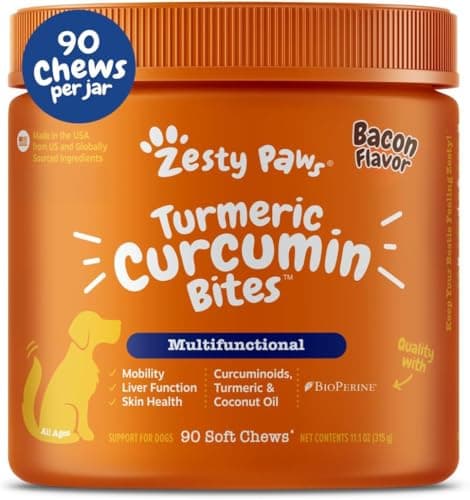
If you are going to try turmeric, start with the one that tells you what is in it. The listing names a standardized curcumin extract at 95% curcuminoids and pairs it with a black pepper extract for absorption — the two things that separate a curcumin supplement from a jar of spice. It is a soft chew, so a dog that fights pills will still take it.
The sensible compromise: turmeric sitting on top of glucosamine and chondroitin rather than instead of them. The two canine trials that found anything at all tested curcumin in combination, never alone, and this is the cheapest way to buy the combination idea. It is also NASC-certified, which is a quality-program membership, not an efficacy claim.
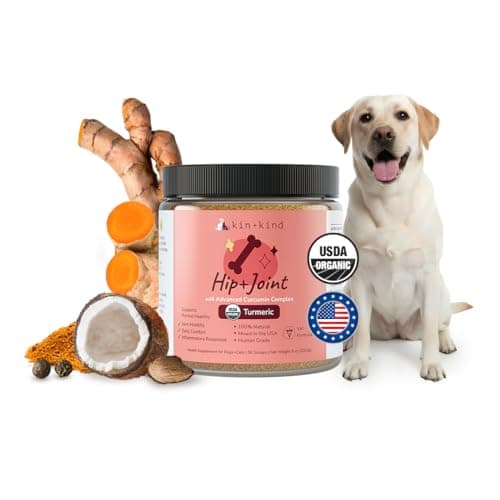
A plain USDA Organic powder — turmeric with organic coconut and organic black pepper and nothing else — scooped onto food. It is the pick for the owner who wants to start at a quarter dose and work up, or whose vet asked for a specific amount, because a powder is the only format here that lets you choose the number.
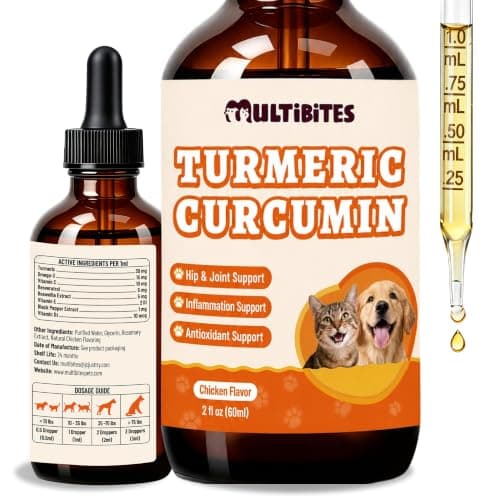
A liquid, for the dog that has worked out how to eat around a chew and spit out a tablet. Drops go into wet food or straight onto the tongue and the dose is countable. The formula is a kitchen sink — turmeric plus boswellia, omega-3 and resveratrol — which makes it convenient and makes it impossible to attribute anything.
#ad · Live prices from the Amazon Product API, as of October 19, 2026. Where we have no verified live price we show none — we would rather leave a gap than print a number that has rotted.
In detail
The picks, in full
01
Most dogs, if you are trying turmeric at all
Zesty Paws Turmeric Curcumin Bites
90 soft chews (listed)Organic turmeric + 95% curcuminoid extract (listed)BioPerine black pepper extract (listed)Coconut oil base (listed)
7.9/10
If you are going to try turmeric, start with the one that tells you what is in it. The listing names a standardized curcumin extract at 95% curcuminoids and pairs it with a black pepper extract for absorption — the two things that separate a curcumin supplement from a jar of spice. It is a soft chew, so a dog that fights pills will still take it.
Ingredient transparency
8.5
Absorption design
8.5
Easy to give
9.5
Dose control
6
Value
7
Pros
+Names its extract and its curcuminoid percentage, which most turmeric products for dogs do not — you can at least see what you are buying
+Includes a black pepper extract, which is the only absorption lever the research community agrees matters for oral curcumin
+Soft chew format: no pill to hide, which is the practical reason supplement trials fail in real households
+A large, long-established pet supplement brand rather than a one-listing seller
Cons
−The listing says the formula helps "relieve joint aches and pains"; no supplement has shown that against placebo on force-plate gait analysis in dogs, and we are not repeating the claim
−A chew is a fixed dose in a biscuit — fine for maintenance, useless for the gradual dose-finding a vet may want
−Chews carry calories and a palatant, which matters for the lean body condition that has better evidence than any supplement
−Costs around a dollar a day for a mid-size dog, against an evidence base that is thin and mixed
Don't buy this if…
…your dog is on an NSAID or any drug affecting clotting or the liver, or has a bleeding disorder or liver disease — those are the cases where veterinary sources say to ask before adding turmeric, not after.
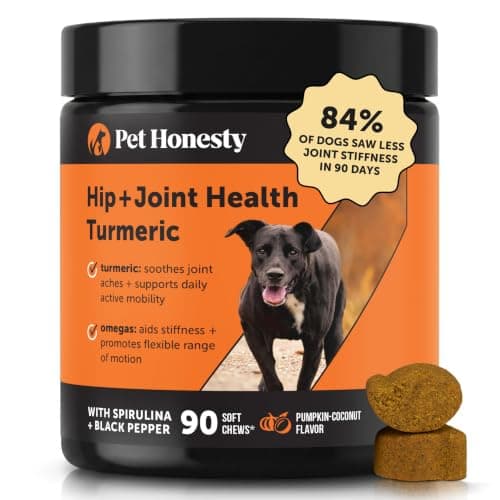
The sensible compromise: turmeric sitting on top of glucosamine and chondroitin rather than instead of them. The two canine trials that found anything at all tested curcumin in combination, never alone, and this is the cheapest way to buy the combination idea. It is also NASC-certified, which is a quality-program membership, not an efficacy claim.
Ingredient transparency
6
Absorption design
8
Easy to give
9
Dose control
5.5
Value
7.5
Pros
+Combination formula, which is the only form curcumin has been trialed in on dogs with naturally occurring osteoarthritis
+NASC membership means an audited quality program — worth something in a category with no pre-market approval
+Pumpkin-coconut chew that most dogs take as a treat
+One chew replaces two bottles if you were already buying a glucosamine product
Cons
−Its listing is the single worst offender here for claims: it says the formula will "rebuild worn cartilage" and works "rapidly" on stiffness. Nothing sold without a prescription has shown either, and the gap between that copy and the trials is the reason this page exists
−A fixed blend means you cannot raise one ingredient without raising all of them
−The amount of each active per chew is not something the listing lets you compare against a trial dose
−If your vet has recommended a specific glucosamine product, stacking this on top duplicates it
Don't buy this if…
…you want to know whether turmeric is doing anything — in a blend you will never be able to tell which ingredient, if any, moved the needle.
8 oz powder (listed)Certified USDA Organic (listed)Turmeric + coconut + black pepper only (listed)Scoop onto food (listed)
7.7/10
A plain USDA Organic powder — turmeric with organic coconut and organic black pepper and nothing else — scooped onto food. It is the pick for the owner who wants to start at a quarter dose and work up, or whose vet asked for a specific amount, because a powder is the only format here that lets you choose the number.
Ingredient transparency
7.5
Absorption design
7
Easy to give
5.5
Dose control
9.5
Value
9
Pros
+Three ingredients. Nothing to attribute a change to except the turmeric, which is exactly what a blend cannot give you
+You control the amount, so a cautious start and a slow build is possible — the sensible way to introduce anything to an old dog's stomach
+Certified organic and made to human-grade standards per the listing, with no palatant and no calories to speak of
+A jar lasts a long time on a small dog, so cost per day is the lowest here
Cons
−A powder on dinner is the format dogs refuse most often, and a senior dog with a fading appetite is the dog most likely to refuse it
−Turmeric stains everything it touches — bowls, floors, white chins and your fingers
−No published curcuminoid percentage, so there is no way to line a scoop up against a trial dose
−"Vet-formulated" on a listing is a marketing statement, not a trial result, and should not be read as one
Don't buy this if…
…your dog already picks around anything new in the bowl — a chew that gets eaten beats a powder that gets left.
2 oz liquid (listed)Turmeric + boswellia + omega-3 + resveratrol (listed)Black pepper for absorption (listed)Mix into food or dose directly (listed)
7.3/10
A liquid, for the dog that has worked out how to eat around a chew and spit out a tablet. Drops go into wet food or straight onto the tongue and the dose is countable. The formula is a kitchen sink — turmeric plus boswellia, omega-3 and resveratrol — which makes it convenient and makes it impossible to attribute anything.
Ingredient transparency
4.5
Absorption design
7
Easy to give
8.5
Dose control
8.5
Value
8
Pros
+Drops are the one format you can get into a dog that has stopped cooperating, and they mix invisibly into wet food
+Countable doses, so you can start low in the same way as a powder
+Cheapest entry here by a wide margin
+Boswellia and omega-3 alongside the turmeric are both ingredients with their own, separate research — omega-3 has the better evidence of the two
Cons
−Four actives in one bottle. If your dog improves you will not know what did it, and if it reacts badly you will not know what to stop
−A no-track-record brand with no published analysis, in a category that has no pre-market approval
−The listing talks about "pain relief" and "arthritis pain relief" — that is drug language on a food supplement and we are not endorsing it
−Liquids go off faster than chews once opened, and a 2 oz bottle does not last long on a large dog
Don't buy this if…
…you are trying to test one ingredient — buy the plain powder, and read our note on running a trial that is not confounded.
We ranked on things that can be checked rather than things that can be claimed. Does the listing name the extract and its curcuminoid strength? Is there an absorption system — black pepper, a fat carrier — or just powder? Can you control the dose, which matters for a stomach that is already older than it was? Will your dog actually take it every day for eight weeks, which is how long the trials ran before measuring anything? And is the price sane against an evidence base this thin?
Two candidates were resolved, read and then left off. A well-known curcumin powder sold under a veterinarian's own pet brand claims "24x greater absorption than standard curcuminoid extracts" — a number we cannot verify anywhere outside the maker's own copy, on a listing whose brand field and product name do not match, which fails the check we apply to every ASIN. And a ready-made golden paste was dropped because its own listing describes a probiotic product and states two different sizes, and a listing that contradicts itself is not something to send a reader to.
How to run a trial you can believe
This is the part that gets skipped, and it is the reason households end up with four open bottles and no idea what helped.
Change one thing. If you start turmeric the same week you buy a new bed and a rug for the hallway, you have learned nothing about turmeric. The dog may well be better. You will never know why.
Write down three specific things first. Not "seems brighter". Pick measurable household facts: how many attempts to stand up from the kitchen floor, how far down the street before the pace drops, whether the dog uses the sofa unaided. Comblain 2017 found its clearest effect on exactly this kind of measure — rising from lying down.
Give it eight weeks. Innes dosed for eight weeks and assessed at four, six and eight. Two weeks of a supplement tells you about your mood, not your dog's joints. Our note on how long joint supplements take to work covers the timeline properly.
Expect to be wrong sometimes. In every trial above there were non-responders, and in the placebo groups there were dogs whose owners were sure they had improved. You are not immune to that and neither are we.
Safety, plainly
Turmeric is not risk-free just because it is a spice. Chewy's veterinary-reviewed guide (reviewed by Barri J. Morrison, DVM) lists gastrointestinal upset — vomiting, diarrhea, reduced appetite — as the common side effect, and says dogs with bleeding disorders or liver disease, or on medications that affect clotting or liver function, should avoid it. McKenzie goes further in Veterinary Practice News, warning that the assumption of safety around herbal remedies is itself one of the biggest problems in the field, and noting reports of serious acute liver injury associated with turmeric in humans.
Practical version: start low, give it with food, stop if the stools change, and tell your vet what your dog is taking — especially before any procedure where clotting matters. Turmeric is one of the supplements worth mentioning at the next vet visit rather than after it.
How we chose
We haven't lab-tested these
We compiled the published specifications, manufacturer manuals and aggregated owner reviews, then scored each product against a published rubric. The scores are judgments from that research — they are not measurements we took in a lab, because we don't have one and we won't pretend we do. Prices are pulled live from Amazon; where we can't verify one, we say "check price" rather than print a stale number.
Questions
Frequently asked
Does turmeric actually help dogs with arthritis?+
The honest answer is that it has not been shown to, on the objective measures. Three randomized placebo-controlled trials in pet dogs found no significant difference in force plate gait analysis. Two of them did find improvements in subjective or functional measures — pain on manipulation, owner-rated pain, the ability to rise from lying down. It may do a little; it is not a substitute for veterinary pain control.
Can I just use turmeric from my kitchen cupboard?+
You can, and it is the cheapest option, but culinary turmeric contains much less curcumin than a standardized extract — and absorption is already the limiting factor. If you are going to try it, a product that names its curcuminoid strength and includes black pepper extract is a more honest shot at the idea. Never add turmeric to the food of a dog on medication without asking your vet first.
Is turmeric or glucosamine better for a senior dog?+
Neither has strong evidence, but glucosamine and chondroitin have the longer track record and the larger body of trials, and omega-3 fatty acids have the best support of anything in this aisle. The canine trials of curcumin all tested it as part of a combination, which is an argument for a blend rather than for turmeric on its own.
How long before I would see anything?+
The published trials dosed for eight weeks to three months before drawing conclusions, with assessments along the way. Give any joint supplement at least eight weeks, change nothing else at the same time, and write down three specific things you can count before you start.
Does turmeric interact with my dog's arthritis medication?+
It can, which is the main reason to ask rather than assume. Veterinary guidance says to avoid turmeric in dogs with bleeding disorders or liver disease and in dogs taking drugs that affect clotting or liver function — a group that includes the NSAIDs commonly prescribed for canine arthritis. Tell your vet what you are giving.
We don't run a testing lab, and we don't pretend to. Product facts are compiled from manufacturer listings and manuals; health facts are cited to reputable veterinary sources. Where we couldn't verify something, we say so on the page rather than quietly leaving it out. Read our full method.