The rear sling our roundup ranks first, read closely through its maker's own sizing instructions and FAQ. What the long lead is really for, why the measurement is not your dog's weight, and who should buy a full-body harness instead.
We earn a commission when you buy through our Amazon links, at no extra cost to you. It never changes our rankings, and we say so when the cheaper product is the better buy. How this works.
If you have searched for a sling to help a dog with weak back legs, this is the product everyone eventually mentions. It sits first in our rear-leg support roundup, which gives the short reasons. This page is the long version: what it physically is, how it is sized - which is the part people get wrong and the reason most returns happen - what the long lead does for the person holding it, and the three dogs we would buy something else for.
The standing disclosure first. We have not used a GingerLead on a dog, and we do not have a lab. What follows is built from GingerLead's own product pages, sizing instructions and FAQ, the Amazon listing we link, the alternatives' own published descriptions, and the veterinary sources at the foot of the page. Where we are reading a manufacturer claim rather than a fact we can check, we say so. The reasoning behind all of this is on our methodology page.
What it actually is
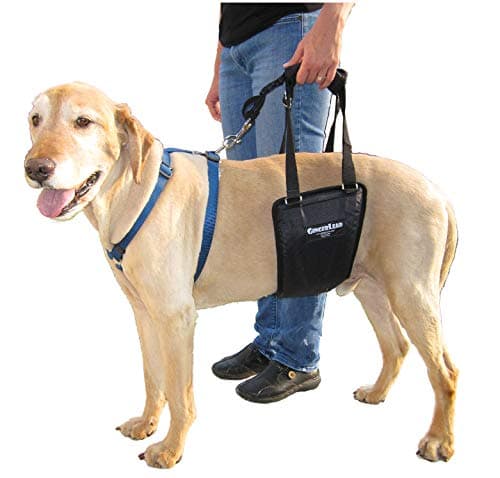
A padded belly pad that sits under the dog's abdomen, in front of the hind legs, with straps running up both sides to a handle you hold while standing upright - plus an integrated, detachable leash so the same hand that is carrying weight can also steer. The exterior is a pack cloth; the surface against the dog is corduroy. It is made in Colorado, which is unusual in a category dominated by generic imports, and the maker states the sling supports dogs up to 250 lbs.
The design is a single unisex pattern with a cutout that the maker says accommodates most males. That detail is worth more than it sounds: a sling without one has to be shifted or dropped every time a male dog needs to relieve itself, which on five trips a day is the difference between a tool you use and a tool in the closet.
GingerLead markets it for senior dogs, disabled pets, orthopedic surgery recovery, physical therapy and rehabilitation, intervertebral disc disease, neurological disorders, amputees, and help with stairs and getting in and out of vehicles. That is a broad list, and it is broadly fair - the product is a rear support, and all of those are rear-support situations. What matters is whether your dog's problem is behind or in front, which we come back to below.
Sizing: the part that decides whether this works
Here is the single most useful thing on this page. GingerLead is not sized by your dog's weight. Its sizing page works from two measurements instead, and if you order from a weight guess you will probably get the wrong one.
Pad width. Measure along the dog's underside, from the front of the hind legs - in front of the penis on a male - to the base of the rib cage. That span is what the pad has to fit inside. Too wide and it bunches up against the ribs; too narrow and it digs.
Strap length. Start where the handle would sit in your hand while you are standing up straight, run the tape down and under the dog's belly, up the far side and back to your hand. That loop includes the pad, the straps, the handle and the gap between your hand and the dog's back - so it is a measurement of the dog and of you.
The sizes are Mini, Small, Medium/Large and Tall, with male and female variants at the smaller end. Two rules from the maker's own page are worth quoting because they point in the direction most owners do not guess:
When your dog falls between sizes, order the smaller one. The reason given is that the pads do not bunch up, so a slightly narrow pad still works while a slightly wide one fouls the ribs. Barrel-chested dogs - Boxers are the example named - often need to size down.
A strap loop of 37 inches or less points to the Tall size, which uses shorter straps. Tall is about the handler, not the dog: it is the size for a shorter person or a lower dog, and getting it wrong leaves you holding slack you cannot use.
There is also a towel test, and it is the best thing on the maker's site. Fold a towel to a given width, slip it under your dog where the pad would go, and see how it sits before you spend anything: 7.5 inches simulates the Large Female pad, 5.5 inches the Medium/Large, 4 inches the Small Female, and for a male dog 5.5 inches placed in front of the penis simulates the Medium/Large and 3.5 inches the Small Male. If even the smallest option is too much, the Mini is the answer - and male dachshunds, the maker notes, typically use the Mini with the sling positioned behind the penis.
Do the towel test. It costs nothing, it takes two minutes, and it removes the one failure mode that makes this product look bad. For the general version of this advice across every mobility product we rank, see how to measure your dog and getting a harness to fit.
The long lead is the real feature, and it is for you
Most rear slings are a loop of fabric with a short grab handle. They work - for one lift, up one step. What they do to the person using them is force a permanent stoop, because a short handle puts your hand at the height of the dog's hips. Four potty trips a day at that angle is a back injury waiting to happen, and the owner is very often in their sixties or seventies.
GingerLead's straps and handle are long enough to be held at your side while you walk upright behind the dog. That is the whole argument for paying more than a generic sling costs. It does not make the dog lighter; it moves the load from your lumbar spine to your arm and shoulder, and it lets you walk at the dog's pace instead of shuffling bent over it. If you are supporting a big dog, that distinction is the one that decides whether the routine survives the month - the arithmetic is on lift harnesses for a big dog, and the technique that goes with it is at how to lift a dog without hurting either of you.
The integrated leash is the second half of the same idea. It detaches, and the maker describes clipping it either to the collar - for controlling pace - or to a chest harness, for added support. There is also an optional accessory, the Stay-on Straps: double-sided hook-and-loop strips that cinch the sling's straps together so the pad stays in place when you let go of the handle. GingerLead includes them with the Medium, Large and Tall sizes, and says they are for holding position while the dog relieves itself or while you open a door - explicitly not for unsupervised or overnight use.
What it does not do - stated plainly
Nothing for the front legs. This is a rear support, and a dog that is buckling in front needs a full-body harness with handles at both ends. That is the first alternative below, and the comparison is at sling vs full-body harness.
It is not a wearable your dog lives in. GingerLead's FAQ says never to leave it on an unsupervised pet and that it is not intended to be left on overnight. If what you actually need is something the dog can wear all day with a handle you grab occasionally, that is a different product.
The chest harness is not included. For a dog that struggles going down stairs, the maker's own recommendation is to use the GingerLead together with a standard chest harness - so budget for both if downstairs is your problem. Our page on stairs covers why down is harder than up.
Sizing has to be done properly. Two measurements, not a weight. See above. This is the most common reason a sling disappoints, and it is avoidable.
Washing, for completeness: most sizes are machine washable and dryable per the maker, while the Mini must be air dried because of its neoprene.
The two alternatives, and who each one is for
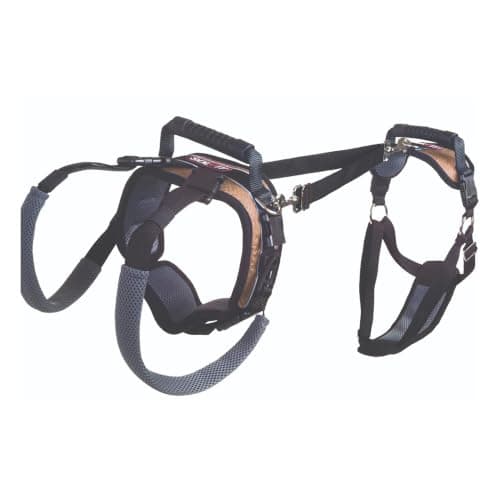
If your dog is unsteady in front as well as behind, buy a full-body harness instead of this. The PetSafe CareLift below has front and rear support in one piece, which is the right answer for a dog that is going down at both ends, for a wobbly post-operative dog, or for a dog with advancing degenerative myelopathy, where the problem spreads forward over time.
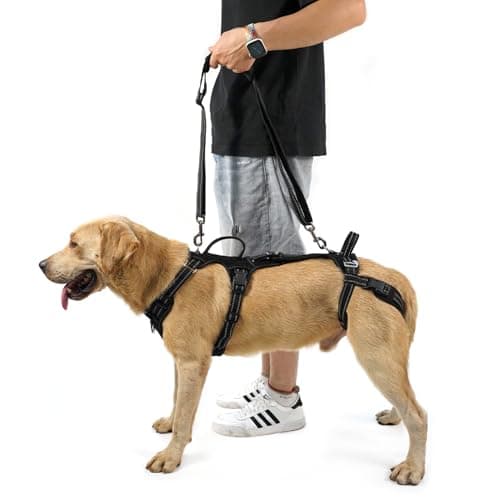
If what you need is a quick grab by the back door, not a walking aid, a cheap short-handled sling is the honest recommendation and we will not pretend otherwise. The Coodeo below goes on in seconds for one lift into the car or up the porch step, costs a fraction of the GingerLead, and is cheap enough to keep one at each door. It is worse for whole walks, for exactly the back-angle reason above.
And if the back legs are no longer carrying weight at all, a sling is a bridge rather than a destination. The question then is wheels, which we work through at when does a dog need a wheelchair and what a dog wheelchair costs. A sling is still the right first purchase, because it tells you whether the dog tolerates being supported before you spend several hundred dollars finding out.
A padded belly sling on a long lead so you can support a dog's back end and walk upright behind it — the kind thing for both the dog's hips and your back.
The premium option: a structured full-body harness with front and rear handles, so you can support either end or the whole dog. Built for the long haul, priced like it.
A quick-on rear sling with a handle — grab it for the few hard moments (up the porch step, into the car) rather than a full walk. Cheap, simple, kept by the door.
#ad · Live prices from the Amazon Product API, as of October 20, 2026. Where we have no verified live price we show none — we would rather leave a gap than print a number that has rotted.
In detail
The picks, in full
01
Weak back legs, walks and potty trips
GingerLead Rear Support Sling Harness
Padded belly slingLong integrated leadMale/female cut optionsSized to fit
8.6/10
A padded belly sling on a long lead so you can support a dog's back end and walk upright behind it — the kind thing for both the dog's hips and your back.
Support match
9
Padding
8.5
Owner ergonomics
9
Adjustability
8
Value
8.5
Pros
+Long handle lets you stand straight instead of stooping
+Wide padded sling spreads the lift comfortably under the belly
+Cut-out versions keep it clear for the dog to relieve itself
Cons
−Supports the rear only — no help for a dog weak in front
−Sizing matters; measure before ordering
Don't buy this if…
…your dog is unsteady in the front legs too — you'll want a full-body harness with front and rear handles.
Full-body harnessFront + rear lift handlesPadded and structuredAdjustable fit
8.5/10
The premium option: a structured full-body harness with front and rear handles, so you can support either end or the whole dog. Built for the long haul, priced like it.
Support match
9.5
Padding
9
Owner ergonomics
8.5
Adjustability
8.5
Value
7
Pros
+Supports the whole dog — front, rear, or both
+Structured build distributes the lift and stays put
+Handles are placed for an upright, back-friendly lift
Cons
−The most expensive harness here
−More straps to fit and put on than a simple sling
Don't buy this if…
…your dog is only weak in the back legs — a rear sling is simpler, cheaper, and enough.
Rear support slingGrab handleAdjustable strapsBreathable fabric
8.0/10
A quick-on rear sling with a handle — grab it for the few hard moments (up the porch step, into the car) rather than a full walk. Cheap, simple, kept by the door.
Support match
8
Padding
7.5
Owner ergonomics
7.5
Adjustability
8
Value
9
Pros
+Goes on fast for a one-off lift up a step or into the car
+Handle sits right over the hips
+Inexpensive enough to keep one by every door
Cons
−Short handle means more bending than a long-lead sling for full walks
−Best for brief assists, not hours of support
Don't buy this if…
…you need to support your dog for whole walks — a long-handled GingerLead is kinder to your back.
On four things an owner can verify before buying, none of which require a lab: whether the support matches where the dog is actually failing; what the product demands of the person holding it, over a day rather than over one lift; how the sizing works and how easy it is to get wrong; and what the maker states versus what it leaves unsaid. Where GingerLead publishes a figure - the 250 lb support claim, the 37-inch strap rule, the towel-test widths - we have reported it as the maker's figure and said so. We did not add any product to our registry to write this page; the two alternatives are products we already rank in the rear-support roundup.
Before you order, in order
Get the problem diagnosed if it is new. The sling comes after that, not instead of it.
Measure the pad span - front of the hind legs to the base of the ribs - and run the towel test at that width.
Measure the strap loop from your own hand, standing upright. At 37 inches or less, look at Tall.
Between two sizes, take the smaller one.
Decide whether you also need a chest harness - you do if the hard part is going down stairs.
Is it worth the money?
For a dog that needs supporting several times a day, for months, by a person who would rather not hurt their own back: yes, and the long handle is the reason. For a dog that needs one lift into the car each morning: no, and the cheap sling is the better buy. That is the whole verdict, and it has nothing to do with the brand name - it is about how many times a day you are going to be bent over.
How we chose
We haven't lab-tested these
We compiled the published specifications, manufacturer manuals and aggregated owner reviews, then scored each product against a published rubric. The scores are judgments from that research — they are not measurements we took in a lab, because we don't have one and we won't pretend we do. Prices are pulled live from Amazon; where we can't verify one, we say "check price" rather than print a stale number.
Questions
Frequently asked
How do you size a GingerLead?+
By two measurements, not by weight. First the pad width: measure along the underside from the front of the hind legs - in front of the penis on a male - to the base of the rib cage. Then the strap loop: from where the handle sits in your hand while you stand upright, under the belly, up the other side and back to your hand. The maker's towel test lets you simulate each pad width with a folded towel before you buy, and if your dog falls between sizes its advice is to order the smaller one because the pads do not bunch.
Does a GingerLead help a dog with weak front legs?+
No. It is a rear support that sits under the abdomen in front of the hind legs. A dog that is buckling in front, or going down at both ends, needs a full-body harness with front and rear handles - the PetSafe CareLift on this page is that product.
Can my dog wear a GingerLead all day?+
The maker says not to leave it on an unsupervised pet and that it is not intended to be left on overnight. The optional Stay-on Straps hold the pad in position when you release the handle - for a potty trip or while you open a door - and the same supervision rule applies to those.
Is a GingerLead worth it compared with a cheap sling?+
It depends entirely on how often you are lifting. The thing you are paying for is a long handle that lets you stand upright instead of stooping, which matters if you are supporting a dog several times a day for months. For one quick lift into the car, a cheap short-handled sling does the job and we would buy that instead.
Will a GingerLead work for a dog with degenerative myelopathy?+
Early on, yes - it is a rear support and DM starts behind. But DM progresses forward, so a sling that works this spring may not be enough next year, and a full-body harness or a cart becomes the answer. Plan for that rather than buying twice by surprise, and work the timing out with your vet.
We don't run a testing lab, and we don't pretend to. Product facts are compiled from manufacturer listings and manuals; health facts are cited to reputable veterinary sources. Where we couldn't verify something, we say so on the page rather than quietly leaving it out. Read our full method.